
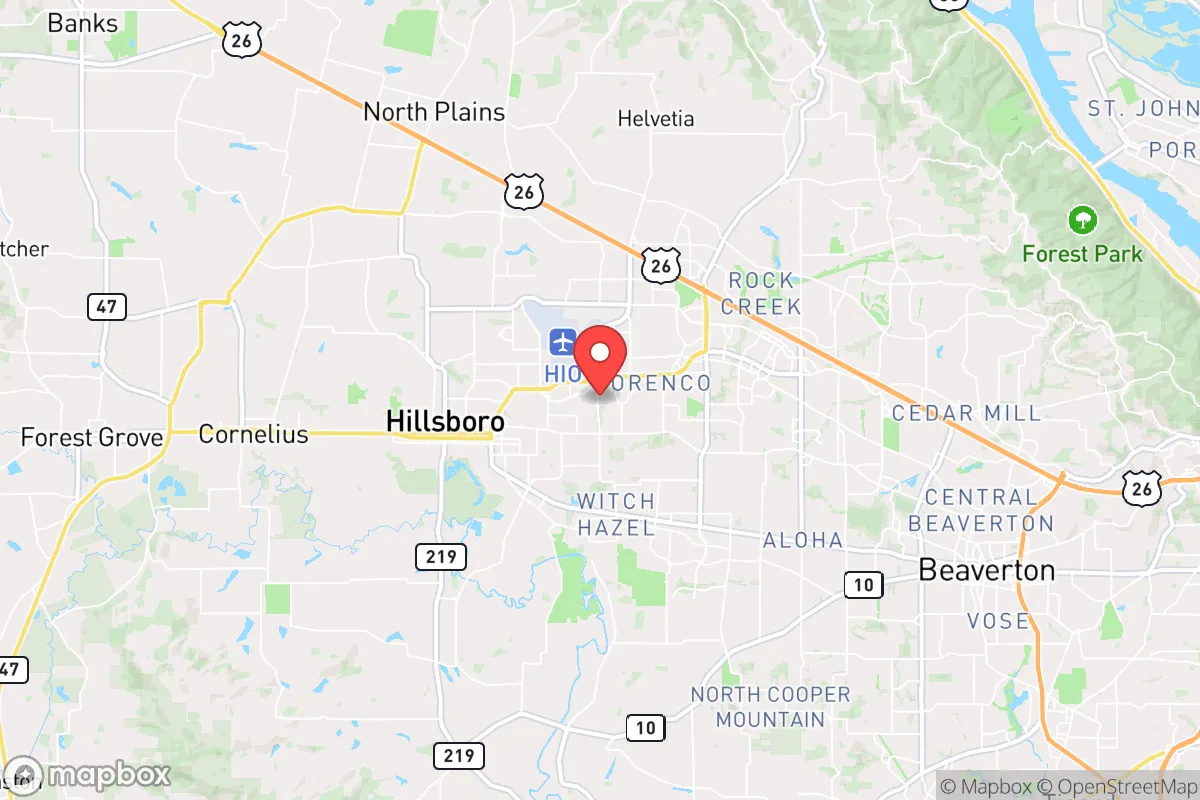
Photo: Wikipedia
Personal Sovereignty in Hillsboro, OR
Viable for self-reliance. Generally workable, though some barriers may limit total independence.
What does Personal Sovereignty tell us?
Personal Sovereignty measures your capacity for self-reliance and independence with minimal government friction. Higher scores mean fewer barriers between you and the way you want to live... but it assumes you have the space you need and good neighbors.
What does this tell us?
Personal Sovereignty measures your capacity for self-reliance and independence with minimal government friction. Higher scores mean fewer barriers between you and the way you want to live... but it assumes you have the space you need and good neighbors.
State Policy
Energy independence: Importer (35% of energy produced in-state)
Personal Liberty
Homesteading

Personal Liberty Analysis
For a conservative-leaning individual or family prioritizing personal sovereignty, Hillsboro, Oregon presents a complex picture of trade-offs. While Oregon’s state-level governance leans heavily progressive—with some of the nation’s most restrictive gun laws, high income taxes, and a regulatory environment that can feel intrusive—Hillsboro itself offers a more pragmatic, blue-collar counterbalance. The city’s tech-driven economy, anchored by Intel and a growing semiconductor corridor, provides high-wage opportunities that can offset some fiscal burdens, but the underlying legal and cultural framework demands careful navigation. Your autonomy here is not handed to you; it must be actively defended through local engagement, property choices, and a clear-eyed understanding of where state power ends and your personal domain begins.
Tax burden and regulatory posture in Oregon’s Silicon Forest
Oregon’s tax structure is a significant drag on personal sovereignty. With no state sales tax, the government relies heavily on a progressive income tax that tops out at 9.9% for high earners—a rate that kicks in above $125,000 for single filers and $250,000 for joint filers. Property taxes in Washington County are moderate by West Coast standards, averaging around 1.0% of assessed value, but the state’s property tax system includes a “compression” mechanism that limits annual increases to 3%, which can create inequities for new buyers. The regulatory posture is equally challenging: Oregon’s land-use laws, governed by statewide planning goals, severely restrict rural development and off-grid living. Hillsboro’s urban growth boundary (UGB) means that even within city limits, building permits, septic systems, and accessory dwelling units face layers of bureaucratic review. For a prepper or homesteader, this translates to limited ability to expand or modify property without government sign-off. The state’s Business Activity Tax (CAT) also adds a compliance layer for any side hustle or small-scale enterprise, making self-employment less attractive than in lower-tax states like Texas or Florida.
Self-defense and gun law specifics in a restrictive state
Oregon’s firearm laws are among the most restrictive in the nation, and Hillsboro residents must operate within that framework. The state’s Measure 114, passed in 2022 but currently tied up in legal challenges, would require a permit to purchase any firearm, a mandatory background check for private sales, and a ban on magazines holding more than ten rounds. Even without Measure 114 fully in effect, Oregon already has a “red flag” law (Extreme Risk Protection Order) that allows law enforcement or family members to petition a court to temporarily seize firearms from an individual deemed a risk. Open carry is legal without a permit, but concealed carry requires a license—and Washington County’s sheriff has historically been moderate in issuing them, though processing times can stretch to 90 days. For a survivalist, the key takeaway is that Oregon’s legal climate is hostile to self-defense autonomy. You cannot legally carry a firearm into a public building, school, or airport without facing felony charges. The state’s preemption law prevents local governments from enacting stricter rules, but Hillsboro itself has not pushed for additional restrictions. If self-defense is a priority, you must be prepared to navigate a system that views armed citizens with suspicion and may become more restrictive depending on future court rulings.
Self-reliance and homesteading viability in a suburban growth corridor
Hillsboro’s zoning and lot sizes make traditional homesteading difficult but not impossible. Most residential lots in the city are 5,000 to 7,000 square feet, with newer subdivisions offering even smaller parcels. The city’s municipal code allows backyard chickens (hens only, no roosters) and beekeeping with a permit, but livestock like goats or pigs are prohibited within urban limits. For off-grid feasibility, Oregon’s building codes require connection to municipal water and sewer in most developed areas, and solar panel installation is permitted but must comply with local utility interconnection standards. The state’s net metering policy is favorable, allowing you to sell excess power back to the grid, but battery storage systems face fire code restrictions. A more viable path for self-reliance is to purchase land outside the UGB—in unincorporated Washington County or neighboring Yamhill County—where minimum lot sizes for rural residential zoning are 5 to 20 acres. However, even there, Oregon’s Statewide Planning Goal 3 restricts building on land zoned for farm or forest use unless you meet strict income thresholds from agricultural activity. For a prepper, the practical reality is that Hillsboro itself is a suburb, not a homestead. True self-reliance requires a rural property within a 30- to 60-minute drive, which adds commute time but preserves the ability to raise food, store water, and operate independently of municipal systems.
Personal liberties in a blue state context: parental rights, medical autonomy, speech, and property
Oregon’s progressive tilt creates friction points for conservative families. On parental rights, the state has a comprehensive sex education mandate (Oregon Revised Statute 336.455) that requires age-appropriate instruction on sexual orientation and gender identity from kindergarten through high school. Hillsboro School District follows this law, and parents cannot opt their children out of the entire curriculum—only specific lessons. This has led to ongoing tensions, with some families choosing private or homeschool options. Medical autonomy is similarly constrained: Oregon has no parental consent requirement for minors to receive reproductive health services, including contraception and abortion, under state law. For adults, the state’s Death with Dignity Act allows physician-assisted suicide, which some conservatives view as a slippery slope. Free speech is protected under the Oregon Constitution, which has stronger protections than the First Amendment in some areas, but the state’s workplace and public accommodation laws prohibit discrimination based on sexual orientation and gender identity, which can conflict with religious liberty claims. Property rights are the most concerning: Oregon’s land-use system gives the state government significant control over what you can build, where you can build it, and how you can use your land. The Oregon Court of Appeals has upheld the constitutionality of these regulations, meaning your property is not truly yours to do with as you see fit. For a survivalist, this is the core issue: the state’s regulatory apparatus can override your decisions on everything from building a fence to starting a home business.
Overall, Hillsboro offers a moderate degree of personal sovereignty compared to Portland or Eugene, but it falls far short of the autonomy available in states like Idaho, Montana, or Texas. The city’s economic opportunities and relatively low crime rate (violent crime is about 60% of the national average) provide a stable foundation, but the state-level legal framework imposes significant constraints on self-defense, property use, and parental authority. For a conservative individual or family willing to engage in local politics, join the Washington County Republican Party, and potentially invest in rural land outside the UGB, Hillsboro can be a workable base. But for those seeking maximum personal sovereignty—where your home is truly your castle and your rights are not subject to state preemption—the Pacific Northwest is not the ideal destination. The trade-off here is clear: you gain economic security and a relatively safe environment, but you surrender a meaningful degree of control over your own life to a government that does not share your values. If that trade is acceptable, Hillsboro can work; if not, look east of the Cascades or south of the Columbia River.

* Values derived from national, state, county, city and local statistics and may differ in a specific area. Last updated: 2026-04-24T19:58:36.000Z
Narrative content on this page is AI-generated and may contain mistakes. Verify any details that matter before acting on them.
ReloMaps may earn a commission from affiliate links at no extra cost to you.

