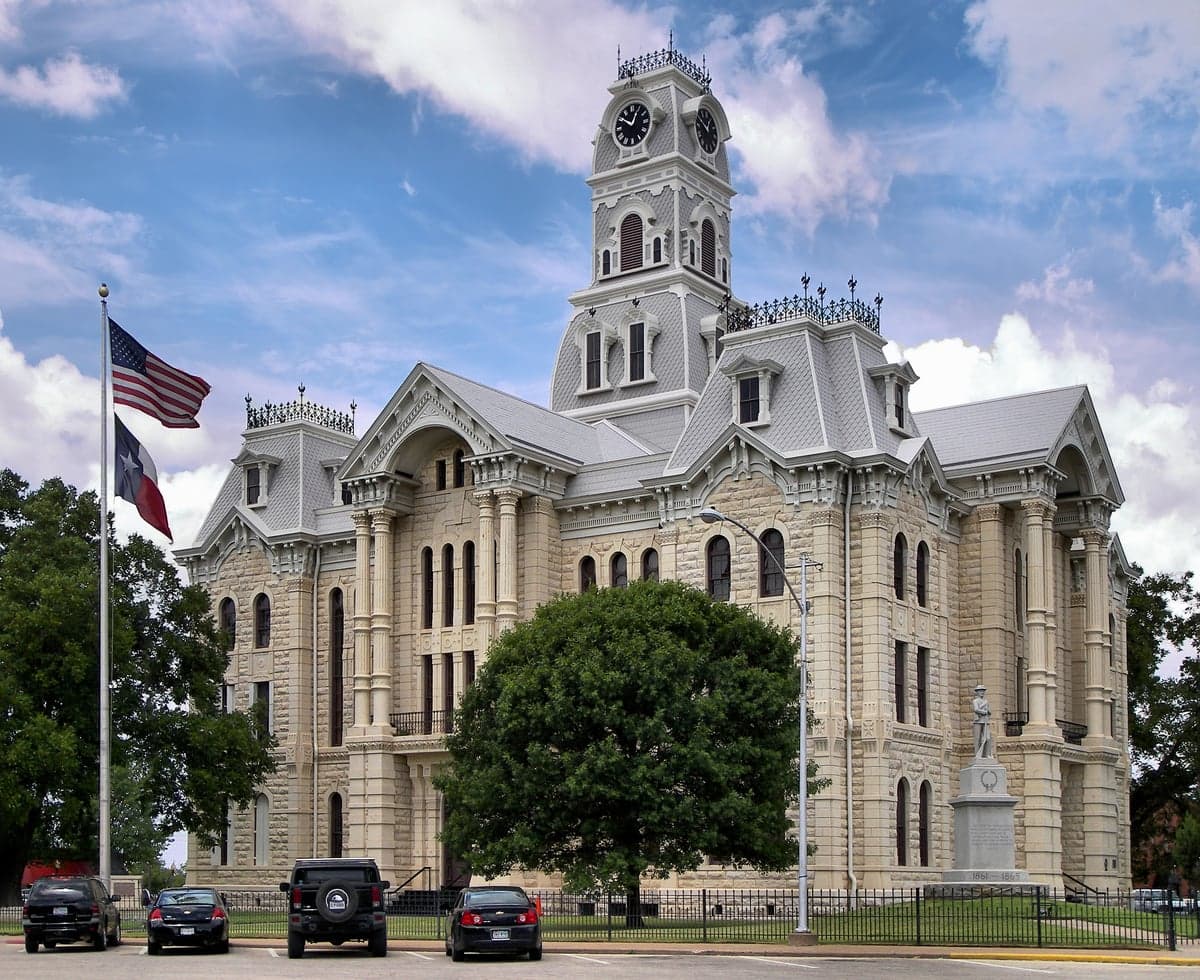
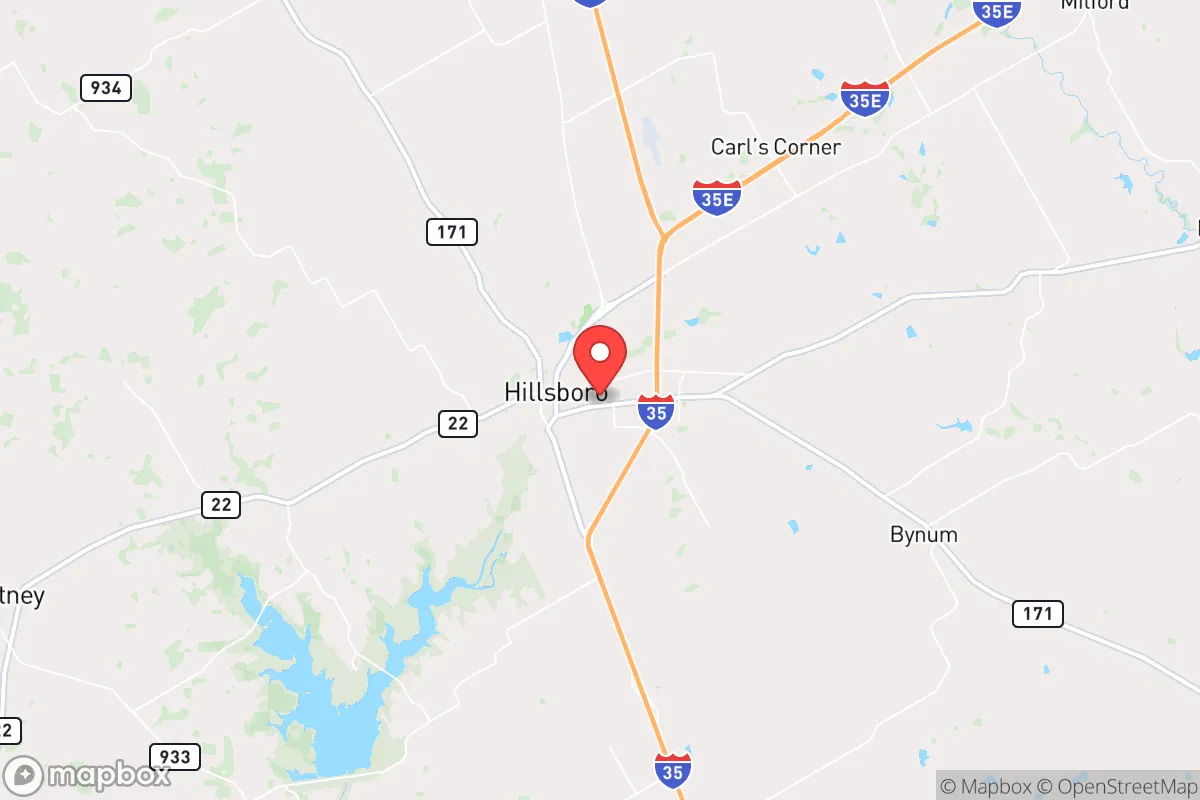
Photo: Wikipedia
Demographics of Hillsboro, TX
Affluence Level in Hillsboro, TX
A below-average socioeconomic profile. Incomes, home values, and educational attainment trail the U.S., with higher poverty and unemployment.
People of Hillsboro, TX
The people of Hillsboro, Texas, today number roughly 8,375, forming a community defined by its stark racial and economic diversity within a small-town Hill Country setting. The city is nearly evenly split between non-Hispanic white residents (43.6%) and Hispanic residents (40.6%), with a significant Black population (12.7%) that is unusually large for a town this size in Central Texas. With only 17.9% of adults holding a college degree, Hillsboro’s population is predominantly working-class, and its identity is shaped by a history of distinct settlement waves that have left lasting geographic footprints in specific neighborhoods.
How the city was settled and grew
Hillsboro’s original population was drawn by the promise of rich blackland prairie soil and the arrival of the railroad in the 1880s. The town was founded in 1853 as a trading post for cotton farmers, but the real growth came after the Missouri-Kansas-Texas (Katy) Railroad laid tracks through the area. The earliest white settlers—primarily Anglo-American farmers from the Upper South—built homes in what is now the West End Historic District, a neighborhood of Victorian-era houses near the courthouse square. By the early 1900s, a small but steady stream of Black families arrived to work the cotton fields and railroad yards, settling in the South Side area along what is today Highway 81, where a separate school and church network developed. Mexican and Mexican-American laborers began arriving during the 1910s and 1920s, recruited for railroad maintenance and agricultural labor; they formed the core of the Barrio neighborhood, located just east of the downtown tracks. These three groups—Anglo, Black, and Hispanic—lived in largely separate enclaves through the mid-20th century, with the white population dominating politics and commerce.
Modern era (post-1965)
The post-1965 period brought significant demographic change, driven by the decline of cotton agriculture and the expansion of regional highway infrastructure. The construction of Interstate 35 through the eastern edge of town in the 1960s shifted commercial activity away from the historic square, and many white families moved to newer subdivisions like Oak Ridge Estates in the northwest, a predominantly white, middle-class neighborhood developed in the 1970s and 1980s. Meanwhile, the Hispanic population grew steadily through both domestic migration from South Texas and new immigration from Mexico. By 2024, the Hispanic share had risen to 40.6%, with many families settling in the East Side neighborhoods near the I-35 corridor, where older housing stock and rental properties are concentrated. The Black population, which peaked at around 15% in the 1990s, has held relatively steady at 12.7%, with most Black residents still living in the South Side and adjacent Fairgrounds area, though some have moved into newer subdivisions. The foreign-born share stands at 9.1%, almost entirely from Latin America, with no measurable East/Southeast Asian or Indian subcontinent populations. The college-educated share remains low at 17.9%, reflecting the town’s reliance on manufacturing, warehousing, and service-sector jobs rather than professional or tech employment.
The future
Hillsboro’s population is trending toward a near-even split between white and Hispanic residents, with the Black share likely to remain stable or decline slightly as younger Black residents leave for larger cities like Dallas or Austin. The Hispanic population is growing primarily through natural increase (higher birth rates) rather than new immigration, and the foreign-born share may plateau as second- and third-generation families assimilate. The city is not tribalizing into new enclaves; rather, the old geographic divisions are slowly blurring as younger families of all backgrounds move into newer subdivisions like Meadowbrook Addition in the north, which is more mixed than the historic neighborhoods. However, the West End Historic District remains overwhelmingly white and older, while the Barrio and South Side retain their Hispanic and Black majorities respectively. Over the next 10–20 years, Hillsboro will likely become a majority-Hispanic city, mirroring trends across much of Central Texas, but without the rapid diversification seen in suburban boomtowns—the population is homogenizing into a white-Hispanic binary rather than becoming more multiracial.
For someone moving in now, Hillsboro offers a working-class, family-oriented environment where racial lines are present but softening. The city is becoming more Hispanic in character, with bilingual signage and a growing number of Hispanic-owned businesses along I-35, while the white population ages in place in the historic core. Newcomers should expect a community where educational attainment is low, civic life centers on churches and schools, and the economy is tied to logistics and manufacturing rather than knowledge industries. It is a place of slow, steady demographic change rather than rapid transformation.

* Values derived from national, state, county, city and local statistics and may differ in a specific area. Last updated: 2026-04-28T23:17:22.000Z
Narrative content on this page is AI-generated and may contain mistakes. Verify any details that matter before acting on them.
ReloMaps may earn a commission from affiliate links at no extra cost to you.

