 Popular
Photo: Wikipedia
Demographics of Holly Springs, NC
Affluence Level in Holly Springs, NC
An upper-middle-class area. Household wealth, education levels, and homeownership run ahead of national benchmarks.
People of Holly Springs, NC
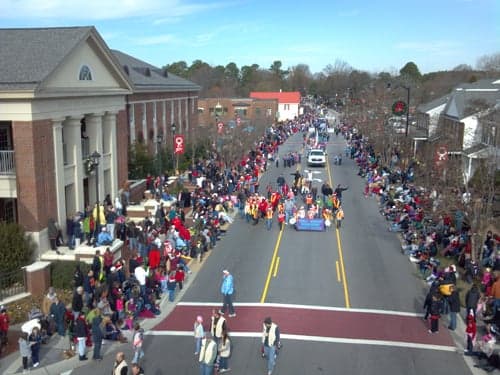
The people of Holly Springs, North Carolina today number 43,429, forming a predominantly white (74.2%), highly educated (67.7% college-educated) community with a notably bifurcated Asian and Indian presence. The city’s identity is shaped by rapid suburban growth—its population has more than doubled since 2010—and a demographic profile that blends native-born Southerners with a significant professional class drawn by Research Triangle Park employment. Distinctive markers include a foreign-born share of just 4.0%, well below the national average, and a Hispanic population of 5.6% that is growing but still modest compared to neighboring towns.
How the city was settled and grew
Holly Springs was originally settled in the early 1800s as a small agricultural crossroads, with the first European-descended families arriving via land grants from the Granville District. The community remained a rural hamlet through the 19th and early 20th centuries, centered on the Holly Springs Historic District along Main Street, where the original white farming families built homes and churches. Enslaved African Americans worked the area’s cotton and tobacco fields before emancipation, and their descendants formed the core of the town’s Black population into the mid-20th century. The Bass Lake area, originally a mill pond and later a recreational site, was part of the agricultural landscape that sustained these early residents. By 1950, Holly Springs had fewer than 500 residents, almost entirely white and Black, with no significant immigrant presence.
Modern era (post-1965)
The post-1965 transformation of Holly Springs began slowly, then accelerated dramatically after 1990. The Immigration and Nationality Act of 1965 opened doors for skilled professionals, but Holly Springs—unlike nearby Cary or Morrisville—saw little direct immigration until the 2000s. Instead, the city’s modern growth has been driven overwhelmingly by domestic in-migration: white and Black families moving from other parts of Wake County and the Northeast, drawn by new housing developments and proximity to Research Triangle Park. The Sunset Ridge neighborhood, built in the 1990s and 2000s, became a primary landing area for these white professional families, while Twelve Oaks attracted a mix of white and Black residents seeking larger lots. The city’s Black population, at 7.9%, is lower than Wake County’s overall 20% share, reflecting Holly Springs’ historical pattern of limited Black settlement outside the historic district. The Indian subcontinent population (5.5%) and East/Southeast Asian population (2.0%) are concentrated in newer subdivisions like Withers Grove and Brambleton, built after 2010, where tech and pharmaceutical professionals from India and China have settled. The Hispanic population (5.6%) is more dispersed, with families living in apartments along the NC-55 corridor and in older single-family homes near the Holly Springs Towne Center.
The future
Holly Springs’ population is projected to continue growing rapidly, likely exceeding 60,000 by 2040, but its demographic composition is shifting slowly. The white share is declining from over 80% in 2010 to 74.2% today, while the Indian subcontinent and Hispanic shares are rising. New communities are concentrating in the Holly Glen and 12 Oaks areas, where master-planned developments are attracting a more diverse mix of buyers, including second-generation Indian Americans and Hispanic professionals. The city’s cultural identity is evolving from a homogeneous white Southern suburb into a more cosmopolitan, but still family-oriented, community. The next 10-20 years will likely see the Indian and Hispanic populations each reach 8-10%, while the Black share remains stable or grows slightly. The foreign-born share may rise to 6-7%, still low by Triangle standards, as Holly Springs remains a destination for domestic movers seeking good schools and newer housing rather than for direct immigrants.
Holly Springs is becoming a moderately diverse, highly educated, and family-centric suburb where the dominant culture remains white and native-born, but with growing Indian and Hispanic communities adding new layers. For someone moving in now, the city offers a stable, low-crime environment with excellent schools and a population that is gradually—but not rapidly—becoming more varied. The key trade-off is between homogeneity and the professional-class amenities that draw newcomers from across the country.

* Values derived from national, state, county, city and local statistics and may differ in a specific area. Last updated: 2026-10-10T16:27:40.000Z
Narrative content on this page is AI-generated and may contain mistakes. Verify any details that matter before acting on them.
ReloMaps may earn a commission from affiliate links at no extra cost to you.

