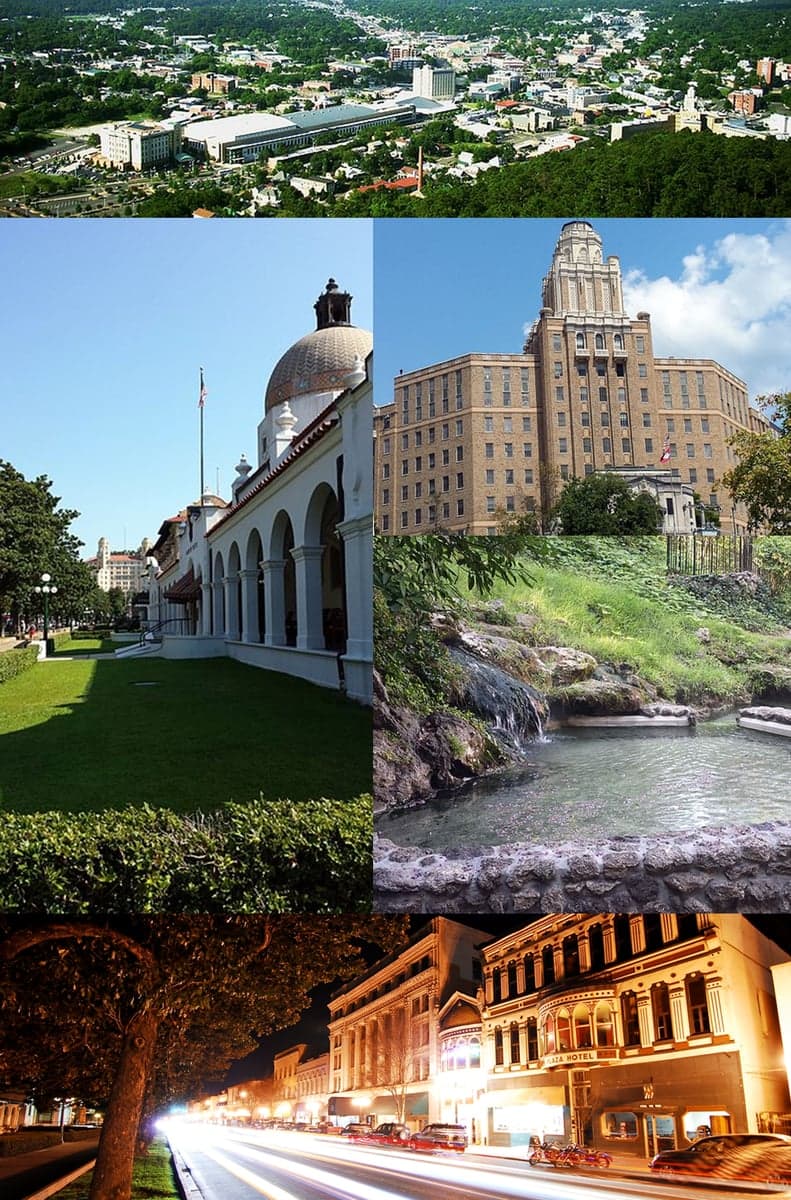
Photo: Wikipedia
Personal Sovereignty in Hot Springs, AR
Viable for self-reliance. Generally workable, though some barriers may limit total independence.
What does Personal Sovereignty tell us?
Personal Sovereignty measures your capacity for self-reliance and independence with minimal government friction. Higher scores mean fewer barriers between you and the way you want to live... but it assumes you have the space you need and good neighbors.
What does this tell us?
Personal Sovereignty measures your capacity for self-reliance and independence with minimal government friction. Higher scores mean fewer barriers between you and the way you want to live... but it assumes you have the space you need and good neighbors.
State Policy
Energy independence: Importer (35% of energy produced in-state)
Personal Liberty
Homesteading

Personal Liberty Analysis
Hot Springs, Arkansas, offers a notably high degree of personal sovereignty compared to much of the coastal and Midwestern United States, largely due to Arkansas’s consistently conservative state-level governance and a local culture that prizes self-reliance. For the individual or family operating from a survivalist or prepper mindset, the area presents a legal and regulatory environment that is generally permissive, with low taxes, strong gun rights, and minimal interference in daily life. However, the specific trade-offs—particularly in local zoning, medical freedom, and the encroachment of federal land management—require careful examination before making a strategic relocation decision.
Tax burden and regulatory posture: How Arkansas law protects your income and property
Arkansas maintains a tax and regulatory climate that is deliberately light on its citizens, a key consideration for anyone seeking to maximize personal financial sovereignty. The state’s individual income tax is a flat 4.4% as of 2026, with a top marginal rate that has been steadily declining from over 7% a decade ago, signaling a clear policy direction. Property taxes are among the lowest in the nation, with an effective rate around 0.62% of assessed home value—meaning a $250,000 home in Hot Springs carries an annual tax bill of roughly $1,550. There is no state-level estate or inheritance tax, allowing wealth to pass to heirs without government confiscation. On the regulatory front, Arkansas is a right-to-work state with minimal business licensing hurdles, and Garland County does not impose the kind of onerous county-level building codes or environmental restrictions found in states like California or Colorado. The state’s constitutional amendment prohibiting a state income tax increase without a supermajority vote provides a structural check on future government overreach. For the prepper, this means more of your earnings stay in your control, and the cost of land and improvements is not artificially inflated by regulatory compliance costs.
Self-defense and gun law specifics: Stand your ground, constitutional carry, and practical access
Hot Springs sits in a state that is a national leader in firearm freedom, which is a non-negotiable pillar of personal sovereignty for the survivalist. Arkansas enacted constitutional carry in 2021, meaning no permit is required to carry a concealed handgun for any law-abiding adult 18 or older. The state also has a strong Stand Your Ground law with no duty to retreat in any place you are lawfully present, including your vehicle. This legal framework is backed by state preemption laws that prevent local municipalities like Hot Springs from enacting their own gun bans or magazine restrictions—so the city council cannot infringe on your rights. For long-term preparedness, Arkansas law explicitly protects the right to build private armories and stockpile ammunition without registration or quantity limits. The only practical caveat is that National Park Service land, including Hot Springs National Park, prohibits loaded firearms in certain buildings (visitor centers, park offices), but the park itself is open to concealed carry under federal law. For the prepper, this means your defensive capabilities are legally maximized, and the local sheriff’s office in Garland County is known for a pro-Second Amendment stance, rarely issuing denials for permits that are still useful for reciprocity in other states.
Self-reliance and homesteading viability: Lot sizes, zoning, and off-grid feasibility
For those seeking to reduce dependence on centralized systems, Hot Springs offers mixed but generally favorable conditions. Within the city limits, zoning is relatively permissive for urban homesteading—chickens are allowed on residential lots under 0.5 acres with a permit, and larger lots (common in the outskirts) permit goats and even small livestock. The real opportunity lies in unincorporated Garland County, where minimum lot sizes for rural residential zoning are typically 1 to 5 acres, and there are no county-wide bans on rainwater collection, composting toilets, or solar panel installation. Off-grid feasibility is high: the area receives about 55 inches of rain annually, making rainwater catchment a reliable primary water source, and the state has no restrictions on private well drilling. Solar potential is moderate (4.5-5 peak sun hours per day), but net metering policies are favorable, allowing you to sell excess power back to the grid. The major constraint is that Garland County does enforce the 2018 International Residential Code for new construction, which can complicate truly off-grid builds if you want a certificate of occupancy—though many preppers simply build without permits on rural land, accepting the risk of future code enforcement. For the serious homesteader, the Ouachita National Forest borders the area, offering public land for foraging, hunting, and timber, but be aware that federal land management can restrict certain activities like permanent structures or large-scale logging.
Personal liberties: Parental rights, medical autonomy, speech, and property
Arkansas has been at the forefront of protecting parental rights and medical freedom, which are critical for families concerned about government overreach. The state’s Parental Bill of Rights (Act 627 of 2021) explicitly affirms that parents have the fundamental right to direct the upbringing, education, and healthcare of their children, including the right to opt out of any school curriculum or medical treatment they find objectionable. This has been tested in court and upheld, meaning Hot Springs schools cannot push gender ideology or experimental medical procedures on your child without your consent. On medical autonomy, Arkansas was one of the first states to ban COVID-19 vaccine mandates for both public and private employers, and it has a broad medical freedom law (Act 1002 of 2021) that prohibits discrimination based on vaccination status. For the prepper, this means you can stockpile ivermectin, hydroxychloroquine, or other off-label treatments without fear of state prosecution, as long as you have a prescription. Speech is protected under the state constitution, which has its own free speech clause that has been interpreted more broadly than the First Amendment in some cases—no local ordinances in Hot Springs restrict political signage, public assembly, or the distribution of preparedness literature. Property rights are strong: Arkansas is a Dillon’s Rule state, meaning local governments only have powers explicitly granted by the state, which limits Hot Springs’ ability to impose rent control, short-term rental bans, or excessive land-use restrictions. The only notable limitation is that eminent domain for private economic development is prohibited by the state constitution, a safeguard against the kind of corporate land grabs seen in other states.
In the broader context of American personal sovereignty, Hot Springs represents a solid B+ to A- grade. It lacks the extreme libertarian legal framework of states like New Hampshire or Alaska, but it compensates with a low cost of living, a state government that actively pushes back against federal overreach, and a local culture that is deeply skeptical of authority. The primary risks for the survivalist are the increasing federal presence in the Ouachita National Forest and the potential for future state-level tax increases if the current conservative majority weakens. Compared to the Pacific Northwest or the Northeast, Hot Springs offers a far more permissive environment for the individualist seeking to live life on their own terms—just be prepared to drive 20 minutes for the nearest bulk ammo dealer and to accept that your neighbors might not share your level of preparedness, but they will respect your right to it.

* Values derived from national, state, county, city and local statistics and may differ in a specific area. Last updated: 2026-04-30T02:27:40.000Z
Narrative content on this page is AI-generated and may contain mistakes. Verify any details that matter before acting on them.
ReloMaps may earn a commission from affiliate links at no extra cost to you.

