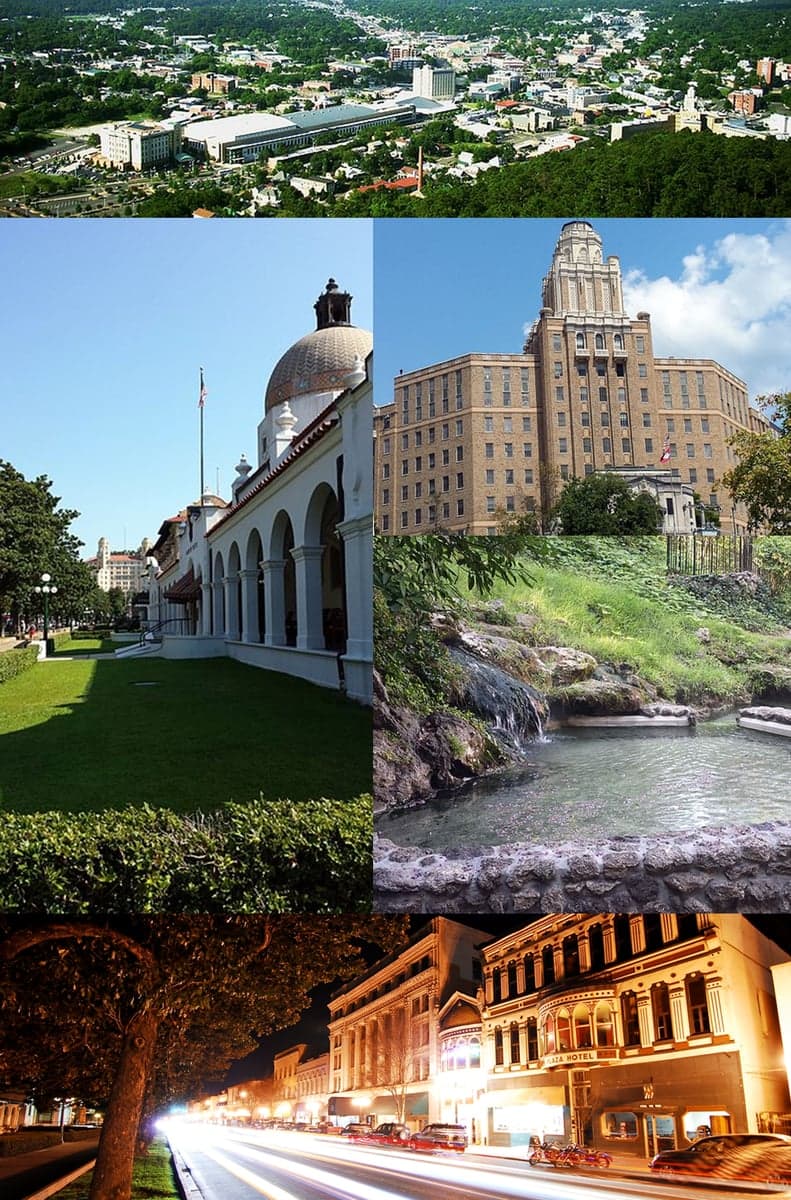
Photo: Wikipedia
Political ClimatePolitical Climate in Hot Springs, AR
District shown is the primary district for this city’s centroid. Cities may span multiple districts.
Local Political AnalysisPolitical Analysis of Hot Springs, AR
Hot Springs, Arkansas, has long been a reliably conservative area, and that hasn't changed much despite some national trends. The Cook Partisan Voting Index (PVI) sits at a solid R+20, meaning the district votes about 20 points more Republican than the national average. In practical terms, that means local elections are usually decided in the Republican primary, and Democratic candidates rarely get much traction here. The surrounding Garland County has voted Republican in every presidential election since 2000, often by double-digit margins. That said, the city itself has a slightly more moderate streak than the rural areas around it, thanks to a mix of retirees, tourism workers, and a small but vocal arts community. Still, the overall trajectory is steady red, with no signs of flipping anytime soon.
How it compares
If you drive 50 miles east to Little Rock, you'll find a much more politically mixed environment—Pulaski County leans Democratic, and the city itself has a progressive mayor and city council. Hot Springs is a different animal entirely. Compared to nearby towns like Malvern (Hot Spring County) or Mount Ida (Montgomery County), Hot Springs is actually a bit more moderate, but that's a low bar. Those areas are deep red, often voting 70-80% Republican. The real contrast is with Fayetteville or Eureka Springs up north, which are liberal outliers in Arkansas. Here, you won't see many "Defund the Police" signs or drag queen story hours at the library. The local government has kept taxes low, zoning minimal, and gun rights strong. The biggest political fights in recent years have been over short-term rental regulations and lakefront development, not social issues. That tells you a lot about the priorities here.
What this means for residents
For someone who values personal freedom and limited government, Hot Springs is a breath of fresh air. There's no city income tax, property taxes are among the lowest in the state, and the county sheriff's office is pro-Second Amendment. You won't find mask mandates or vaccine passports being enforced here—those battles were largely avoided. The school board has resisted critical race theory and gender ideology curricula, and the local library hasn't gone the way of some urban systems that push controversial materials on minors. That said, there are some creeping concerns. The city council has shown interest in historic preservation overlays that can restrict what you do with your own property, and there's been talk of increasing the tourism tax to fund more city projects. These are small steps, but they're steps in the wrong direction. Long-term, the biggest threat is probably in-migration from blue states. More people moving here from California or Illinois could shift the political balance over the next decade, but so far, most newcomers seem to come here because they like the conservative culture, not to change it.
Culturally, Hot Springs has a few quirks that set it apart from the rest of Arkansas. The Oaklawn Racing Casino Resort brings in a lot of out-of-state money and a more transient population, which can dilute local values. The Hot Springs National Park draws tourists from all over, and with them comes a certain tolerance for alternative lifestyles. But the core of the city is still deeply rooted in traditional Southern conservatism. Church attendance is high, the VFW and American Legion posts are active, and the annual Hot Springs Documentary Film Festival hasn't gone full-woke like similar events in other cities. The biggest policy distinction is probably the city's independent spirit—Hot Springs has historically been a place where people do their own thing, whether that's running a small business, owning a boat, or just keeping to themselves. That's the kind of freedom worth protecting, and most folks here are keenly aware of how easily it can slip away if we're not paying attention.

State Political ClimatePolitical Climate in Arkansas
State Political AnalysisPolitical Environment in the State
Arkansas has been a reliably red state for decades, with a solid Republican lean that has only deepened since the 2010 midterms. The state hasn't voted for a Democratic presidential candidate since Bill Clinton’s 1996 re-election, and by 2024, Donald Trump carried it by a comfortable 30-point margin. The dominant coalition is a mix of rural conservatives, evangelical Christians, and a growing number of suburban families fleeing the high costs and progressive policies of states like California and Illinois. Over the last 10-20 years, the shift has been dramatic—Arkansas went from having a Democratic-controlled legislature and governor’s mansion in the early 2000s to a near-total Republican supermajority today, with the GOP holding every statewide office and a firm grip on both chambers of the General Assembly.
Urban vs. rural divide
The political map of Arkansas is a textbook study in the urban-rural split. The state’s two major metro areas—Little Rock and Fayetteville-Springdale-Rogers (Northwest Arkansas)—are the only real blue dots on the map. Pulaski County, home to Little Rock, has trended Democratic for years, voting for Biden in 2020 by about 15 points. Washington County, which includes Fayetteville and the University of Arkansas, is a classic college-town outlier, flipping blue in recent presidential cycles. But outside these islands, the state is deeply conservative. The Arkansas Delta, stretching from Jonesboro down to Pine Bluff, was once a Democratic stronghold but has shifted hard red, with counties like Mississippi and Crittenden now reliably Republican. The rural Ozarks and Ouachita Mountains, including towns like Mountain Home and Hot Springs, are among the most conservative areas in the country. The real story is in the suburbs: places like Bentonville, Rogers, and Conway are growing fast with families and professionals, and they’re voting increasingly Republican as they expand, pulling the state further right. The only exception is the city of Little Rock itself, where progressive activism is concentrated, but it’s increasingly isolated from the rest of the state’s politics.
Policy environment
Arkansas’s policy environment is aggressively conservative, with a strong emphasis on low taxes, limited regulation, and traditional values. The state has a flat income tax rate of 4.4% (down from 7% in 2015), and the legislature has passed multiple rounds of cuts, aiming for a 3.9% flat rate by 2027. There is no state property tax, and sales tax is capped at 6.5%, though local add-ons can push it higher. The regulatory climate is business-friendly, with right-to-work laws and a tort reform system that caps non-economic damages in medical malpractice cases at $500,000. On education, Arkansas has leaned into school choice: the state’s LEARNS Act, passed in 2023, created a universal school voucher program that allows any family to use state funds for private or homeschool expenses—a major win for parental rights. Healthcare is a mixed bag: the state expanded Medicaid under the private option model, but the legislature has consistently rejected Obamacare’s full expansion and has passed laws restricting abortion to the first 12 weeks, with a near-total ban after that. Election laws are strict: voter ID is required, early voting is limited to 15 days, and the state has purged inactive voters from rolls. There’s no ballot harvesting, and absentee voting requires an excuse. For a conservative moving in, the policy environment is largely aligned with limited-government principles, though the Medicaid expansion remains a point of contention among fiscal hawks.
Trajectory & freedom
Arkansas is on a clear trajectory toward more personal freedom, especially in areas of gun rights, parental rights, and economic liberty. The state passed constitutional carry in 2021, allowing any law-abiding adult to carry a concealed firearm without a permit. In 2023, the LEARNS Act not only expanded school choice but also banned critical race theory and prohibited classroom instruction on gender identity and sexual orientation in K-5, a move that has drawn both praise and legal challenges. On medical freedom, Arkansas was one of the first states to ban gender-affirming care for minors, overriding a veto from then-Governor Asa Hutchinson in 2021. The state also passed a law in 2023 prohibiting COVID-19 vaccine mandates by private employers, a direct response to federal overreach. Property rights are strong: Arkansas is a “Dillon’s Rule” state, meaning local governments have limited authority, but the legislature has repeatedly preempted local ordinances on issues like rental inspections and plastic bag bans, keeping regulation light. The biggest concern for freedom advocates is the state’s reliance on federal funding—Medicaid expansion and highway money come with strings attached—but the legislature has been pushing back, with bills to audit federal funds and reject grants that impose conditions. Overall, Arkansas is moving in a libertarian-leaning direction, with a focus on individual choice and limited government intervention.
Civil unrest & political movements
Civil unrest in Arkansas is minimal compared to national hotspots, but there have been flashpoints. The most visible was the 2020 Black Lives Matter protests in Little Rock, which saw several nights of demonstrations and some property damage, but they were smaller and less violent than in cities like Portland or Seattle. The state’s political movements are dominated by grassroots conservative groups like the Arkansas Family Council and the state’s chapter of Moms for Liberty, which have been instrumental in pushing school board elections to the right and advocating for parental rights legislation. On the left, the Arkansas Democratic Party is weak and fractured, with most energy going into local races in Little Rock and Fayetteville. Immigration politics are relatively quiet—Arkansas has a small foreign-born population (about 5%), and the state has passed laws requiring E-Verify for public employers and prohibiting sanctuary cities. There’s been no serious secession or nullification rhetoric, though the state’s attorney general has joined multi-state lawsuits against federal vaccine mandates and environmental regulations. Election integrity is a live issue: after the 2020 election, the legislature passed Act 249, which requires signature verification on absentee ballots and limits drop boxes, and there’s ongoing debate about hand-counting ballots in some rural counties. A new resident would notice that political activism is mostly low-key, focused on school boards and county commissions, with the occasional rally at the state capitol in Little Rock.
Projection
Over the next 5-10 years, Arkansas is likely to become even more conservative, driven by two forces: in-migration from blue states and the continued growth of Northwest Arkansas. The region around Bentonville and Rogers is booming, with Walmart’s headquarters and a wave of tech and logistics companies drawing in families from California, Illinois, and New York. These newcomers tend to be fiscally conservative and socially moderate, but they’re voting Republican at higher rates than the locals expect. Meanwhile, the Arkansas Delta is depopulating, losing its remaining Democratic-leaning voters. The state’s Republican supermajority is unlikely to be challenged—Democrats haven’t won a statewide race since 2010, and the party’s base is shrinking. The biggest wildcard is the state’s growing Hispanic population, concentrated in Northwest Arkansas, which could shift some suburban precincts toward the center over time. But for now, the trajectory is clear: more school choice, lower taxes, tighter election laws, and a continued pushback against federal mandates. Someone moving in now should expect to find a state that is doubling down on its conservative identity, with a government that is responsive to grassroots conservative activism and increasingly hostile to progressive policy experiments.
For a new resident, the bottom line is that Arkansas offers a stable, predictable political environment where conservative values are the norm, not the exception. You won’t find the political chaos of a swing state or the overreach of a deep-blue state. The trade-off is that you’ll need to be comfortable with a state that is deeply rural and culturally homogeneous, where progressive voices are a distinct minority. If you’re looking for a place where your tax dollars are relatively low, your kids can attend a school that aligns with your values, and your Second Amendment rights are secure, Arkansas is a solid bet. Just be prepared for the heat and the humidity—and the fact that everyone you meet will probably agree with you on politics.
* Values derived from national, state, county, city and local statistics and may differ in a specific area. Last updated: 2026-04-30T02:27:40.000Z
Narrative content on this page is AI-generated and may contain mistakes. Verify any details that matter before acting on them.
ReloMaps may earn a commission from affiliate links at no extra cost to you.

