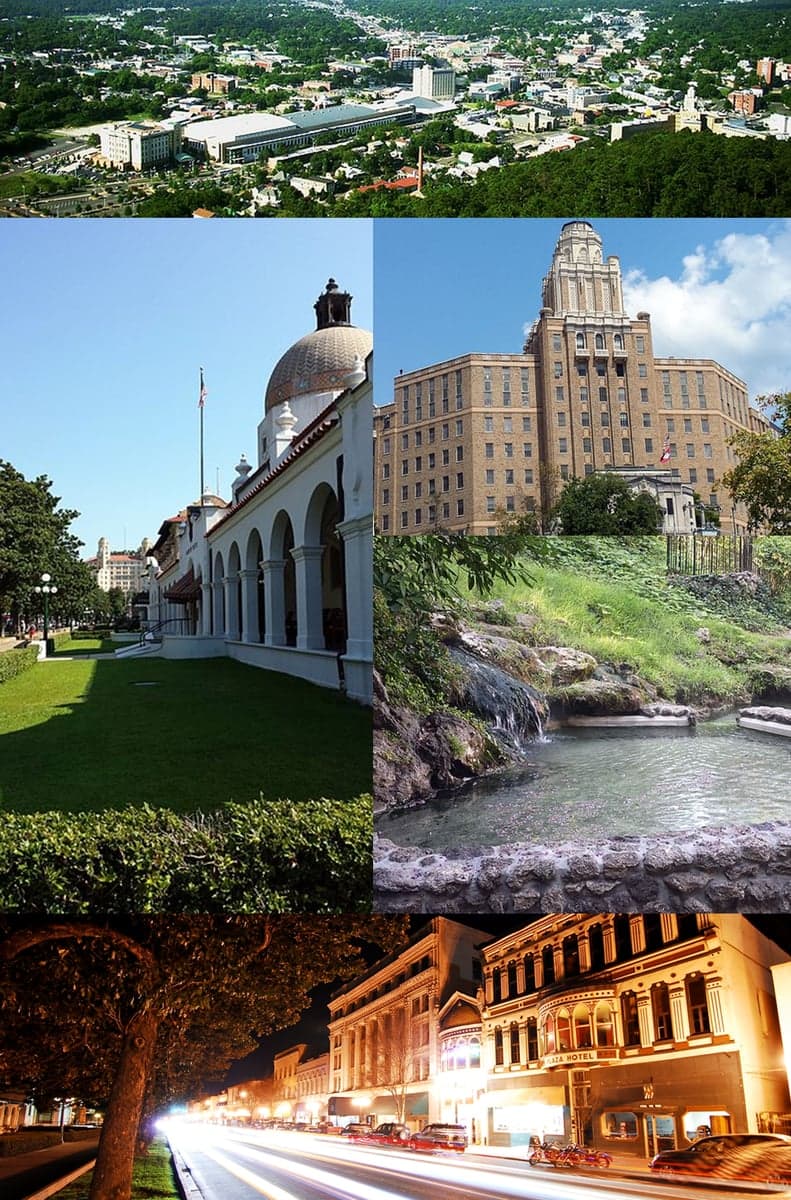
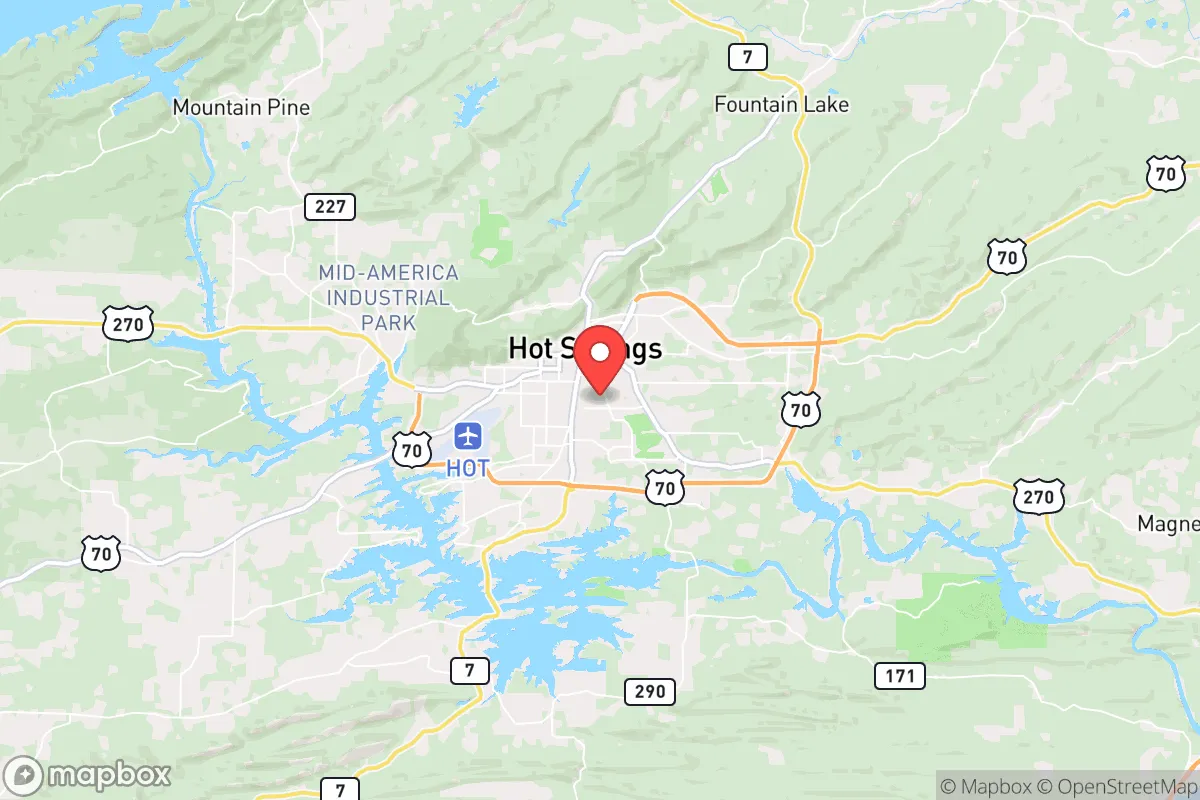
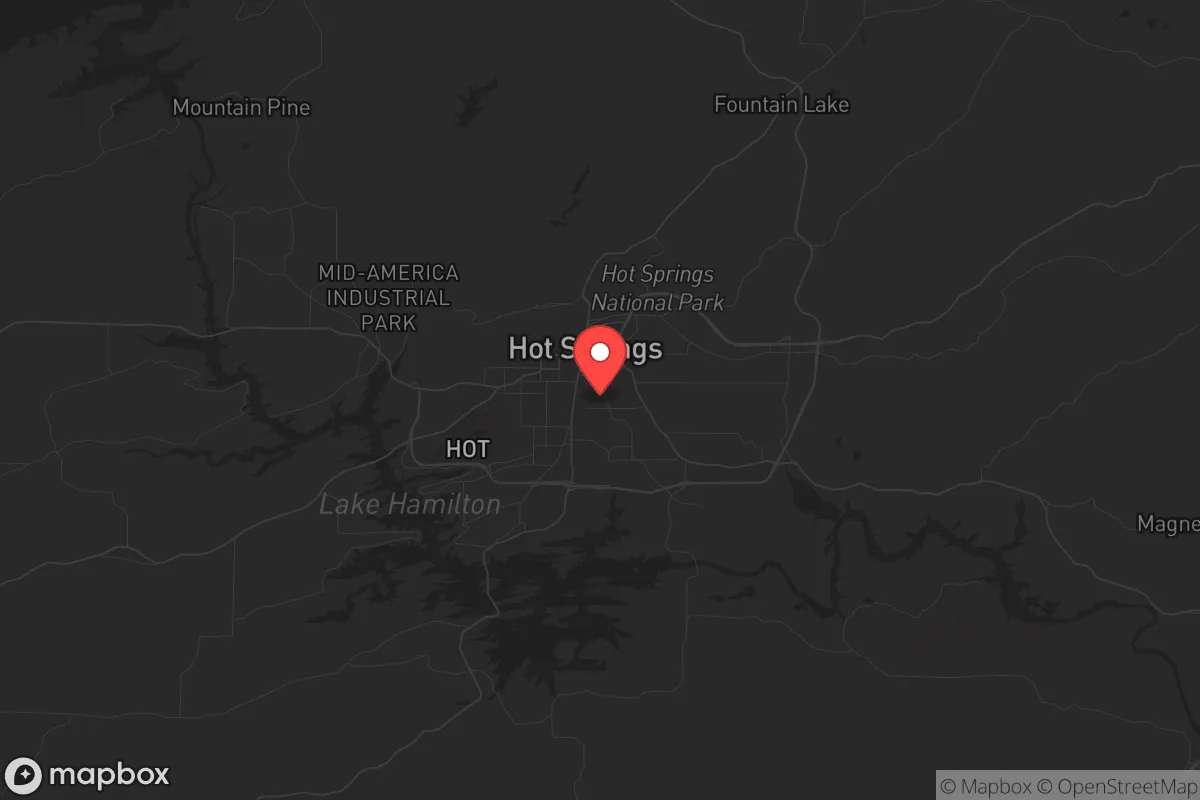
Photo: Wikipedia
Demographics of Hot Springs, AR
Affluence Level in Hot Springs, AR
A low-income area with significant economic hardship. Household wealth and educational attainment are well below national averages.
People of Hot Springs, AR
The people of Hot Springs, Arkansas, today number 38,023, forming a community that is predominantly White (66.1%) with a significant Black minority (16.0%) and a growing Hispanic population (11.4%). The city’s identity is shaped by its history as a resort and health destination, giving it a more transient and service-oriented character than many other Arkansas towns. With only 27.7% of adults holding a college degree, the workforce leans heavily toward tourism, hospitality, and healthcare, creating a distinct blue-collar and retiree-influenced culture.
How the city was settled and grew
Hot Springs’s human history begins not with agriculture but with its thermal springs, which drew Native American tribes for centuries before European contact. After the Louisiana Purchase, the area was set aside as a federal reservation in 1832, making it the oldest federally protected area in the U.S. The first major wave of White settlers arrived in the mid-19th century, drawn by the promise of healing waters and the construction of bathhouses. These early residents clustered in the Historic Downtown district, building the grand bathhouses and hotels that still define the city’s core. A second wave came after the Civil War, when freed Black families moved to Hot Springs for work in the resort economy, establishing a vibrant community in the Malvern Avenue corridor and the Pleasant Street neighborhood, which became the heart of Black commercial and social life. By the early 20th century, the city’s reputation as a gambling and entertainment hub attracted a diverse mix of workers, including Italian and Irish immigrants who settled in the Whittington Avenue area near the bathhouses.
Modern era (post-1965)
The post-1965 period brought significant demographic shifts. The Immigration and Nationality Act opened doors for new groups, but Hot Springs’s foreign-born population remains low at just 4.2%, well below the national average. The most notable change has been the growth of the Hispanic community, which rose from a negligible share in 1990 to 11.4% today. These families, primarily of Mexican origin, have concentrated in the Park Avenue corridor and the Central Avenue extension south of downtown, where they work in construction, landscaping, and the hospitality industry. The Black population, which once made up over 25% of the city in the 1970s, has declined to 16.0% as middle-class families moved to suburbs like Lake Hamilton or left for larger cities. The East/Southeast Asian community (0.8%) and Indian subcontinent community (0.7%) remain small, with no distinct ethnic enclave; these residents are dispersed, often working in healthcare at CHI St. Vincent or as small business owners. The White population, at 66.1%, is aging, with many retirees from the Midwest and Texas moving into gated communities like Hot Springs Village (technically outside city limits) or the West Mountain area.
The future
The population is heading toward greater Hispanic representation, driven by both immigration and higher birth rates. The Hispanic share is projected to reach 15-18% by 2040, with continued concentration in the Park Avenue corridor. The Black population is likely to stabilize or decline slightly as younger families leave for better economic opportunities in Little Rock or Dallas. The White population will continue to age, with the city’s median age (currently 42.5) rising as retirees replace younger out-migrants. The city is not tribalizing into distinct enclaves so much as sorting by income: wealthier residents cluster on the hillsides and lakefronts, while lower-income families, including most Hispanic and Black households, remain in the flatland neighborhoods near downtown. The foreign-born share is expected to rise slowly, possibly to 6-7% by 2040, but Hot Springs will remain a predominantly native-born city.
For someone moving in now, Hot Springs is becoming a more Hispanic-influenced, service-oriented town with an aging White base and a shrinking Black middle class. The city’s character is less about ethnic diversity than about economic stratification between lakefront wealth and downtown service workers. New residents should expect a community that is politically conservative, culturally Southern, and increasingly shaped by the hospitality industry that has defined it for 150 years.

* Values derived from national, state, county, city and local statistics and may differ in a specific area. Last updated: 2026-04-30T02:27:40.000Z
Narrative content on this page is AI-generated and may contain mistakes. Verify any details that matter before acting on them.
ReloMaps may earn a commission from affiliate links at no extra cost to you.

