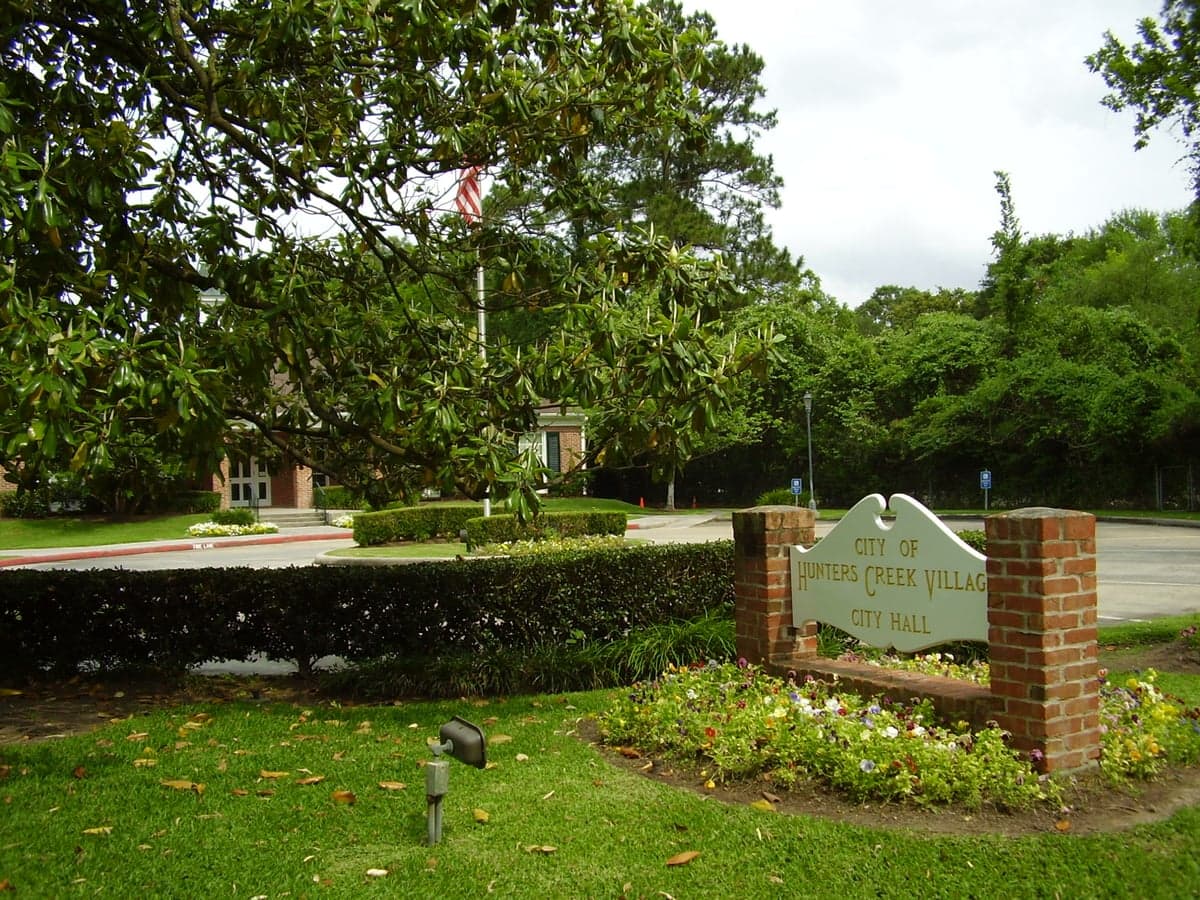
Photo: Wikipedia
Demographics of Hunters Creek Village, TX
Affluence Level in Hunters Creek Village, TX
An elite concentration of wealth — high incomes, strong home values, advanced degrees, and minimal poverty signal a top-tier socioeconomic profile.
Census doesn't track above $250K
People of Hunters Creek Village, TX
Hunters Creek Village is an affluent, predominantly white enclave of 4,358 residents in western Harris County, characterized by its exceptionally high education levels—85.1% of adults hold a college degree—and a foreign-born population of just 4.5%, well below the Houston metro average. The city’s population is 88.9% white, with a Hispanic share of 5.0%, East/Southeast Asian residents at 2.3%, and Indian-subcontinent residents at 1.1%. Black residents account for 0.0% of the population, reflecting the city’s history as a deliberately exclusive, deed-restricted suburb that has maintained its demographic profile through high property values and limited housing turnover.
How the city was settled and grew
Hunters Creek Village was founded in the 1950s as a master-planned, deed-restricted community within the larger Memorial area of Houston. Unlike older Houston suburbs that grew organically around rail lines or industry, Hunters Creek was a post-World War II planned development designed for white, upper-middle-class families seeking large lots, low density, and strict architectural controls. The original population consisted almost entirely of white professionals—executives, doctors, and lawyers—who worked in Houston’s expanding oil and gas, medical, and legal sectors. The first homes were built in the Hunters Creek proper section, centered around the Hunters Creek Country Club, which became the social and recreational anchor for the community. The Piney Point Village border area, along Memorial Drive, saw the earliest wave of construction, with ranch-style and mid-century modern homes on one- to two-acre lots. By the 1960s, the Briar Grove and Briarcroft subdivisions within the city limits were filling in with custom homes, attracting families who valued the combination of suburban privacy and proximity to downtown Houston (roughly 10 miles east). The city incorporated in 1955 specifically to maintain local control over zoning, policing, and property standards—a move that effectively locked in its demographic character.
Modern era (post-1965)
After the 1965 Hart-Cellar Act opened immigration from Asia and Latin America, Hunters Creek Village did not experience the diversification seen in many Houston suburbs. The city’s high home prices—median home values consistently above $1 million since the 1990s—and lack of rental housing created a natural barrier to demographic change. The Hunters Creek Country Club area remained overwhelmingly white, while the Memorial Drive corridor saw a modest influx of East/Southeast Asian families (now 2.3% of the population), many of whom were second-generation professionals in medicine and energy. The Indian-subcontinent population (1.1%) is a very recent phenomenon, concentrated in the Briarcroft section, where a handful of tech and finance executives have purchased homes since 2015. The Hispanic share (5.0%) is largely composed of domestic in-migrants from other Texas cities, not recent immigrants, and these households are spread thinly across the city rather than forming a distinct ethnic neighborhood. The black population remains at 0.0%, a figure that reflects the city’s original deed restrictions (which explicitly excluded non-white buyers until the 1968 Fair Housing Act) and the continued absence of affordable housing stock. No neighborhood within Hunters Creek Village has experienced significant racial turnover; the city has instead homogenized further as older white residents age in place and new buyers are drawn from the same professional demographic.
The future
Hunters Creek Village’s population is projected to remain stable or shrink slightly over the next decade, as the city is essentially built out with no vacant land for new development. The aging white population—many residents are over 60—will gradually sell homes to a younger generation of professionals, but these buyers are likely to be demographically similar: white, college-educated, and employed in high-income fields. The East/Southeast Asian and Indian-subcontinent shares may grow modestly as Houston’s broader professional class diversifies, but the city’s high price point (median home value over $1.5 million) will limit this to the top income brackets. Hispanic and black populations are unlikely to increase significantly without a change in housing stock—no apartments or townhomes exist within city limits, and zoning prohibits multi-family construction. The city is not tribalizing into distinct enclaves; rather, it is homogenizing into a single, high-income white professional community with small, assimilated Asian and Indian minorities. For a conservative-leaning mover seeking a stable, low-crime, highly educated suburb with strong property values and minimal demographic flux, Hunters Creek Village offers continuity—but at the cost of diversity and housing affordability.
Hunters Creek Village is becoming a legacy community where property turnover is slow and new residents are overwhelmingly drawn from the same demographic pool as the original settlers. For someone moving in now, the city offers a predictable, insulated environment with excellent schools (Spring Branch ISD) and low crime, but little ethnic or economic diversity. The population is aging, and the next decade will see a gradual handoff to younger families who can afford the entry price—likely maintaining the city’s character rather than transforming it.

* Values derived from national, state, county, city and local statistics and may differ in a specific area. Last updated: 2026-04-14T05:04:05.000Z
Narrative content on this page is AI-generated and may contain mistakes. Verify any details that matter before acting on them.
ReloMaps may earn a commission from affiliate links at no extra cost to you.

