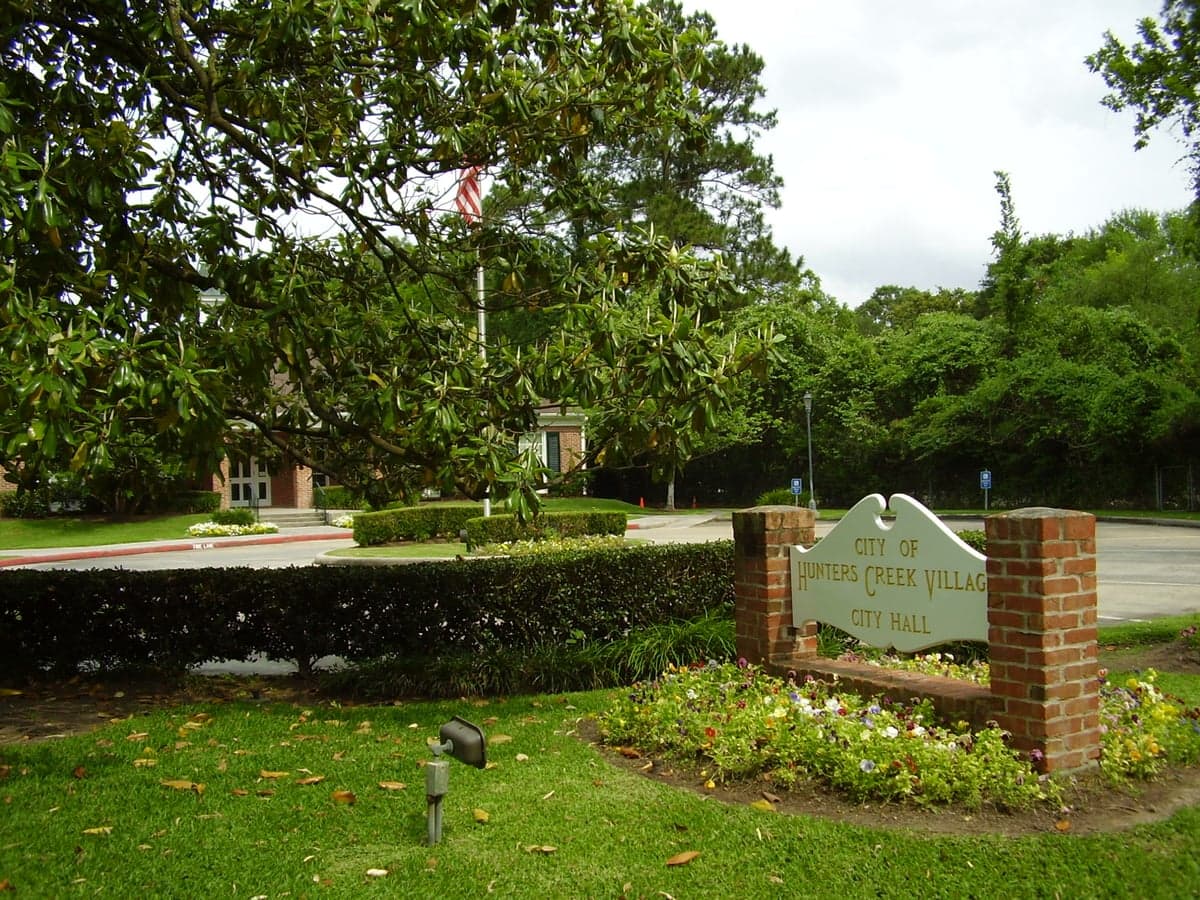
Photo: Wikipedia
Personal Sovereignty in Hunters Creek Village, TX
Strong independent fundamentals that actively favor personal liberty and low regulation.
What does Personal Sovereignty tell us?
Personal Sovereignty measures your capacity for self-reliance and independence with minimal government friction. Higher scores mean fewer barriers between you and the way you want to live... but it assumes you have the space you need and good neighbors.
What does this tell us?
Personal Sovereignty measures your capacity for self-reliance and independence with minimal government friction. Higher scores mean fewer barriers between you and the way you want to live... but it assumes you have the space you need and good neighbors.
State Policy
Energy independence: Net exporter (220% of energy produced in-state)
Personal Liberty
Homesteading

Personal Liberty Analysis
Hunters Creek Village, an affluent enclave within Houston’s Memorial area, offers a notably high degree of personal sovereignty relative to most urban and suburban jurisdictions in Texas, but it is not a libertarian free zone. The village’s small size—roughly one square mile with fewer than 5,000 residents—and its independent municipal government create a localized environment where residents can exert significant control over local ordinances, but they remain subject to Harris County and state-level constraints. For the survivalist or prepper mindset, the key trade-off is this: you get a tight-knit, low-crime community with strong property rights and minimal local bureaucracy, but you trade the ability to go fully off-grid or operate without any regulatory oversight. The village’s governance model leans heavily on homeowner association-style rules, which can be both a shield against unwanted development and a source of petty restrictions on personal expression. Overall, Hunters Creek Village provides a sanctuary-like buffer from the chaos of larger cities, but it demands compliance with a specific, conservative-leaning social contract.
Tax burden and regulatory posture in Hunters Creek Village
Texas’s lack of a state income tax is the foundation of the tax burden here, but Hunters Creek Village adds its own property tax levy on top of Harris County and school district rates. The village’s total property tax rate typically hovers around 2.0–2.2% of assessed value, which is moderate for the Houston metro but high by national standards. However, the village provides direct services—police, fire, and road maintenance—that justify the cost for many residents. There is no city sales tax beyond the state’s 6.25% and Harris County’s 2%, so everyday purchases are not penalized further. Regulatory posture is where the village shines for those wary of government overreach: the municipal code is thin compared to Houston’s sprawling ordinance book. Zoning is restrictive—residential only, no commercial—which preserves the character but also prevents any home-based business or cottage industry without a variance. Permitting for home improvements is straightforward, with no building permit required for interior work under $50,000, a significant advantage for DIY preppers who want to reinforce structures or add safe rooms without bureaucratic delays. The village does not have its own environmental or energy codes beyond state minimums, so solar panels, rainwater collection, and backup generators face no local hurdles—though HOA covenants may impose aesthetic restrictions.
Self-defense and gun law specifics in Hunters Creek Village
Texas’s permitless carry law, effective since 2021, applies fully in Hunters Creek Village, meaning any law-abiding adult can carry a handgun openly or concealed without a license. The village has no local firearm ordinances—no additional waiting periods, no magazine capacity limits, and no registration requirements. Hunters Creek Village Police Department does not enforce any gun-specific local laws beyond state statutes, so the only restrictions are those imposed by Texas law: felons cannot possess firearms, and carrying in certain locations (schools, polling places, bars) is prohibited. For the prepper, this is a clean slate. The village’s low crime rate—typically under 10 violent crimes per year—means defensive firearm use is rare, but the legal environment is permissive enough that a well-stocked armory is not a legal risk. Stand-your-ground and castle doctrine protections are fully in effect, with no duty to retreat in any place where the individual is lawfully present. The nearest gun ranges and retailers are within a 15-minute drive in unincorporated Harris County, and there are no local restrictions on ammunition storage or bulk purchases. For those concerned about government overreach, the village’s small police force (about 15 officers) is responsive but not intrusive—traffic stops and noise complaints are the primary interactions, not firearms checks.
Self-reliance and homesteading viability in Hunters Creek Village
Hunters Creek Village is not a homesteading paradise. Lot sizes average 0.5 to 1 acre, which is generous for a Houston suburb but insufficient for serious self-sufficiency. Chickens are permitted, but roosters are not, and any livestock beyond poultry requires a special exception—so no goats, pigs, or cattle. Gardening is unrestricted, and many homes have established vegetable beds, but the village’s deed restrictions often mandate manicured lawns and prohibit front-yard fencing that would protect crops from deer. Off-grid feasibility is limited: the village is connected to the Houston grid for electricity, natural gas, and water. Rainwater collection is legal and encouraged by the state, but the village has no specific ordinance supporting it, and HOA covenants may limit visible cisterns. Solar panels are allowed, but roof-mounted arrays must be flush-mounted and not visible from the street in many subdivisions. Backup generators are common and unrestricted, and propane tanks up to 500 gallons are typically permitted without a permit. Composting is allowed, but open burning is prohibited, so waste disposal requires municipal trash service. For a serious prepper, Hunters Creek Village offers a comfortable suburban base with room for a substantial pantry, a generator, and defensive preparations, but it is not a retreat property—it is a staging area. The village’s location within the Houston metro means that a full collapse scenario would require evacuation to a rural property, as the area would be densely populated and dependent on fragile infrastructure.
Personal liberties in Hunters Creek Village: parental rights, medical autonomy, speech, and property
Parental rights are robust in Texas, and Hunters Creek Village adds no local restrictions. Homeschooling is fully legal with no notification requirement to the village, and the local school district (Spring Branch ISD) offers a limited but functional virtual option. Medical autonomy is a mixed bag: Texas has no state-level vaccine mandate, and the village has no local health ordinances beyond basic sanitation codes. There are no local restrictions on alternative medicine, supplements, or off-label drug use, but the village is within Harris County, which has a public health department that can issue emergency orders—though it rarely does in this affluent area. Speech is fully protected under the First Amendment, and the village has no local noise or signage ordinances that would restrict political expression, though HOA rules may limit yard signs. Property rights are the strongest pillar: the village has no rent control, no short-term rental bans, and no inclusionary zoning. You can build a fence up to six feet without a permit, and accessory dwelling units (granny flats) are allowed on lots over 10,000 square feet, providing space for extended family or a caretaker. The village’s small government means that most disputes are handled at the HOA level, which can be a double-edged sword—neighbors can enforce covenants that restrict paint colors, tree removal, or parking, but the village itself rarely intrudes on daily life.
For the survivalist or conservative individual weighing personal sovereignty, Hunters Creek Village offers a high degree of autonomy within a structured suburban framework. The tax burden is manageable, gun laws are permissive, and property rights are strong, but the village’s HOA culture and small lot sizes limit full self-reliance. Compared to rural Texas counties like Bandera or Llano, where you can own 20 acres and shoot on your property, Hunters Creek Village is a compromise: you gain security, low crime, and proximity to resources, but you lose the ability to live entirely by your own rules. For those who view government overreach as a primary threat, this village is a buffer zone—not a fortress, but a well-defended outpost within the system. The key is to treat it as a base of operations, not a final retreat, and to ensure your legal preparations (firearms, documents, property rights) are airtight before the next crisis hits.

* Values derived from national, state, county, city and local statistics and may differ in a specific area. Last updated: 2026-04-14T05:04:05.000Z
Narrative content on this page is AI-generated and may contain mistakes. Verify any details that matter before acting on them.
ReloMaps may earn a commission from affiliate links at no extra cost to you.

