Photo: Wikipedia
Demographics of Huntington Beach, CA
Affluence Level in Huntington Beach, CA
An upper-middle-class area. Household wealth, education levels, and homeownership run ahead of national benchmarks.
People of Huntington Beach, CA
Huntington Beach today is a predominantly white, college-educated city of 196,010 residents where nearly half of adults hold a bachelor’s degree or higher, giving it a distinctly professional-class character. Its population is notably less diverse than surrounding Orange County, with a foreign-born share of just 5.6% — roughly one-third the county average — and a Hispanic population of 19.4% that is concentrated in specific older neighborhoods rather than spread evenly. The city’s identity is shaped by a blend of surf-culture conservatism, aerospace-era prosperity, and a strong sense of local autonomy that sets it apart from more ethnically fluid coastal neighbors like Costa Mesa or Santa Ana.
How the city was settled and grew
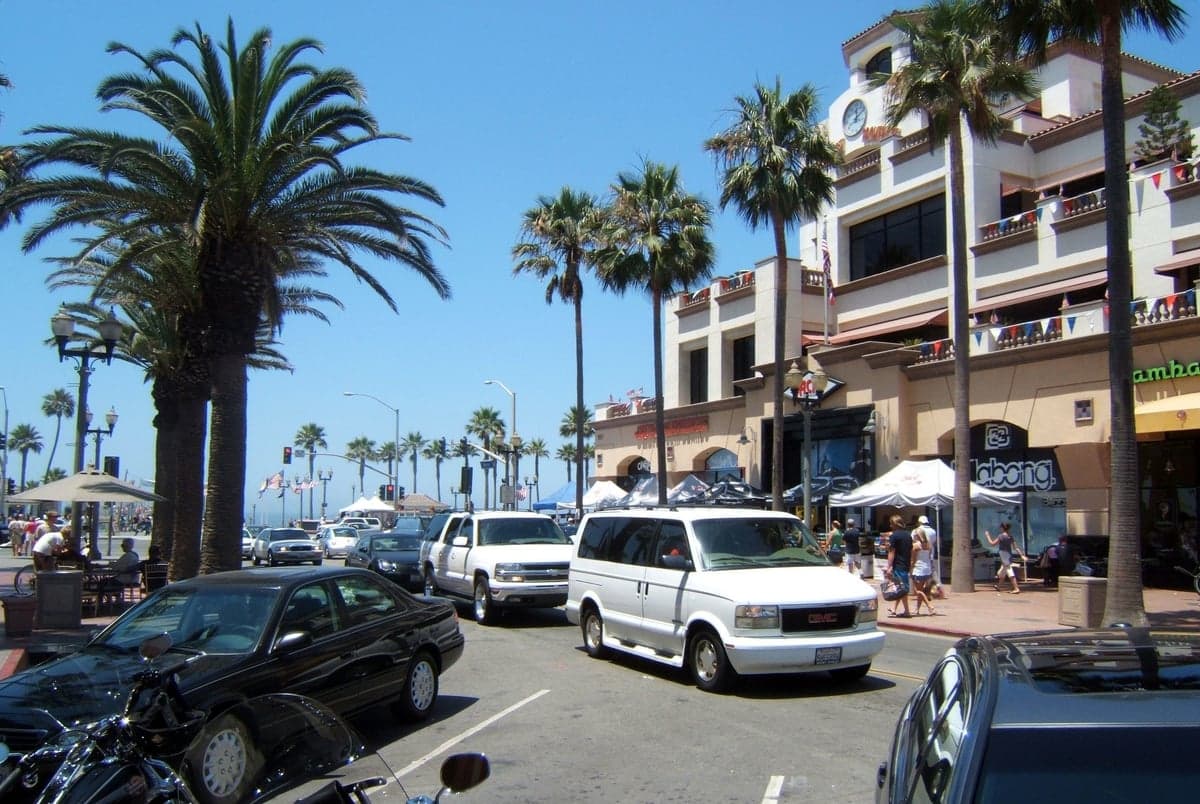
Huntington Beach was a latecomer among California coastal cities, incorporated only in 1909 after the Pacific Electric Railway extended a Red Car line south from Los Angeles. The original population was overwhelmingly white and Anglo-American, drawn by the promise of beachfront land speculation and the discovery of oil in 1920. The Oil Field District around present-day Beach Boulevard and Yorktown Avenue became a rough-edged company town for roughnecks and roustabouts, mostly migrants from Texas, Oklahoma, and the Midwest who lived in small bungalows and boarding houses. Meanwhile, the Downtown / Main Street area developed as a modest beach resort for middle-class Angelenos, with seasonal hotels and a pier built in 1914. The city’s first major growth spurt came during the 1920s oil boom, when the population jumped from 1,500 to over 5,000, but the real transformation began after World War II. Defense contractors like McDonnell Douglas (later Boeing) and Hughes Aircraft set up operations in nearby Long Beach and Fountain Valley, drawing a wave of white engineers, technicians, and managers who settled in newly built subdivisions. The Edison District and Gothard Street corridor filled with ranch-style homes for these aerospace families, while the Sunset Beach area (annexed in 1957) attracted a more bohemian, surf-oriented crowd. By 1960, the city’s population had reached 72,000, and it was already 95% white.
Modern era (post-1965)
The post-1965 period brought modest diversification, but Huntington Beach remained far whiter than Orange County as a whole. The 1970s and 1980s saw the first significant Hispanic settlement, primarily in the Oak View neighborhood (bounded by Beach Boulevard, Adams Avenue, and the Santa Ana River), where working-class Mexican-American families moved into older, more affordable housing stock. This area remains the city’s most Hispanic concentration, with census tracts showing 40–50% Hispanic populations. East and Southeast Asian immigration — mostly Vietnamese and Chinese — began in the 1980s and 1990s, but at a much smaller scale than in neighboring Westminster or Garden Grove. These families tended to settle in the Seacliff area near Goldenwest Street and the newer condominium developments along Edinger Avenue, where the Asian share now reaches 15–18% in some tracts. The Indian subcontinent population (0.7%) is tiny and dispersed, with no identifiable ethnic enclave. The black population (1.2%) has remained consistently low, concentrated in the Oak View and downtown rental areas. The city’s white population peaked numerically around 1990 at roughly 155,000 and has since declined to about 116,000, but the city’s overall population has grown only modestly (from 190,000 in 1990 to 196,000 today), meaning the white share has dropped from 82% to 59% largely through aging and low replacement rather than rapid in-migration of non-white groups.
The future
Huntington Beach’s demographic future points toward slow, incremental diversification rather than rapid change. The Hispanic population is growing steadily — from 12% in 2000 to 19.4% today — and is projected to reach roughly 25–28% by 2040, driven by higher birth rates and continued migration from Santa Ana and Anaheim. The Asian share (11.7%) is likely to plateau or grow only slightly, as the city lacks the ethnic infrastructure (Asian grocery stores, language services, community organizations) that draws new immigrants to Westminster or Irvine. The white population will continue its slow numerical decline, but will remain the majority group for at least another two decades. The city is not tribalizing into distinct ethnic enclaves in the way that Los Angeles or San Jose have; instead, the Oak View neighborhood is becoming more Hispanic while the rest of the city remains overwhelmingly white and Asian. The biggest wild card is housing policy: Huntington Beach’s restrictive zoning and high home prices ($1.2 million median) limit in-migration of younger, more diverse families, reinforcing its older, whiter, wealthier character. For a conservative-leaning mover, this means the city will likely remain culturally familiar — English-dominant, politically center-right, and family-oriented — while slowly absorbing a more Hispanic working class in its older neighborhoods.
For someone moving in now, Huntington Beach is a city that has largely avoided the rapid demographic churn of inland Orange County. It is becoming slightly more Hispanic and Asian, but at a pace slow enough that the city’s core identity — white, suburban, surf-oriented, politically conservative — will remain intact for the foreseeable future. The trade-off is that this stability comes with high housing costs and limited ethnic diversity, which may appeal to those seeking continuity but feel restrictive to those looking for a more cosmopolitan environment.

* Values derived from national, state, county, city and local statistics and may differ in a specific area. Last updated: 2026-04-24T11:47:44.000Z
Narrative content on this page is AI-generated and may contain mistakes. Verify any details that matter before acting on them.
ReloMaps may earn a commission from affiliate links at no extra cost to you.

