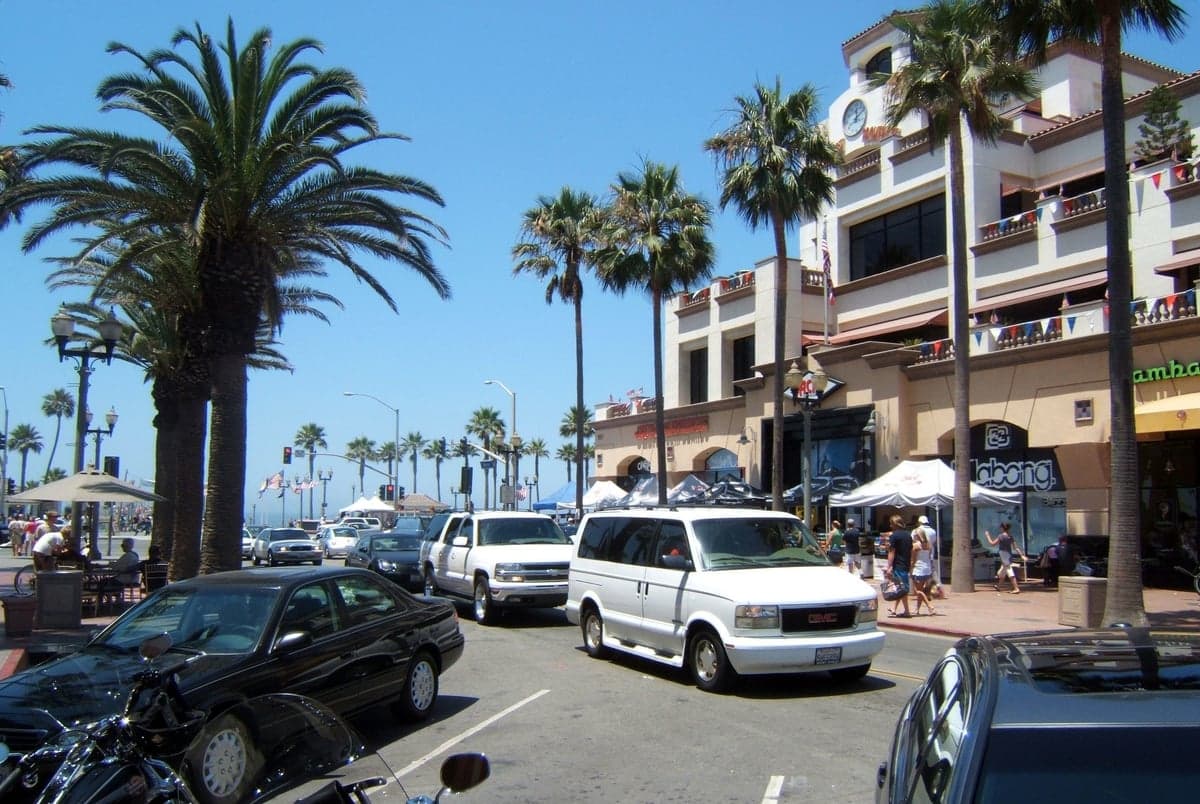
Photo: Wikipedia
Political ClimatePolitical Climate in Huntington Beach, CA
District shown is the primary district for this city’s centroid. Cities may span multiple districts.
Local Political AnalysisPolitical Analysis of Huntington Beach, CA
Huntington Beach has long been one of the last strongholds of traditional, common-sense values in Orange County, but the political winds have shifted noticeably in the last decade. The Cook PVI rating of D+3 might surprise folks who remember when this city was reliably red, but it reflects a slow creep of progressive influence that has many long-time residents on edge. While the city council still holds a conservative majority, the surrounding county trends have made Surf City a battleground where personal freedoms and local control are constantly under pressure from Sacramento’s overreach.
How it compares
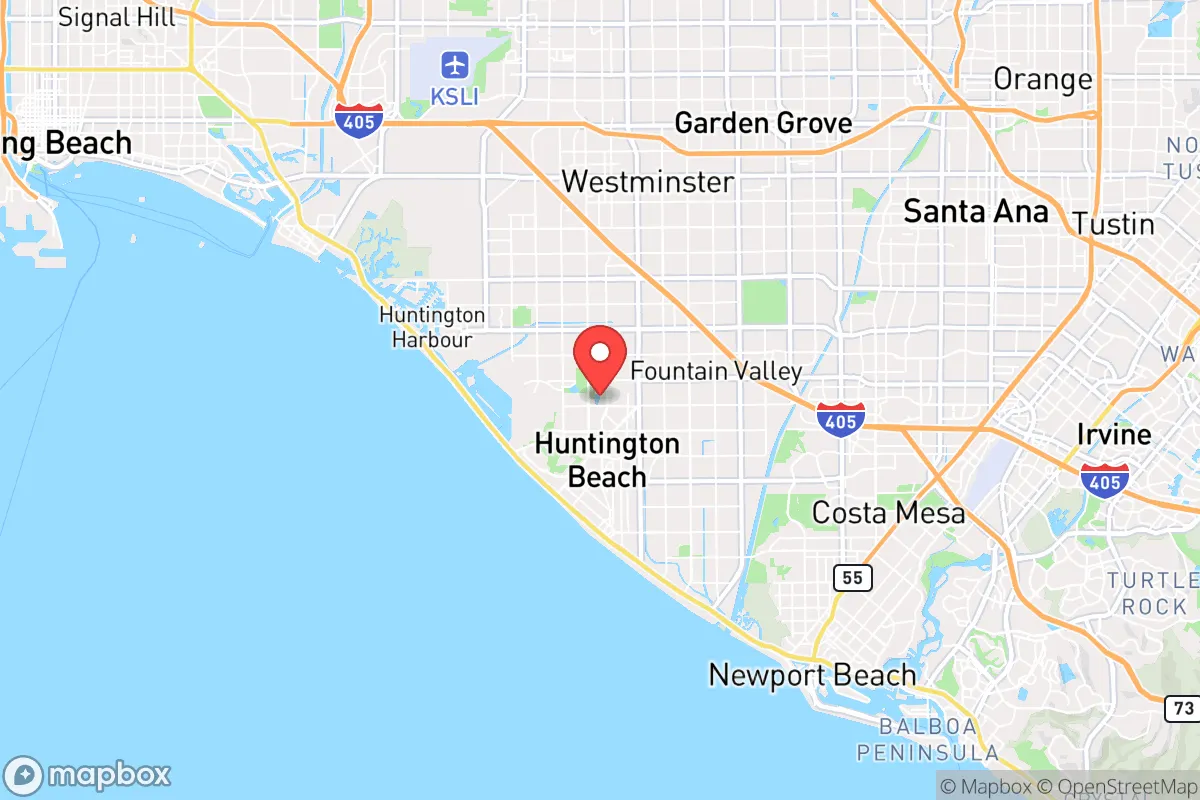
If you want to see the contrast, just drive a few miles inland to places like Fountain Valley or Westminster, which still lean more traditionally conservative, or head south to Newport Beach, where the Republican base remains solid. Huntington Beach sits as a kind of buffer zone—politically, it’s closer to Seal Beach or Los Alamitos, but it’s nothing like the deep-blue enclaves of Santa Ana or Irvine just a few exits up the 405. The D+3 rating masks a reality where local ballot measures and city council races are often decided by razor-thin margins, and where the progressive push for things like high-density housing mandates and mask requirements has been met with fierce resistance from residents who value their property rights and personal choice.
What this means for residents
For those of us who’ve lived here for decades, the biggest concern is how state-level mandates keep trying to override local decisions. You see it in the fights over the Huntington Beach City School District curriculum, the battles over short-term rental regulations, and the constant pressure to adopt “equity” policies that feel more like social engineering than good governance. The good news is that the city council has pushed back hard—things like the Voter ID requirement and the ban on mask mandates in schools were direct responses to what many saw as government overreach. But the long-term trend is worrying: as more people move in from higher-tax states and younger voters register, the political center of gravity is shifting. If you’re a conservative who values low taxes, minimal regulation, and the right to live your life without a bureaucrat’s permission, Huntington Beach is still one of the better bets in Southern California—but you’ll need to stay engaged to keep it that way.
Culturally, Huntington Beach has always prided itself on being a place where the American flag flies high and the Fourth of July parade is a big deal. That identity is under constant assault from activists who want to rebrand the city as a woke beach town. The recent fights over the Surf City Nights event and the Pier Plaza homeless encampment clearings show a community that still values order and public safety over progressive experiments. But the long-term outlook depends on whether enough residents show up to vote in local elections—because the state legislature in Sacramento will keep trying to strip away local control, and the only defense is a city council that remembers who pays the bills.

State Political ClimatePolitical Climate in California
State Political AnalysisPolitical Environment in the State
California has been a one-party Democratic state for over a decade, with Democrats holding supermajorities in both legislative chambers and every statewide office since 2011. The state’s overall partisan lean is roughly D+20 in presidential elections, but this masks a dramatic internal split: the coastal metros of Los Angeles, San Francisco, and San Jose drive the blue wave, while vast inland regions—like the Central Valley and far northern counties—vote reliably red. Over the last 20 years, the state has shifted from a purple battleground (voting for George W. Bush in 2004) to a deep-blue fortress, driven by rapid demographic change, urbanization, and the exodus of moderate and conservative voters to states like Texas and Idaho.
Urban vs. rural divide
The political map of California is a tale of two states. The coastal urban crescent—from San Diego through Los Angeles, the Bay Area, and up to Sacramento—generates roughly 70% of the state’s vote and is overwhelmingly Democratic. Los Angeles County alone delivers about 2 million more Democratic votes than Republican in presidential years. In contrast, the Central Valley cities of Bakersfield, Fresno, and Visalia are Republican strongholds, with Bakersfield’s Kern County voting +20 R in 2024. The far north, including counties like Shasta (Redding) and Siskiyou, is deeply red, while the Sierra foothills (Placer County, El Dorado County) have become suburban Republican bastions. A notable exception is Orange County, which flipped from red to blue in 2018 and now leans Democratic, driven by Asian-American and Latino voters in cities like Irvine and Santa Ana. The inland empire—Riverside and San Bernardino counties—remains a swing zone, trending blue but still hosting conservative pockets in places like Temecula and Murrieta.
Policy environment
California’s policy environment is the most progressive in the nation, with a tax burden that ranks among the highest in the country. The state income tax tops out at 13.3%, and sales taxes can exceed 10% in cities like Los Angeles and San Francisco. Property taxes are capped at 1% of assessed value (Prop 13), but reassessment upon sale means new buyers face steep jumps. The regulatory posture is aggressive: California has its own environmental review process (CEQA), which can delay housing and infrastructure projects for years. Education policy is dominated by the California Teachers Association, with per-pupil spending around $15,000 but low test scores relative to cost. Healthcare is heavily regulated, with a state-run insurance exchange (Covered California) and a push toward single-payer that has stalled. Election laws are among the most liberal: universal mail-in voting, same-day registration, and no voter ID requirement. For a conservative, this environment feels like a constant expansion of government into daily life—from gas car bans (2035) to strict energy mandates on new homes.
Trajectory & freedom
On the freedom index, California is moving in the wrong direction for conservatives. Recent legislation has expanded government control over personal choices. The 2024 gun law package (SB 2, AB 28) bans concealed carry in most public places and imposes new taxes on firearms and ammunition, effectively gutting the Second Amendment for law-abiding citizens. Parental rights have been eroded: AB 1955 (2024) prohibits schools from notifying parents if a child changes their gender identity, overriding local school board decisions. Medical autonomy took a hit with the state’s COVID-19 vaccine mandates for healthcare workers and schoolchildren, which remain in effect despite the pandemic’s end. Property rights are constrained by rent control (AB 1482) and the Coastal Commission’s sweeping authority over development. On the plus side, Proposition 22 (2020) preserved gig-worker independence, and the state has resisted some federal overreach on immigration. But the overall trajectory is toward less personal liberty, with Sacramento dictating everything from what kind of stove you can buy to how many chickens you can keep in your backyard.
Civil unrest & political movements
California has been a flashpoint for political unrest. The 2020 George Floyd protests in Los Angeles and San Francisco caused billions in damage, with lax prosecution of rioters. The state’s sanctuary law (SB 54) limits cooperation with federal immigration enforcement, creating tension with ICE and border states. The secession movement (Calexit) has fizzled but still has a small following. On the right, the “Recall Newsom” movement in 2021 gathered 1.7 million signatures but failed to remove him, though it showed the depth of conservative frustration. Election integrity is a live issue: the state’s universal mail-in system (AB 37) has led to allegations of ballot harvesting and voter roll inflation, though no widespread fraud has been proven. In rural counties like Shasta and Siskiyou, there have been standoffs between local sheriffs and state officials over gun laws and COVID mandates. A new resident would notice the constant presence of political signage—both progressive and conservative—and the palpable tension between coastal elites and inland traditionalists.
Projection
Over the next 5-10 years, California will likely become even more Democratic and progressive. Demographic trends favor the left: the state’s Latino population (40% of residents) leans Democratic, and Asian-American voters are shifting blue. The exodus of conservatives to red states (net domestic migration of -300,000 per year) will accelerate, leaving a more homogeneous electorate. Housing costs will continue to push moderates out, while high taxes and regulation deter new businesses. The state’s population has already declined for three consecutive years (2020-2023), a historic first. For a conservative moving in now, expect a decade of more gun control, higher taxes, and expanded government programs like universal healthcare. The only countervailing force is the growing “exurb revolt” in places like Temecula and Rocklin, where parents are fighting school board policies on critical race theory and gender ideology. But these local wins are unlikely to change the state-level trajectory.
For a conservative individual or family considering California, the bottom line is this: you will be a political minority in a state that actively works against your values. Your tax dollars will fund policies you oppose, your children will be exposed to progressive curricula, and your gun rights will be severely restricted. If you value personal freedom, low taxes, and a community that shares your worldview, California is a tough sell. The best you can hope for is a conservative enclave like Bakersfield or Redding, where you can live a relatively normal life while the state government does its best to make it harder. If you’re set on moving here, buy a house in a red county, get involved in local politics, and prepare for a constant defensive battle against Sacramento.
* Values derived from national, state, county, city and local statistics and may differ in a specific area. Last updated: 2026-04-24T11:47:44.000Z
Narrative content on this page is AI-generated and may contain mistakes. Verify any details that matter before acting on them.
ReloMaps may earn a commission from affiliate links at no extra cost to you.

