 Popular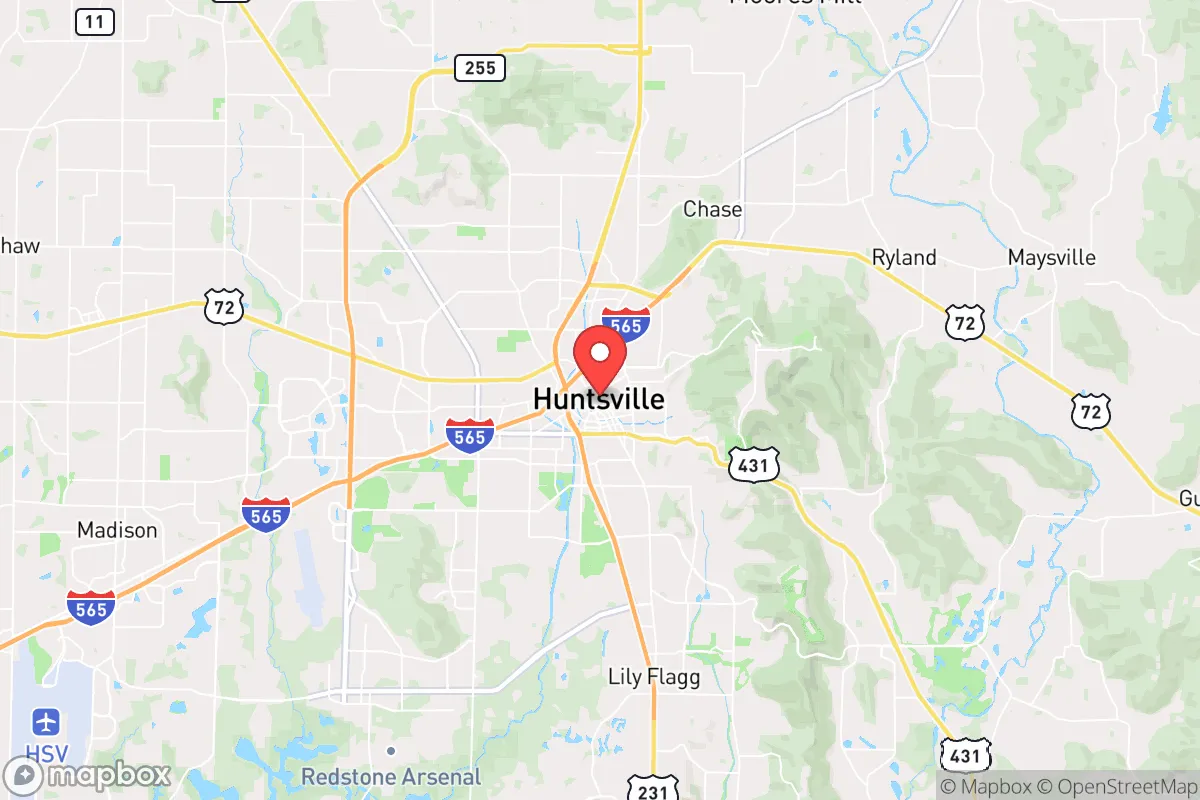
Photo: Wikipedia
Quality of Life in Huntsville, AL
A high quality of life with strong walkability, manageable living costs, healthy neighborhood signals, and solid amenity access.
What does Quality of Life tell us?
Quality of Life blends cost of living, nearby amenities, socioeconomic signals, and neighborhood character. City-level scores represent the whole municipality; individual neighborhoods can differ.
What does this tell us?
Quality of Life blends cost of living, nearby amenities, socioeconomic signals, and neighborhood character. City-level scores represent the whole municipality; individual neighborhoods can differ.
Cost of Living
7% below national average
The Real Cost of Living in Huntsville, AL for 2026
| Tier | Individual | Family (4) |
|---|---|---|
| Survival | $17k | $32k |
| Comfortable | $51k | $75k |
| Luxury | $128k+ | $198k+ |
| Elite (Top 5%) | $172k+ | $267k+ |
94%
The Area Signal
A metric tracking the socioeconomic signals of the area.


Hobbies
Explore the areaGroceries
4 within 10 miles
Gas
0 within 10 miles
Hospital
3 within 20 miles
Airport
BNA — Nashville International
Post Office
USPS — Madison, AL
Critical Amenities
Quality-of-Life Analysis
Huntsville, Alabama, presents a quality of life defined by a strong, diversified economy and a cost of living that remains well below the national average, attracting a mix of aerospace engineers, defense contractors, young families, and retirees. With a cost of living index of 93 (100 = US average), the city offers a tangible financial advantage over peer tech hubs like Austin or Denver, while maintaining a median household income that consistently outpaces the state average. This economic stability, rooted in the presence of Redstone Arsenal and Cummings Research Park, creates a population that is both highly educated and relatively affluent, yet the city retains a distinctly Southern, down-to-earth character.
Cost of living, housing affordability, and how Huntsville compares to nearby cities
Huntsville’s affordability is a central pillar of its appeal, particularly when compared to other growing metro areas in the Southeast. The median home value sits at $263,100, a figure that is roughly 30% lower than the national median and significantly less than in Nashville or Charlotte, where comparable homes often exceed $400,000. For renters, the median rent of $1,078 provides a realistic path to housing for young professionals and families, especially when paired with the city’s strong job market. The average commute time of 19.3 minutes is a standout advantage, cutting the national average nearly in half and allowing residents to reclaim significant time each week. While home prices have risen steadily since 2020—driven by in-migration from higher-cost states—the market remains accessible for dual-income households, and property taxes in Madison County are among the lowest in the region, further stretching take-home pay.
What daily life is like: amenities, schools, and the local rhythm
Daily life in Huntsville balances professional opportunity with a relaxed, family-oriented pace. The city’s public school system, particularly in the Huntsville City and Madison City districts, consistently ranks among the top in Alabama, with several schools earning National Blue Ribbon recognition. For recreation, the U.S. Space & Rocket Center anchors a robust cultural scene that includes the Huntsville Museum of Art, the Lowe Mill ARTS & Entertainment complex, and a growing craft brewery and restaurant corridor along Campus 805. Outdoor amenities are plentiful, with the 2,000-acre Monte Sano State Park offering hiking and mountain biking just minutes from downtown, and the Tennessee River providing opportunities for boating and fishing. The local rhythm is defined by a relatively low-stress environment—traffic congestion is rare outside of peak hours on Research Park Boulevard—and a calendar filled with community events like the Panoply Arts Festival and the Rocket City Trash Pandas minor league baseball games.
Huntsville is best suited for professionals in aerospace, defense, and technology who want a high standard of living without the high costs of coastal metros, as well as for families seeking top-tier public schools and a safe, community-focused environment. Retirees are also drawn to the area for its low taxes and mild climate, though those seeking a vibrant nightlife or dense urban walkability may find the city’s car-dependent layout less appealing. For anyone prioritizing economic stability, short commutes, and a cost structure that allows for homeownership and savings, Huntsville offers a compelling and sustainable quality of life.

Crime in Huntsville, AL
Higher crime rates than 60% of comparable U.S. locations.
Violent CrimeViolent Crime Analysis
Property CrimeProperty Crime Analysis
Crime Analysis
Huntsville, Alabama, presents a mixed safety profile, with violent crime rates that are slightly below the national average but property crime rates that significantly exceed it. The city's overall crime picture is heavily influenced by its rapid growth as a tech and aerospace hub, which has brought both economic opportunity and the challenges of a quickly expanding population. For those considering a move, understanding the specific crime data and how it compares to state and national benchmarks is essential for making an informed decision.
Crime in context
Huntsville's violent crime rate stands at 394.8 incidents per 100,000 residents, which is below the national average of roughly 400 per 100,000 and notably lower than Alabama's state average of approximately 500 per 100,000. This suggests that serious offenses like homicide, rape, robbery, and aggravated assault are less common here than in many other parts of the state. However, the property crime rate tells a different story. At 2,274.4 per 100,000, Huntsville's property crime rate is substantially higher than both the national average (around 1,950 per 100,000) and the Alabama state average. This category—which includes burglary, larceny-theft, and motor vehicle theft—is the primary driver of the city's overall crime index. It is important to note that crime statistics can be influenced by local reporting practices and population shifts, and Huntsville's rapid growth may temporarily inflate per-capita rates.
What residents experience
In practice, Huntsville residents are far more likely to encounter property crime than violent crime. Car break-ins, package theft, and burglaries are the most commonly reported issues, particularly in areas near shopping centers, apartment complexes, and major thoroughfares. The city's status as a major employment center for defense contractors like Lockheed Martin and NASA's Marshall Space Flight Center means a large daytime population, which can contribute to opportunistic theft. While violent crime is less frequent, it is not absent, and certain pockets of the city experience higher rates. A key concern for many relocating families is the local justice system's approach. Like many growing metro areas in the South, Huntsville and surrounding Madison County have generally maintained a more traditional, law-and-order stance in their courts. However, as the city attracts a more diverse and progressive workforce, there is ongoing debate about criminal justice reform. Residents should be aware that any shift toward more lenient, offender-focused policies—such as reduced bail or diversion programs for property crimes—could potentially lead to higher recidivism and more crime on the streets, directly impacting public safety and victim rights.
Neighborhood-level variation in Huntsville is significant. The safest areas are typically the newer, master-planned communities in south Huntsville and the Madison city limits, where home values are higher and police presence is robust. Older, more central neighborhoods near downtown and the University of Alabama in Huntsville (UAH) campus tend to report higher incidences of both property and violent crime. The historic Five Points district, while desirable for its walkability, has seen periodic spikes in theft and break-ins. Prospective residents are strongly advised to examine block-by-block crime maps and consult with local real estate agents who can provide granular, up-to-date safety information for specific streets and subdivisions.
* Values derived from national, state, county, city and local statistics and may differ in a specific area. Last updated: 2026-04-19T18:55:52.000Z
Narrative content on this page is AI-generated and may contain mistakes. Verify any details that matter before acting on them.
ReloMaps may earn a commission from affiliate links at no extra cost to you.

