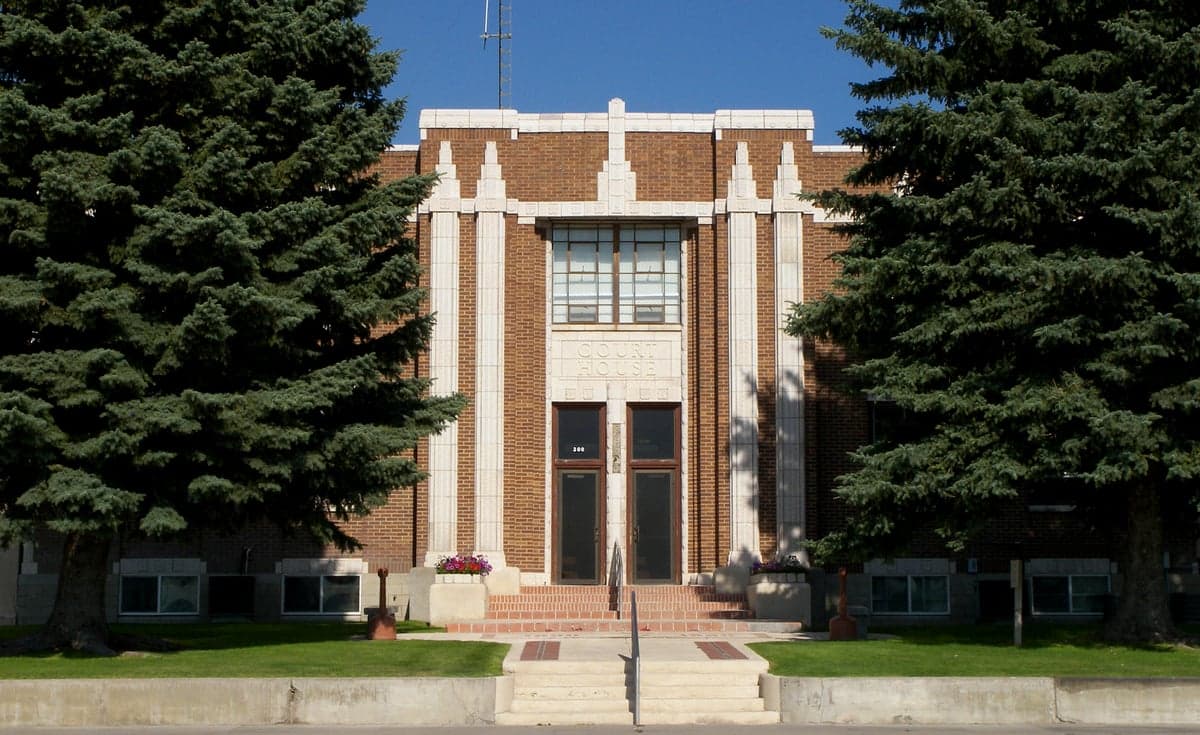
Photo: Wikipedia
Political ClimatePolitical Climate in Jerome County
Showing district-level results — no local-only data available.
Local Political AnalysisPolitical Analysis of Jerome County
Jerome County has long been a solid conservative stronghold, but if you’ve lived here as long as I have, you’ve seen the political ground shift under your feet. The county’s Cook PVI of R+13 tells you it’s reliably red, but that’s a full five points less Republican than the state of Idaho as a whole, which sits at R+18. That gap isn’t an accident—it reflects real changes happening on the ground, especially in the county seat of Jerome itself, where a growing number of younger families and out-of-state transplants have started to nudge things toward the center. Meanwhile, the smaller farming communities like Eden and Hazelton have held the line, staying deeply conservative and suspicious of any government overreach.
How it compares
When you stack Jerome County against the rest of Idaho, the difference is most visible in the precinct-level voting patterns. In the 2024 election, Jerome City’s west-side precincts—particularly around the newer subdivisions near the high school—showed a noticeable uptick in split-ticket voting, with some precincts going only 55-60% Republican. That’s a far cry from the 75-80% margins you’ll see in rural areas like the Hunt precinct or around the town of Eden. Compare that to neighboring Twin Falls County, which has a similar R+13 rating, or the deep-red strongholds like Madison County (R+38), and you start to see Jerome as a bellwether for where Idaho might be heading if progressive trends aren’t checked. The state’s R+18 rating masks the fact that places like Boise and Blaine County are pulling left, while rural counties are holding firm—Jerome sits right in the middle of that tension.
What this means for residents
For folks living here, the political climate directly affects daily life in ways that go beyond bumper stickers. The county commission and school board have stayed reliably conservative, which means property taxes have been kept in check and there’s been strong resistance to any state-level mandates on things like vaccine requirements or curriculum changes. But the creeping influence from Boise and Washington D.C. is real—I’ve watched the city council in Jerome debate zoning ordinances that feel like they were written for a Portland suburb, not a farming community. The real concern is that if the county’s political lean continues to soften, we could see more pressure to adopt policies that erode local control, especially around land use and water rights. That’s a big deal in a place where the ag economy depends on keeping government out of the way.
One thing that sets Jerome County apart from the rest of Idaho is its unique blend of agricultural tradition and a growing Hispanic population, which has brought a strong emphasis on family values and hard work that actually reinforces conservative principles. You won’t find the kind of libertarian streak you see in North Idaho, but there’s a practical, live-and-let-live attitude here that’s increasingly rare. The bottom line is this: Jerome County is still a safe bet for conservatives, but it’s not a lock. If you’re thinking of moving here, pay attention to the local school board races and city council elections—that’s where the real fight over the county’s future is happening. The state may be R+18, but Jerome is the front line.

State Political ClimatePolitical Climate in Idaho
State Political AnalysisPolitical Environment in the State
Idaho is one of the most reliably Republican states in the nation, with a Cook PVI of R+18, meaning it votes about 18 points more Republican than the national average. The dominant coalition is a mix of rural conservatives, Mormon cultural conservatives in the southeast, and a growing wave of out-of-state transplants fleeing blue states, which has actually reinforced the rightward tilt over the last 20 years. While the state has always been red, the shift since 2010 has been toward a more assertive, liberty-minded conservatism, with the legislature increasingly willing to challenge federal authority and push back against progressive cultural trends.
Urban vs. rural divide
The political map breaks down predictably: the rural vastness is deep red, while the few urban centers lean left but are too small to swing statewide elections. Boise and its immediate suburbs in Ada County have become a blue island, with the city itself voting Democratic by about 15 points in recent presidential cycles. But that’s misleading—the surrounding Treasure Valley, including Meridian, Eagle, and Nampa, is heavily Republican, and Ada County as a whole still leans red. The real engine of Idaho’s conservatism is the rural corridor from Coeur d’Alene down through the Panhandle, then east across the Magic Valley and into the southeastern Mormon belt. Counties like Bonner, Boundary, and Shoshone in the north are reliably red, while Madison County (home to BYU-Idaho in Rexburg) routinely delivers 85%+ Republican margins. The only other blue spot is Blaine County, home to Sun Valley, where wealthy second-home owners and ski resort workers create a liberal enclave. But these pockets are too small to matter—Idaho hasn’t voted for a Democratic president since 1964.
Policy environment
Idaho’s policy environment is aggressively pro-business and pro-individual freedom, with a low-tax, low-regulation posture that attracts conservatives. There is no state corporate income tax on pass-through entities, and the flat personal income tax rate was cut to 5.8% in 2023, with a path to 5.695% in 2026. Property taxes are relatively low, though they vary by county—Kootenai County (Coeur d’Alene) has seen rapid assessment increases due to in-migration. Education policy is a flashpoint: the state has a robust school choice movement, with a new Education Savings Account (ESA) program passed in 2023 that allows parents to use state funds for private school or homeschooling expenses. However, the program is currently tied up in court challenges from teachers’ unions. Healthcare is largely free-market, with no Medicaid expansion until voters forced it through a ballot initiative in 2018—the legislature has since tried to add work requirements. Election laws are among the most secure in the nation: voter ID is required, same-day registration is not allowed, and the state uses paper ballots with hand-count audits in many counties. There is no no-excuse absentee voting; you need a valid reason to mail in your ballot.
Trajectory & freedom
Idaho is becoming more free in many respects, but the trajectory is complicated by rapid growth. The 2023 legislative session was a landmark for liberty: the state passed a near-total abortion ban (trigger law) with no exceptions for rape or incest, a constitutional carry law allowing permitless concealed carry, and a Parents’ Bill of Rights that requires schools to notify parents of any curriculum involving sexuality or gender identity. The state also passed a law banning transgender girls from female sports in K-12 and college. On the property rights front, Idaho has strong eminent domain protections, but the influx of new residents has driven up land prices and created tension over zoning—especially in Boise and Kootenai County, where local governments have tried to impose growth caps. The biggest threat to freedom, from a conservative perspective, is the importation of progressive voting blocs from California and Washington. While many transplants are conservative, enough are not that Ada County has shifted from R+20 to R+5 in a decade. The legislature has responded by preempting local ordinances on things like sanctuary city policies (banned in 2019) and rent control (banned statewide).
Civil unrest & political movements
Idaho has a history of anti-government sentiment, but it’s mostly expressed through legal channels rather than street protests. The most visible flashpoint in recent years was the 2020-2021 Boise protests over COVID restrictions, where armed counter-protesters faced off against Black Lives Matter demonstrators—the state was one of the first to reopen fully, and the legislature passed a law banning vaccine passports. The People’s Rights organization, founded by Ammon Bundy (of the 2016 Malheur occupation), has a strong presence in the Treasure Valley, though Bundy’s 2022 gubernatorial run only got 3% of the vote. Immigration politics are relatively quiet because Idaho has a small foreign-born population (about 6%), but the legislature passed a law in 2023 requiring local law enforcement to cooperate with ICE. There is no serious secession movement, but there is a growing “Greater Idaho” movement that wants to absorb conservative eastern Oregon counties—the Oregon legislature has actually held hearings on it. Election integrity is a settled issue here: the 2020 and 2022 elections were certified without controversy, and the state’s Republican secretary of state (who won re-election in 2022) has been praised by both parties for running clean elections.
Projection
Over the next 5-10 years, Idaho will likely become more conservative at the state level, even as its cities drift left. The in-migration wave is self-selecting: people moving to Idaho are disproportionately conservative families and remote workers who want lower taxes and fewer regulations. The state is projected to add 300,000 residents by 2030, with most growth in the Treasure Valley and the Coeur d’Alene area. This will create tension between long-time residents who want to preserve the rural character and newcomers who bring urban expectations—expect more fights over land use, water rights, and school funding. The legislature will continue to preempt local progressive ordinances, and the ESA program will likely survive court challenges. The biggest wild card is the Democratic lean of Boise’s growing tech sector—if Micron’s $15 billion expansion in Boise brings in a more diverse workforce, Ada County could become competitive by 2030. But even then, the rest of the state is so red that statewide offices will remain safely Republican.
For a new resident, the bottom line is this: Idaho is one of the last states where you can still live under a government that largely leaves you alone. The taxes are low, the gun laws are permissive, the schools are increasingly parent-friendly, and the culture is still recognizably American. But you need to be strategic about where you land—if you want the full conservative experience, look at the rural counties or the outer suburbs of Boise like Star or Middleton. If you move into Boise proper or Ketchum, you’ll find yourself in a blue bubble that’s increasingly hostile to traditional values. The state is changing fast, but for now, it’s still a refuge for people who want to be left alone to live their lives.
* Values derived from national, state, county, city and local statistics and may differ in a specific area. Last updated: 2026-05-12T15:22:45.000Z
Narrative content on this page is AI-generated and may contain mistakes. Verify any details that matter before acting on them.
ReloMaps may earn a commission from affiliate links at no extra cost to you.

