
Photo: Wikipedia
Political ClimatePolitical Climate in Independence, KY
District shown is the primary district for this city’s centroid. Cities may span multiple districts.
Local Political AnalysisPolitical Analysis of Independence, KY
Independence, Kentucky, has long been a solidly conservative community, and that hasn't changed much despite some national trends. The area's Cook PVI of R+18 tells you everything you need to know about the baseline—this isn't a swing area, and it hasn't been for decades. You'll find that most folks here vote their conscience on traditional values, and the local elections tend to reflect that same no-nonsense, keep-government-out-of-my-business attitude. If you're looking at the political trajectory, it's been stable, but there's a quiet unease about the direction of the state and country as a whole, especially with the creeping influence from more progressive pockets up north.
How it compares
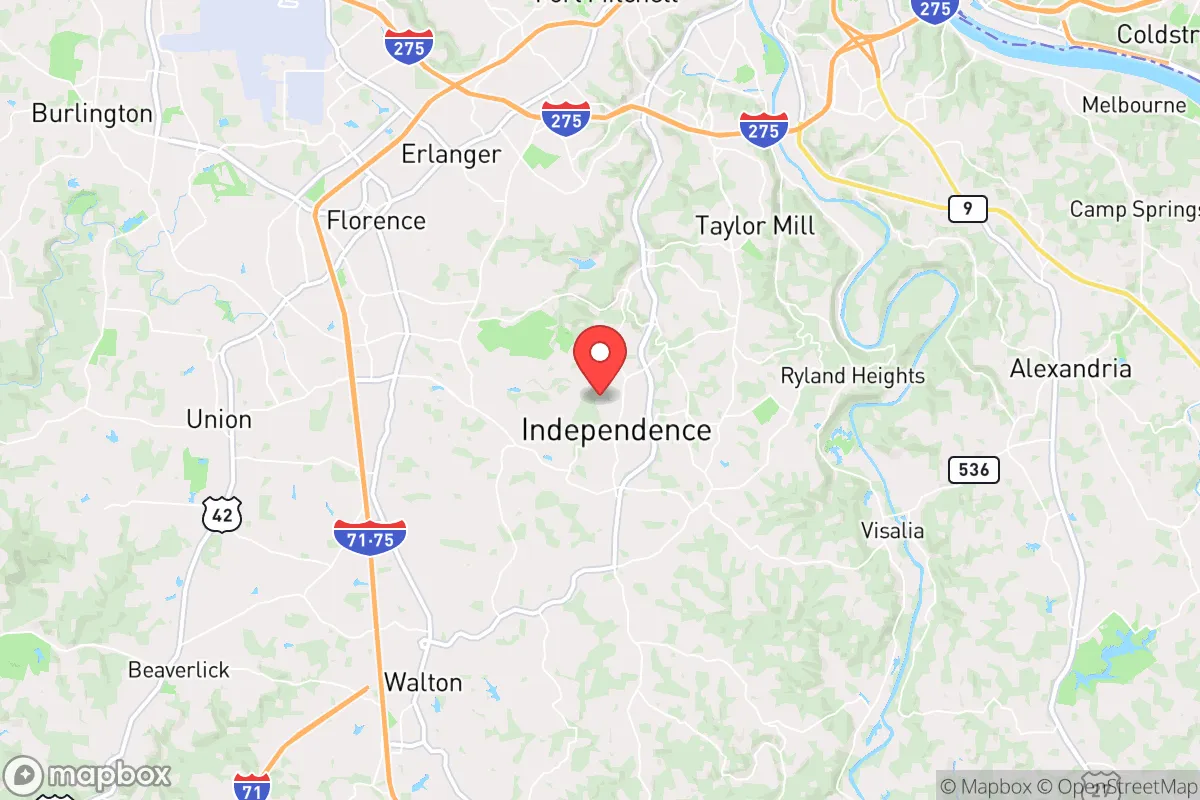
To really get a feel for Independence, you have to look at what's around it. Head north into Covington or Newport, and you'll start seeing a different political animal—those cities lean more moderate to liberal, especially with younger transplants and a growing arts scene. But here in Independence, and really all of Kenton County south of the Ohio River, the vibe is much more like a rural Kentucky town that happens to be close to Cincinnati. Compare it to places like Fort Thomas, which is still conservative but has a more suburban, establishment Republican feel, or to Florence, which is a bit more mixed. Independence feels like the last stronghold where folks are less worried about being politically correct and more worried about property taxes staying low and the Second Amendment staying untouched. The contrast is sharp: drive 15 minutes north and you're in a world of bike lanes and pride flags; drive 15 minutes south and you're in deep red farm country. Independence sits right in that sweet spot of traditional, family-oriented conservatism.
What this means for residents
For someone living here, the political climate means a few concrete things. First, you're not going to see the kind of government overreach that makes headlines in places like Louisville or Lexington. The local school board isn't pushing radical curriculum changes, and the city council isn't wasting time on symbolic resolutions that divide the community. What you get is a focus on practical stuff: keeping roads paved, keeping police funded, and keeping the tax burden reasonable. That said, there's a growing concern among long-time residents about the state-level push for things like expanded gambling or even talk of loosening zoning laws to allow more dense housing. The feeling is that if you want to live in a place where your personal freedoms—like how you raise your kids, what you teach them, and whether you can defend your home—are respected, Independence is still one of the safest bets in Northern Kentucky. But you have to stay engaged, because the progressive wave that's hit Cincinnati is always trying to spill over the river.
One thing that sets Independence apart culturally is its strong sense of local identity. You won't find a lot of chain-store homogenization here; there are still family-owned diners, local gun shops, and churches that actually have full parking lots on Sunday. The policy distinction that matters most is the local government's hands-off approach to property rights and business regulation. Unlike some neighboring cities that have tried to impose strict sign ordinances or noise complaints that target small businesses, Independence generally lets people operate without a mountain of red tape. That's the kind of freedom that keeps people here generation after generation. Looking ahead, the biggest threat isn't from within—it's from the state and federal level trying to impose one-size-fits-all mandates on communities like this. If you're thinking about moving here, just know that you're joining a place that values its independence as much as its name suggests, and it's worth fighting to keep it that way.

State Political ClimatePolitical Climate in Kentucky
State Political AnalysisPolitical Environment in the State
Kentucky has long been a reliably Republican state at the federal level, voting for the GOP presidential candidate by double digits in every election since 2000, but its state-level politics tell a more complex story. The dominant coalition is a mix of rural, socially conservative voters and a growing suburban base, though the state’s two major metro areas—Louisville and Lexington—pull in opposite directions, creating a persistent tension. Over the last 20 years, the state has shifted from a competitive purple state to a solid red one, driven largely by the exodus of rural Democrats and the nationalization of local elections, but the Bluegrass State still harbors deep blue pockets that keep the political landscape from being a monolith.
Urban vs. rural divide
The political map of Kentucky is a textbook study in the urban-rural split. Louisville (Jefferson County) is the state’s Democratic stronghold, consistently delivering 60%+ margins for Democratic candidates, fueled by a diverse, union-heavy, and increasingly progressive base. Lexington (Fayette County) leans blue as well, though less overwhelmingly, with a mix of university faculty, young professionals, and a growing tech sector. In contrast, the rest of the state is deeply red. Bowling Green and Owensboro are reliably conservative, while rural counties like Pike County in the east and Graves County in the west routinely vote 75-80% Republican. The most striking example of the divide is Boone County in the northern suburbs of Cincinnati—once a swing area, it has shifted hard right over the past decade, mirroring the national trend of suburban voters moving toward the GOP on cultural and economic issues. The I-75 corridor from Lexington to the Tennessee line is a mix of exurban and rural conservative areas, while the Jackson Purchase region in the far west is reliably red but with a populist streak that sometimes bucks the establishment.
Policy environment
Kentucky’s policy environment is broadly conservative, but with notable exceptions. The state has a flat income tax that is being phased down from 5% to 4% by 2026, with a goal of eventual elimination—a clear win for fiscal conservatives. Property taxes are low, and there is no state-level estate or inheritance tax. The regulatory posture is business-friendly, with right-to-work laws in place since 2017 and a tort reform system that caps non-economic damages. On education, the state has a robust school choice movement, with charter schools legalized in 2017 (though few have opened) and a new Education Opportunity Account program passed in 2022 that allows tax-credit scholarships for private school tuition. Healthcare is a mixed bag: Kentucky expanded Medicaid under the Affordable Care Act, but the state has since imposed work requirements (currently tied up in court) and moved to a managed-care model. Election laws are moderately restrictive—voter ID is required, and early voting is limited compared to some states, but no-excuse absentee voting was expanded during COVID and remains in place. The state also has a constitutional carry law (permitless concealed carry) since 2019, and a near-total ban on abortion with no exceptions for rape or incest, which was triggered after Dobbs.
Trajectory & freedom
Kentucky is trending more free in several key areas, particularly on gun rights and tax policy. The 2019 constitutional carry law was a landmark expansion of Second Amendment rights, and the state has resisted federal overreach on firearms, with a 2021 law prohibiting local enforcement of federal gun bans. On parental rights, the state passed a Parents’ Bill of Rights in 2022, requiring schools to notify parents about curriculum changes and allowing them to opt their children out of sex education. Medical freedom took a hit during COVID, with Governor Andy Beshear (a Democrat) imposing mask mandates and business closures, but the Republican legislature has since passed laws limiting the governor’s emergency powers and banning vaccine mandates for state employees. Property rights are generally strong, with no statewide rent control and a robust eminent domain reform law passed in 2020 that requires higher compensation for landowners. The biggest concern for liberty-minded residents is the state’s high incarceration rate and a criminal justice system that still leans punitive, though recent bipartisan efforts have reduced some mandatory minimum sentences. On the whole, the state is moving in a direction that favors personal autonomy, especially on guns and education, but the COVID-era power grabs by the executive branch remain a cautionary tale.
Civil unrest & political movements
Kentucky has seen its share of political flashpoints, most notably the Breonna Taylor protests in Louisville in 2020, which resulted in significant property damage, a state of emergency, and a lasting rift between city leadership and the state government. The Republican legislature responded with a series of “anti-riot” bills in 2021 that increased penalties for rioting and blocking highways, which were seen by critics as a crackdown on protest rights. On the right, the Kentucky Freedom Coalition and local Moms for Liberty chapters have been active in school board races, particularly in suburban counties like Oldham County and Shelby County, pushing back against critical race theory and LGBTQ+ curriculum. Immigration politics are relatively quiet, as Kentucky is not a border state and has a small foreign-born population, but there have been local controversies over sanctuary city proposals in Louisville, which the state legislature has preemptively banned. Election integrity has been a hot topic since 2020, with the legislature passing a voter ID law and tightening absentee ballot rules, though no major fraud has been documented. The most visible political movement is the ongoing tension between the Democratic governor and the Republican supermajority in the legislature, which has led to a series of veto overrides and court battles—a dynamic that any new resident will quickly notice.
Projection
Over the next 5-10 years, Kentucky is likely to become more Republican at the state level, driven by continued in-migration of conservatives from higher-tax states like Illinois and California, particularly to the Lexington suburbs and the Northern Kentucky region. The Democratic stronghold of Louisville is aging and losing population, while the exurbs and rural areas are growing. The state’s tax cuts and business-friendly climate will likely accelerate this trend, attracting more families and remote workers who value low taxes and cultural conservatism. However, the urban-rural divide will deepen, with Louisville and Lexington becoming more progressive and isolated from the rest of the state. The biggest wildcard is the 2027 gubernatorial election, which could flip the governor’s office back to Republican, ending the current divided government and allowing the legislature to pass even more conservative policies on education, taxes, and healthcare. A new resident moving in now should expect a state that is increasingly aligned with traditional conservative values, but with persistent blue islands that will continue to generate political friction. The overall trajectory is toward greater personal freedom on most fronts, but with a strong emphasis on local control and resistance to federal overreach.
For a new resident, the bottom line is that Kentucky offers a high degree of personal liberty in terms of gun rights, low taxes, and parental control over education, but you’ll need to be comfortable with a state that is deeply divided between its urban and rural populations. If you’re looking for a place where your values are reflected in state law and where the government generally stays out of your life, Kentucky is a solid choice—just be aware that the political battles are real and ongoing, especially in the cities. The state is trending in a direction that favors conservative principles, but it’s not a utopia; you’ll still have to navigate local politics, particularly in Louisville and Lexington, where progressive policies are more common. Overall, it’s a state that rewards those who want to be left alone, but demands engagement if you want to keep it that way.
* Values derived from national, state, county, city and local statistics and may differ in a specific area. Last updated: 2026-05-03T20:24:28.000Z
Narrative content on this page is AI-generated and may contain mistakes. Verify any details that matter before acting on them.
ReloMaps may earn a commission from affiliate links at no extra cost to you.

