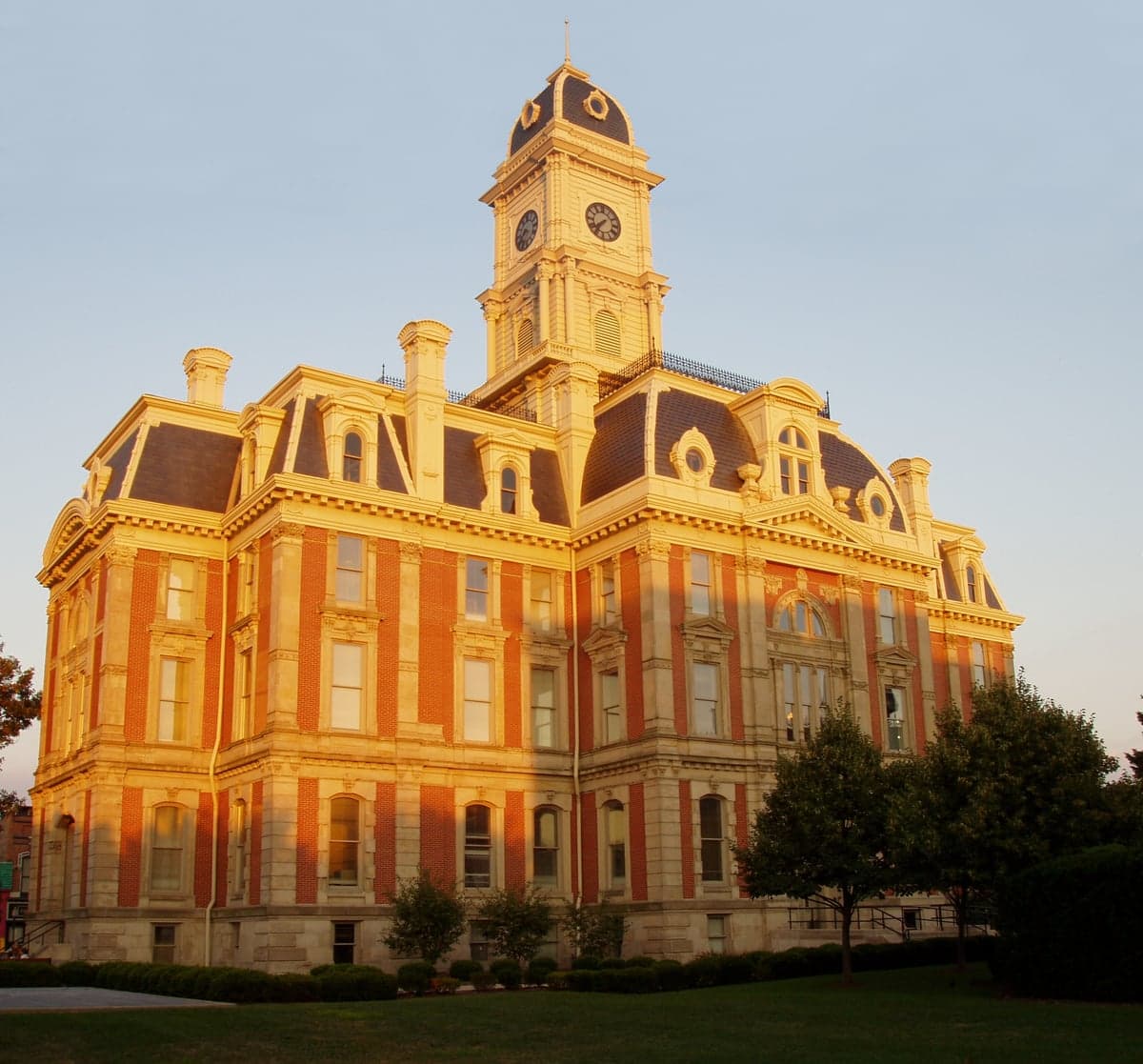
Photo: Wikipedia
Demographics of Hamilton County
Affluence Level in Hamilton County
An upper-middle-class area. Household wealth, education levels, and homeownership run ahead of national benchmarks.
People of Hamilton County
Today, Hamilton County, Indiana, is one of the fastest-growing and most affluent counties in the Midwest, home to over 357,000 residents who are predominantly white (79.7%) and highly educated (61.8% hold a college degree). The county’s identity is shaped by its blend of historic small towns and master-planned suburbs, with a population that is notably family-oriented, politically conservative, and economically driven by the professional and tech sectors of the Indianapolis metropolitan area. While still overwhelmingly white, the county is seeing gradual diversification, with growing Hispanic (5.4%), East/Southeast Asian (3.7%), and Indian-subcontinent (3.0%) communities, though the foreign-born share remains modest at 4.6%.
Settlement & growth (pre-1960)
Before American settlement, the area now known as Hamilton County was inhabited by the Miami and Delaware (Lenape) nations, who used the region’s forests and rivers for hunting and trade. The land was ceded to the U.S. government through a series of treaties in the early 1800s, most notably the 1818 Treaty of St. Mary’s, which opened central Indiana to Euro-American settlement. The county was formally organized in 1823, named after Alexander Hamilton, and its earliest settlers were primarily of Scots-Irish and English stock, migrating from Kentucky, Ohio, and the Upland South in search of fertile farmland.
The first wave of settlers founded the county seat, Noblesville, in 1823, followed by the establishment of Westfield (1834) and Cicero (1835). These communities were agrarian, with the White River providing power for gristmills and sawmills. A distinct group arrived in the 1830s and 1840s: Quakers from North Carolina and Ohio, who settled heavily in Westfield and Sheridan. The Quakers were abolitionists, and their presence made Hamilton County a stop on the Underground Railroad, with several documented safe houses in Westfield and Carmel (then a tiny crossroads called Bethlehem).
German immigrants began arriving in the 1840s and 1850s, drawn by cheap land and the promise of a new life. They concentrated in Fishers (originally Fishers Station, named after a German-American railroad agent) and the northern parts of the county around Atlanta and Arcadia. These German families were largely Lutheran and Catholic, and they established farms, breweries, and small businesses. A smaller wave of Irish immigrants came in the 1850s, many working on the construction of the Indianapolis & Peru Railroad, which connected Noblesville to the state capital. By 1860, the county’s population was about 12,000, overwhelmingly native-born white, with a tiny free Black population (fewer than 50 people) and virtually no foreign-born residents outside the German and Irish pockets.
From the Civil War through the early 1900s, Hamilton County remained a quiet agricultural region. The population grew slowly, reaching 26,000 by 1920. The county saw no major industrial boom or new immigrant wave during this period. The Great Depression and World War II brought little demographic change, though the post-war era saw the first stirrings of suburbanization as Indianapolis began to expand outward. By 1960, the population was still under 40,000, and the county’s character remained rural and small-town, with Noblesville as the largest community at roughly 7,000 residents.
Modern era (post-1965)
The 1965 Hart-Cellar Act, which abolished national-origin quotas, had a delayed but significant effect on Hamilton County. Unlike coastal cities that saw immediate waves of new immigration, Hamilton County’s transformation was driven primarily by domestic migration—specifically, the white flight and suburban expansion from Indianapolis. The construction of Interstate 69 in the 1970s and the expansion of State Road 37 (now the corridor for the future I-69 extension) turned Carmel and Fishers from sleepy towns into booming suburbs. Carmel’s population exploded from 4,000 in 1970 to over 90,000 by 2020, while Fishers grew from 2,000 to nearly 100,000 in the same period. This growth was overwhelmingly white, middle-to-upper-class, and drawn by excellent schools, low crime, and new housing developments like Carmel’s Clay Township and Fishers’ Sunblest Farms.
The first significant non-white population arrived in the 1990s and 2000s, driven by the tech and pharmaceutical industries. Eli Lilly and Company, headquartered in Indianapolis, expanded its operations, and firms like Roche Diagnostics and Dow AgroSciences opened facilities in the county. This brought a wave of highly educated East/Southeast Asian professionals—Chinese, Korean, and Indian-subcontinent engineers and scientists—who settled primarily in Carmel and Fishers. Today, Carmel’s Asian population (East/Southeast Asian) is about 8%, and its Indian-subcontinent population is roughly 5%, making it the most diverse city in the county. Fishers has similar demographics, with a notable concentration of Indian families in the area around 116th Street and Allisonville Road.
Hispanic growth has been more modest but steady, rising from under 1% in 1990 to 5.4% today. This population is largely Mexican-American, with some Central American families, and is concentrated in Noblesville and Westfield, where construction, landscaping, and service-industry jobs are plentiful. The Black population, at 4.1%, is smaller than the state average and is dispersed across the county, with slightly higher concentrations in Noblesville and southern Fishers. Unlike many Midwestern counties, Hamilton County did not experience a Great Migration-era Black influx; its Black population is largely composed of recent transplants from other parts of Indiana or from other states, drawn by professional opportunities.
The post-1965 era also saw the rise of Westfield as a hub for conservative Christian families, with the founding of the Grand Park sports complex and the growth of large evangelical churches. Sheridan and Arcadia, in the northern part of the county, have remained smaller and more rural, with less demographic change. The county’s overall foreign-born share (4.6%) is below the national average, but it is concentrated in the professional class, giving Hamilton County a distinctive character: highly educated, affluent, and culturally conservative, but with a visible and integrated Asian and Indian presence in its most prosperous suburbs.
The future
Hamilton County’s population is projected to continue growing, potentially reaching 450,000 by 2040, driven by continued domestic migration from other Midwestern states and from the coasts. The county is not tribalizing into distinct ethnic enclaves; rather, it is homogenizing into a broadly affluent, family-oriented suburban landscape where racial and ethnic diversity is present but largely assimilated into a shared culture of high-achieving schools, conservative politics, and professional careers. The East/Southeast Asian and Indian-subcontinent communities are growing but are not forming separate neighborhoods; they are dispersing into the same subdivisions as white families, attending the same schools, and participating in the same civic life.
The Hispanic population is likely to grow faster than the Asian or Indian populations, as lower-cost housing in Noblesville and Westfield attracts service-sector workers. However, Hamilton County’s high cost of living and strict zoning laws will limit the formation of large, low-income immigrant enclaves. The Black population is expected to grow slowly, as the county remains less attractive to Black families than neighboring Marion County (Indianapolis) or more diverse suburbs in the eastern part of the metro area.
Culturally, the county is likely to remain conservative and family-focused, even as it becomes more diverse. The in-migration of professionals from blue states (California, Illinois, New York) is introducing a small but visible liberal minority, particularly in Carmel and Fishers, but the overall political character is expected to stay right-of-center. The biggest demographic challenge will be housing affordability: as land becomes scarce, the county may see a slowdown in growth and a shift toward denser, more urban development in its core cities.
For someone moving in now, Hamilton County offers a stable, prosperous, and safe environment with excellent schools and a strong sense of community. The population is becoming more diverse, but the change is gradual and integrated, not disruptive. The county is not becoming a melting pot in the traditional sense; rather, it is a place where newcomers—whether from India, China, Mexico, or California—are expected to adapt to the existing culture of high achievement, civic engagement, and conservative values. That culture is the county’s enduring identity, and it shows no signs of fading.

* Values derived from national, state, county, city and local statistics and may differ in a specific area. Last updated: 2026-06-05T07:53:33.000Z
Narrative content on this page is AI-generated and may contain mistakes. Verify any details that matter before acting on them.
ReloMaps may earn a commission from affiliate links at no extra cost to you.

