
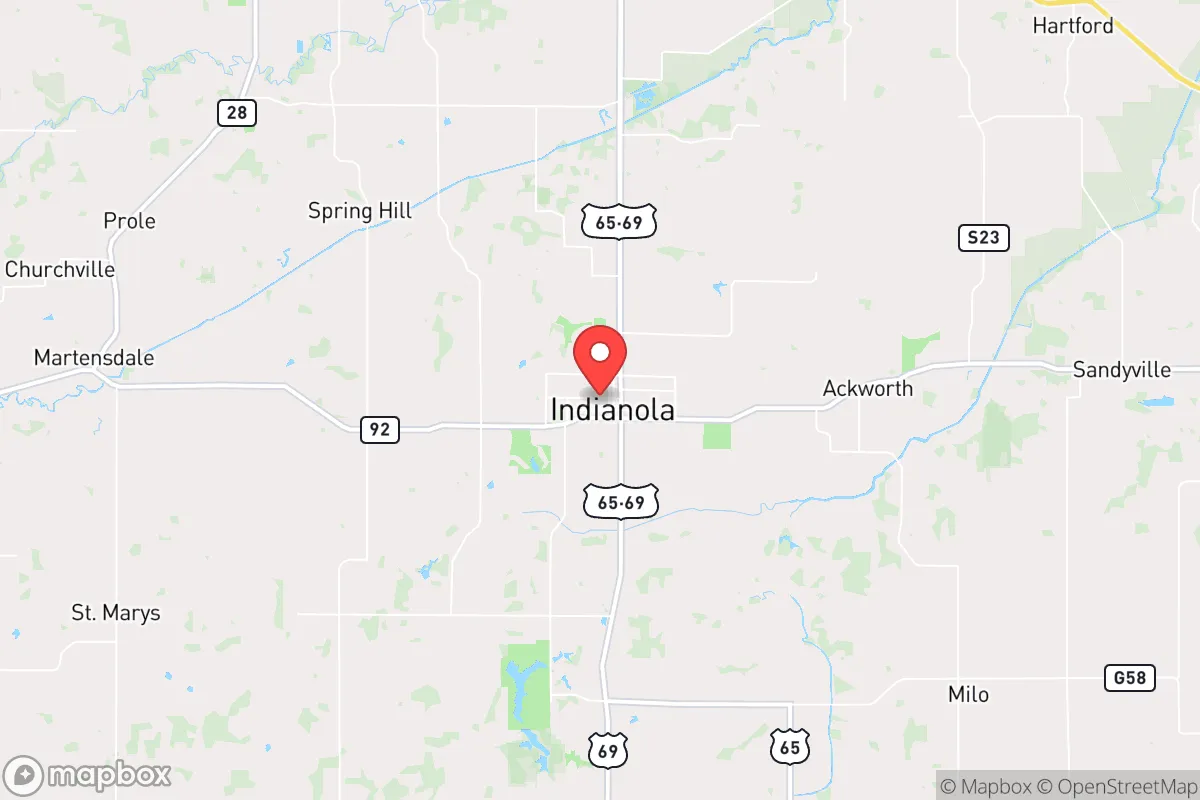
Photo: Wikipedia
Demographics of Indianola, IA
Affluence Level in Indianola, IA
A middle-class area roughly in line with national averages across income, home values, education, and employment.
People of Indianola, IA
The people of Indianola, Iowa, today number 15,918 and form a predominantly white, family-oriented community with a strong civic identity rooted in its role as the Warren County seat and home to Simpson College. The city’s character is defined by a 91.7% white population, a very low 0.4% foreign-born share, and a 33.5% college-educated rate—reflecting a stable, educated, and largely native-born populace. Distinctive markers include a deep sense of local tradition, a visible presence of college faculty and staff, and a population density that feels suburban yet retains small-town walkability. The community is notably homogenous, with Hispanic residents at 2.8%, East/Southeast Asian residents at 1.6%, Black residents at 0.8%, and no recorded Indian subcontinent population.
How the city was settled and grew
Indianola was founded in 1849 as the seat of Warren County, drawing its first wave of settlers—primarily farmers and tradesmen of English, Scottish, and German descent—from the Ohio River Valley and New England. The city’s growth was fueled by the arrival of the Burlington and Missouri River Railroad in the 1860s, which turned Indianola into a regional agricultural hub. The original plat centered on the Courthouse Square, with early residential development spreading north and east along what is now North Buxton Street and East Boston Avenue. The Old Town neighborhood, surrounding the square, was built by these first families and retains many 19th-century homes. A second wave came with the founding of Simpson College in 1860, which drew faculty, ministers, and educated families, many of whom settled in the College Hill area near the campus. By 1900, the population had reached roughly 3,000, and the city’s ethnic makeup remained overwhelmingly white and native-born, with a small number of Irish and German Catholic families clustering near St. Mary’s Church in the South Side district.
Modern era (post-1965)
After the 1965 Hart-Cellar Act, Indianola saw virtually no immigration-driven diversification. The foreign-born share has remained below 1% for decades, and the city’s growth has come almost entirely from domestic in-migration—primarily white families moving from Des Moines (20 miles north) for lower taxes, larger lots, and a quieter lifestyle. This suburbanization wave, accelerating after 1990, filled new subdivisions such as Hunter’s Ridge and Woodland Hills on the city’s west and north sides. These areas attracted professionals commuting to Des Moines and employees of major local employers like the Indianola School District and Warren County government. The Hispanic population, now 2.8%, grew modestly after 2000, with families settling in the Southwest Quadrant near the industrial park, often working in manufacturing or agriculture. The East/Southeast Asian community (1.6%) is largely tied to Simpson College, with faculty and graduate students living in the College Hill and East Side neighborhoods. The Black population (0.8%) is small and dispersed, with no concentrated enclave. Overall, the city has not tribalized into distinct ethnic enclaves; instead, it has remained a largely integrated, white-dominant community where newer non-white residents are scattered rather than clustered.
The future
Indianola’s population is projected to grow slowly, likely reaching 17,000–18,000 by 2040, driven by continued white domestic in-migration from the Des Moines metro. The Hispanic share may rise to 4–5% as agricultural and service-sector jobs attract more families, but the foreign-born share will likely remain below 2%. The East/Southeast Asian population is expected to plateau or decline slightly as Simpson College’s international enrollment stabilizes. The city is not homogenizing further—it is already at a ceiling of whiteness—but it is also not tribalizing into distinct enclaves; new residents of any background tend to assimilate into existing neighborhoods like Hunter’s Ridge or Woodland Hills. The biggest demographic shift may be aging: the median age (roughly 38) is rising as younger adults leave for larger cities, while retirees move in for the low cost of living and proximity to Des Moines healthcare.
For someone moving in now, Indianola is becoming an older, whiter, and more suburban bedroom community—stable, safe, and culturally homogeneous. The city offers strong schools and a tight-knit civic life, but little racial or ethnic diversity. New residents should expect a place where change is slow, community ties are deep, and the population’s character is unlikely to shift dramatically in the next decade.

* Values derived from national, state, county, city and local statistics and may differ in a specific area. Last updated: 2026-04-29T22:47:03.000Z
Narrative content on this page is AI-generated and may contain mistakes. Verify any details that matter before acting on them.
ReloMaps may earn a commission from affiliate links at no extra cost to you.

