Photo: Wikipedia
Demographics of Iowa City, IA
Affluence Level in Iowa City, IA
A middle-class area roughly in line with national averages across income, home values, education, and employment.
People of Iowa City, IA
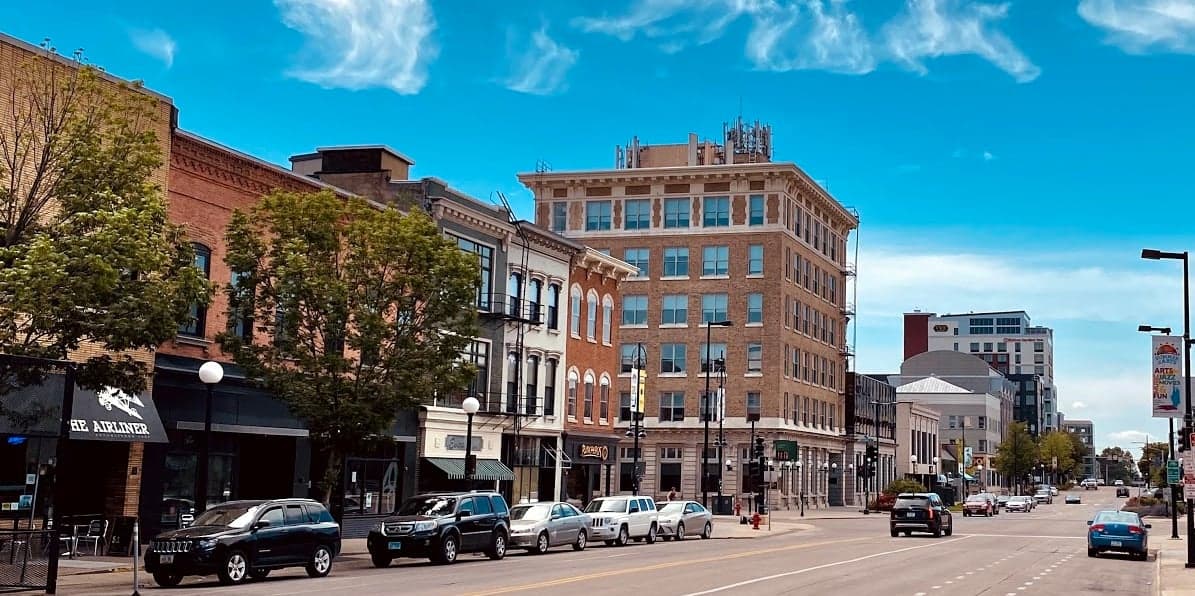
Iowa City is a college town of 75,264 residents, shaped overwhelmingly by the University of Iowa and its associated medical and research sectors. The population is notably young, highly educated—60.7% hold a bachelor’s degree or higher—and predominantly white (72.4%), with a growing but still modest share of Hispanic (8.1%), Black (8.3%), and East/Southeast Asian (5.2%) residents. The city’s character is a blend of transient student energy and a stable, professional class of university staff, healthcare workers, and tech-adjacent professionals, creating a dense, walkable core surrounded by family-oriented suburbs.
How the city was settled and grew
Iowa City was founded in 1839 as the first capital of the Iowa Territory, a planned government seat built on a grid around a central Capitol Square. The original population was a mix of Yankee settlers from New England and upstate New York, along with German and Irish immigrants who arrived to work on the railroad and in local trades. The University of Iowa, established in 1847, became the city’s economic anchor, drawing faculty and students from across the Midwest. By the early 20th century, the city’s growth was tied to the university’s expansion, with the Northside neighborhood developing as a dense, walkable area of single-family homes and boarding houses for faculty and students. The Goosetown neighborhood, originally a working-class German and Irish enclave near the railroad tracks, housed many of the city’s laborers and tradesmen. The post-World War II era brought a wave of veterans using the GI Bill to attend the university, fueling the construction of the Mormon Trek neighborhood, a planned subdivision of mid-century ranch homes built for the growing professional class.
Modern era (post-1965)
The 1965 Hart-Cellar Act opened immigration from Asia and Latin America, but Iowa City’s foreign-born population remains relatively low at 7.3%, reflecting the city’s inland, non-coastal location. The most visible post-1965 shift has been the growth of the university’s international student body, particularly from East and Southeast Asia. These students and their families have concentrated in the University Heights area and the apartment complexes along Dodge Street, near the main campus. The Hispanic population, now 8.1%, grew steadily from the 1990s onward, driven by labor demand in construction, food service, and the university’s custodial and maintenance sectors. Many Hispanic families settled in the South District, a lower-cost area south of Highway 6 with older housing stock and a growing number of Latino-owned businesses. The Black population, at 8.3%, has deep roots in the city, with many families arriving during the Great Migration to work at the university or the now-closed meatpacking plants in nearby Columbus Junction. Today, Black residents are dispersed across the city, with a notable concentration in the Wetherby Park neighborhood, a mid-century subdivision of modest homes. The Indian-subcontinent population (1.6%) is a more recent arrival, almost entirely tied to the university’s graduate programs in engineering, medicine, and business, and is concentrated in the newer apartment complexes near the Iowa River Landing development.
The future
Iowa City’s population is projected to grow slowly, driven primarily by university enrollment and the expansion of the University of Iowa Hospitals and Clinics, the city’s largest employer. The white population share is declining gradually as the university recruits more international students and as younger, more diverse cohorts replace older, whiter ones. The Hispanic and East/Southeast Asian communities are growing, but from a small base, and are likely to remain concentrated in specific neighborhoods rather than dispersing citywide. The city is not tribalizing into stark ethnic enclaves, but distinct clusters are emerging: Goosetown and the Northside are becoming increasingly white and affluent as they gentrify, while the South District is becoming more Hispanic and working-class. The Indian-subcontinent community is likely to grow as the university’s STEM programs expand, but will remain a small, highly educated cohort. The biggest demographic wildcard is the university’s future enrollment—if it continues to attract international students, the Asian and Indian shares will rise; if it contracts, the city will become older and whiter.
For someone moving to Iowa City now, the city is becoming a more diverse but still overwhelmingly white and university-centric place. The core neighborhoods are increasingly expensive and professional, while the southern and eastern edges offer more affordable, family-oriented housing with a growing mix of Hispanic and working-class residents. The city’s future is tied to the university’s ability to remain a top-tier research institution, which will continue to draw a transient, educated population from across the U.S. and the world.

* Values derived from national, state, county, city and local statistics and may differ in a specific area. Last updated: 2026-04-24T15:00:35.000Z
Narrative content on this page is AI-generated and may contain mistakes. Verify any details that matter before acting on them.
ReloMaps may earn a commission from affiliate links at no extra cost to you.

