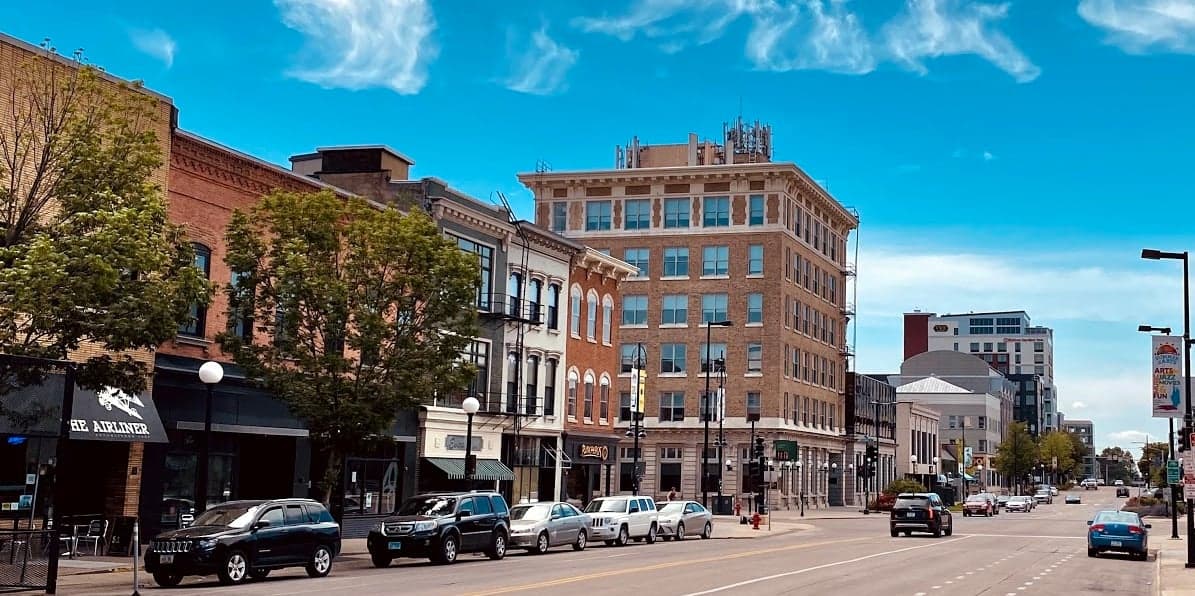
Photo: Wikipedia
Personal Sovereignty in Iowa City, IA
Viable for self-reliance. Generally workable, though some barriers may limit total independence.
What does Personal Sovereignty tell us?
Personal Sovereignty measures your capacity for self-reliance and independence with minimal government friction. Higher scores mean fewer barriers between you and the way you want to live... but it assumes you have the space you need and good neighbors.
What does this tell us?
Personal Sovereignty measures your capacity for self-reliance and independence with minimal government friction. Higher scores mean fewer barriers between you and the way you want to live... but it assumes you have the space you need and good neighbors.
State Policy
Energy independence: Importer (50% of energy produced in-state)
Personal Liberty
Homesteading

Personal Liberty Analysis
Iowa City presents a complex picture for those prioritizing personal sovereignty. While the city itself leans heavily progressive, the surrounding Johnson County and the state of Iowa offer a mixed bag of protections and encroachments that require careful navigation. For the survivalist or prepper, the key takeaway is that Iowa City is not a sanctuary of liberty, but it is not a total loss either—your ability to live autonomously here depends heavily on how much you are willing to work around local ordinances and lean on state preemption laws.
Tax burden and regulatory posture in Johnson County
Iowa’s overall tax climate is relatively favorable compared to coastal states, but Johnson County is a notable outlier. The state income tax is a flat 3.8% as of 2026, which is reasonable, but property taxes in Iowa City are among the highest in the state. The combined city and school district levies push effective rates above 2% of assessed value, meaning a $300,000 home carries an annual tax bill of roughly $6,000 or more. This is a significant recurring cost for anyone trying to minimize government dependency. On the regulatory front, Iowa City has a reputation for aggressive zoning and building codes. The city enforces strict rental housing inspections, energy efficiency mandates, and landscaping requirements that can feel like micromanagement. For a prepper looking to modify a property—adding a root cellar, installing a backup generator, or building a detached workshop—expect to navigate a permitting process that is more burdensome than in rural Iowa counties. The city’s climate action plan also pushes for electrification and bans on certain fossil fuel appliances in new construction, which directly conflicts with off-grid or self-reliant energy strategies. State-level preemption on some issues (like firearm regulation) helps, but local control over land use and building codes remains a real constraint on personal autonomy.
Self-defense and gun law specifics in Iowa City
Iowa is a “shall issue” state for permits to carry, and as of 2021, it became a permitless carry state for anyone 21 or older who can legally possess a firearm. This is a strong foundation for self-defense rights. However, Iowa City itself is not gun-friendly in spirit. The city council has passed resolutions supporting “safe storage” ordinances and has attempted to create local gun-free zones, though state preemption laws generally block these from having legal teeth. In practice, you can carry openly or concealed without a permit in most of the city, but you must be aware of posted restrictions on private property and in government buildings. The University of Iowa campus is a gun-free zone by state law, which is a significant limitation for students, faculty, or anyone who spends time there. For the survivalist, the legal framework is workable—you can keep a rifle in your truck and a pistol on your hip—but the cultural hostility means you will likely be treated with suspicion if you are visibly armed. Johnson County’s sheriff has also been publicly critical of permitless carry, so don’t expect enthusiastic support from local law enforcement if you ever have to use a firearm defensively. The bottom line: state law gives you the right, but local attitudes and university policies create friction.
Self-reliance and homesteading viability in the Iowa City area
True homesteading within Iowa City limits is nearly impossible due to lot sizes and zoning. Most residential lots are under a quarter-acre, and the city code restricts keeping livestock—chickens are allowed only with a permit and strict coop setbacks, and larger animals like goats or pigs are outright banned. For a prepper wanting to raise food, you are better off looking at unincorporated Johnson County or neighboring rural counties like Washington or Cedar. Even there, zoning can be an issue; some townships have minimum lot sizes of 2 to 5 acres for agricultural use. Off-grid feasibility is also limited. Iowa City requires connection to municipal water and sewer for any habitable structure, and the building code mandates grid-tied electrical service for new construction. Solar panels are allowed but must be grid-tied unless you get a special variance, which is rarely granted. Rainwater collection is legal in Iowa, but the city restricts barrel sizes and requires them to be covered to prevent mosquitoes. For a serious off-grid setup—composting toilets, well water, battery storage—you will need to buy land well outside the city, likely 20+ miles out, where county zoning is more permissive. The trade-off is that land in those areas is affordable, with raw acreage going for $5,000 to $10,000 per acre, but you lose proximity to the city’s job market and medical infrastructure.
Personal liberties: parental rights, medical autonomy, speech, and property
Parental rights in Iowa are generally strong compared to blue states. Iowa law gives parents broad authority over their children’s education, including the ability to homeschool without excessive state oversight. The state does not require parents to register with the district or submit curriculum plans, though annual assessments are needed after a certain age. Iowa City schools, however, are progressive and have implemented policies on gender identity and social-emotional learning that may conflict with conservative values. Opt-out options exist but require active effort. Medical autonomy is a mixed bag. Iowa has not enacted broad vaccine mandates for adults, but the University of Iowa and many large employers in the city do require COVID-19 and flu shots for employees. For a prepper concerned about medical freedom, this is a red flag—you may need to seek employment with smaller firms or work remotely to avoid these mandates. On speech, Iowa City is a classic college town with a strong “free speech zone” culture on campus, meaning your right to express conservative or dissenting views is legally protected but socially punished. You can say what you want, but expect pushback, doxxing, or professional consequences if you are vocal. Property rights are decent at the state level—Iowa has strong eminent domain protections—but local zoning boards have wide latitude to deny permits for non-conforming uses. If you want to run a small business from your home or build a bunker, you will likely face a fight.
Overall, personal sovereignty in Iowa City is a study in contrasts. The state provides a solid baseline of gun rights, low income taxes, and parental autonomy, but the city itself layers on progressive zoning, high property taxes, and a cultural environment that is hostile to self-reliance and traditional values. For a single individual or family with a survivalist mindset, the area is livable if you are willing to stay under the radar, avoid university employment, and live on the outskirts where county rules apply. Compared to a place like Austin, Texas, or Portland, Oregon, Iowa City is more permissive on guns and taxes but less so on land use and medical freedom. If your priority is maximum autonomy with minimal government interference, you would be better served by rural Iowa counties like Buchanan or Delaware. But if you need the job market and amenities of a university town, Iowa City can work—just know that you will be trading some of your sovereignty for convenience, and you will need to be strategic about where you live and how you engage with local authorities.

* Values derived from national, state, county, city and local statistics and may differ in a specific area. Last updated: 2026-04-24T15:00:35.000Z
Narrative content on this page is AI-generated and may contain mistakes. Verify any details that matter before acting on them.
ReloMaps may earn a commission from affiliate links at no extra cost to you.

