
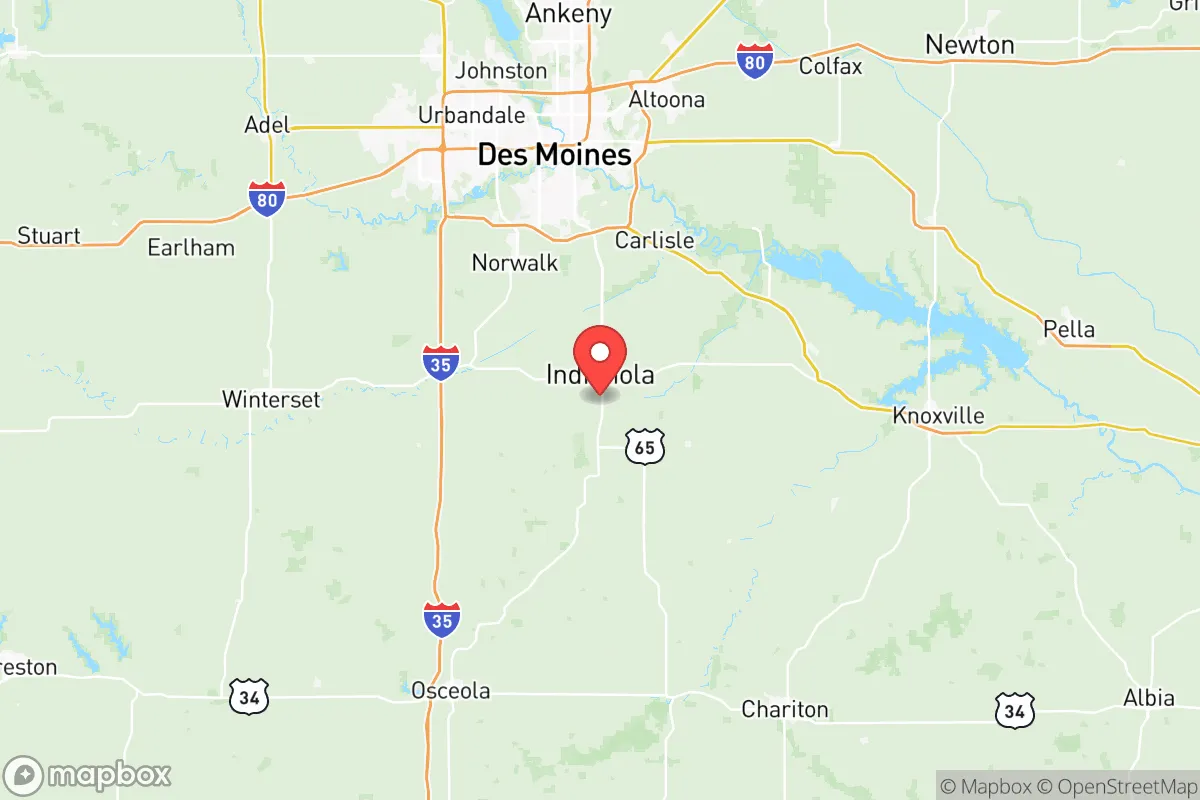
Photo: Wikipedia
Political ClimatePolitical Climate in Warren County
Showing district-level results — no local-only data available.
Local Political AnalysisPolitical Analysis of Warren County
Warren County, Iowa, has long been a reliably conservative area, but like much of the state, it’s been shifting in ways that are worth watching closely. The Cook PVI sits at R+4, which is slightly less red than the state’s overall R+6, but that number masks a lot of internal tension. If you’re looking at the political landscape here, you’re really looking at a battle between the old-school, limited-government values that built this place and the creeping influence of Des Moines’ progressive politics bleeding south down Highway 5/65.
How it compares
Compared to the rest of Iowa, Warren County is a little more of a swing county than you’d expect. The state as a whole is R+6, but Warren’s R+4 means it’s a few points more competitive. That’s largely because of the northern end of the county. Indianola, the county seat and home to Simpson College, is the real battleground. The precincts around the college and the downtown core have been trending blue in recent cycles, with some precincts flipping to Democratic candidates in 2020 and 2022. Meanwhile, the rural towns like Norwalk, Cumming, and Milo are solidly red, with precincts routinely going 65-70% for Republican candidates. The swing precincts are actually in the unincorporated areas between Indianola and Norwalk, where new subdivisions are popping up with families moving out of Des Moines. Those folks often bring their big-government habits with them, and that’s where you see the closest races. It’s a classic story: the old farm families and small business owners who value personal liberty and low taxes are being outnumbered by newcomers who think the government should have a say in everything from your property line to your kids’ school curriculum.
What this means for residents
For those of us who’ve been here a while, the biggest concern is the slow erosion of local control. The county supervisors are still conservative, but the school boards in Indianola and Norwalk have seen some real fights over things like mask mandates and curriculum transparency. In 2021, the Indianola School Board had a contentious vote on a mask mandate that split the community right down the middle, with the rural precincts overwhelmingly against it and the in-town precincts pushing for it. That’s the kind of government overreach that gets people’s backs up around here. The county’s tax base is still strong, thanks to the growing logistics and manufacturing hubs near the interstate, but property taxes have been creeping up as the county tries to keep pace with the new development. If you value your Second Amendment rights and want to keep the government out of your healthcare decisions, Warren County is still a decent place to be, but you have to stay engaged. The local elections matter more here than the national ones, because that’s where the real fights over your freedoms happen.
Culturally, Warren County is still a place where people wave at each other on the back roads and the 4th of July parade in Indianola is a big deal. But the policy distinctions are sharpening. You won’t find any sanctuary city nonsense here, and the county has pushed back hard on state-level attempts to centralize land-use planning, which is a good sign for property rights. The biggest worry for the next decade is that the Des Moines metro keeps expanding south, bringing with it the same kind of progressive politics that have turned Polk County into a one-party machine. If you’re looking to move here, just know that the farther south you go, the more you’ll find the old Iowa values intact. Stick to the small towns and keep an eye on those school board meetings.

State Political ClimatePolitical Climate in Iowa
State Political AnalysisPolitical Environment in the State
Iowa has been a reliably Republican state for over a decade, carrying a Cook PVI of R+6, but it wasn’t always this way. The state voted for Barack Obama in 2008 and 2012, then flipped hard for Donald Trump in 2016 and 2020, with Trump winning by 8.2 points in 2020. Over the last 10-20 years, the shift has been driven by a combination of rural voters consolidating behind the GOP and suburban voters in places like Des Moines’ western suburbs moving right, while the core of Des Moines and Iowa City have become Democratic strongholds. The result is a state that is now solidly red at the statewide level, but with a few blue islands that make it more competitive than its PVI suggests.
Urban vs. rural divide
The political map of Iowa is a classic tale of two landscapes. The rural counties in the northwest and southwest—places like Sioux County (home to Orange City) and Plymouth County (Le Mars)—are deep red, often voting 70-80% Republican. These areas are driven by agriculture, evangelical Christianity, and a strong distrust of federal overreach. On the flip side, the urban cores of Des Moines (Polk County) and Iowa City (Johnson County) are reliably blue, with Johnson County voting for Biden by 30 points in 2020. The real battleground has been the suburbs of Des Moines, particularly Ankeny, Waukee, and West Des Moines. These areas were once swing territory but have trended right over the last decade, driven by families fleeing the progressive policies of the city and seeking lower taxes and school choice. The result is a state where the GOP can win statewide without carrying a single major city, as long as they run up the margins in the rural and suburban rings.
Policy environment
Iowa’s policy environment is a conservative’s dream, especially compared to neighboring states like Illinois or Minnesota. The state has a flat income tax rate of 3.8% (down from 8.98% in 2022) and is on a path to a flat 3.5% by 2027, thanks to the 2022 tax reform signed by Governor Kim Reynolds. There is no inheritance tax, and property taxes are relatively low, with the median effective rate around 1.5%. On education, Iowa has a robust school choice program: the Students First Act (2023) created Education Savings Accounts (ESAs) worth roughly $7,600 per student, usable at private or religious schools. This has been a game-changer for parents in rural areas who previously had no options. Healthcare is a mixed bag—the state expanded Medicaid under the Affordable Care Act, but Governor Reynolds has pushed for work requirements and privatization of the system. Election laws tightened in 2021 with Senate File 413, which reduced early voting days, required polls to close at 8 p.m., and banned ballot drop boxes except at county auditor offices. This was sold as election integrity, but critics call it voter suppression. For a conservative, the policy environment is a clear win: lower taxes, school choice, and secure elections.
Trajectory & freedom
Iowa is becoming more free in several key areas, but there are warning signs. On gun rights, Iowa became a permitless carry state in 2021 with House File 756, allowing any law-abiding adult to carry a concealed firearm without a permit. This was a major expansion of Second Amendment rights. On parental rights, the state passed a law in 2023 banning instruction on sexual orientation and gender identity in K-6 classrooms (Senate File 496), and requiring schools to notify parents if a child requests a name or pronoun change. This is a win for parents who want to control what their kids are taught. However, there are creeping concerns. The state’s medical marijuana program is weak—only low-THC oil is allowed, and there’s no recreational cannabis. Property rights have been under pressure from wind and solar projects, with the state allowing companies to use eminent domain for carbon capture pipelines, which has sparked fierce opposition from farmers in counties like Story and Hardin. The biggest freedom concern is the state’s reliance on federal farm subsidies and the ethanol mandate, which ties Iowa’s economy to federal policy. Overall, the trajectory is positive for personal liberty, but the pipeline fight shows that government overreach can come from any direction.
Civil unrest & political movements
Iowa has seen its share of political flashpoints, but nothing like the riots in Portland or Minneapolis. The most visible unrest came in 2020, when Black Lives Matter protests in Des Moines and Iowa City turned into clashes with police, including the toppling of a statue of a Civil War soldier on the Capitol grounds. Since then, the left has organized around abortion rights and LGBTQ issues, with groups like Planned Parenthood Advocates of Iowa and One Iowa pushing back against the state’s conservative laws. On the right, the most active movement is the anti-carbon-capture pipeline coalition, which has held massive rallies in towns like Mason City and Fort Dodge. This is a rare issue that unites farmers, environmentalists, and libertarians against corporate overreach. Immigration politics are relatively quiet—Iowa has a small but growing immigrant population, mostly in meatpacking towns like Storm Lake and Postville, but the state has not adopted sanctuary policies. Election integrity remains a hot topic, with Trump’s 2020 loss in Iowa (he won it) being uncontroversial, but the 2021 voting law has been challenged in court. A new resident would notice the pipeline signs in rural yards and the occasional protest at the Capitol, but overall, the state is politically stable.
Projection
Over the next 5-10 years, Iowa is likely to stay red, but the margin may shrink. The state is seeing slow in-migration from blue states like Illinois and California, but these newcomers tend to settle in the Des Moines suburbs and are often fiscally conservative but socially moderate. The rural population is aging and shrinking, which could weaken the GOP’s base. However, the state’s tax cuts and school choice policies are a powerful draw for families, and the GOP’s grip on the legislature is strong—Republicans have a supermajority in both chambers as of 2025. The wild card is the carbon capture pipeline fight: if the state continues to allow eminent domain for private projects, it could fracture the GOP coalition between libertarian-leaning farmers and pro-business Republicans. A new resident moving in now should expect a state that remains conservative on taxes, guns, and education, but with growing tensions over land use and corporate power. The blue cities will get bluer, but the red countryside will hold.
For a conservative family or individual, Iowa offers a solid bet: low taxes, school choice, and a government that respects the Second Amendment and parental rights. The downsides are the pipeline fight and the state’s reliance on federal farm policy, but these are manageable. If you’re looking for a place where your vote counts and your values are reflected in the law, Iowa is a strong choice. Just avoid the college towns if you want to skip the protests.
* Values derived from national, state, county, city and local statistics and may differ in a specific area. Last updated: 2026-05-16T20:23:55.000Z
Narrative content on this page is AI-generated and may contain mistakes. Verify any details that matter before acting on them.
ReloMaps may earn a commission from affiliate links at no extra cost to you.

