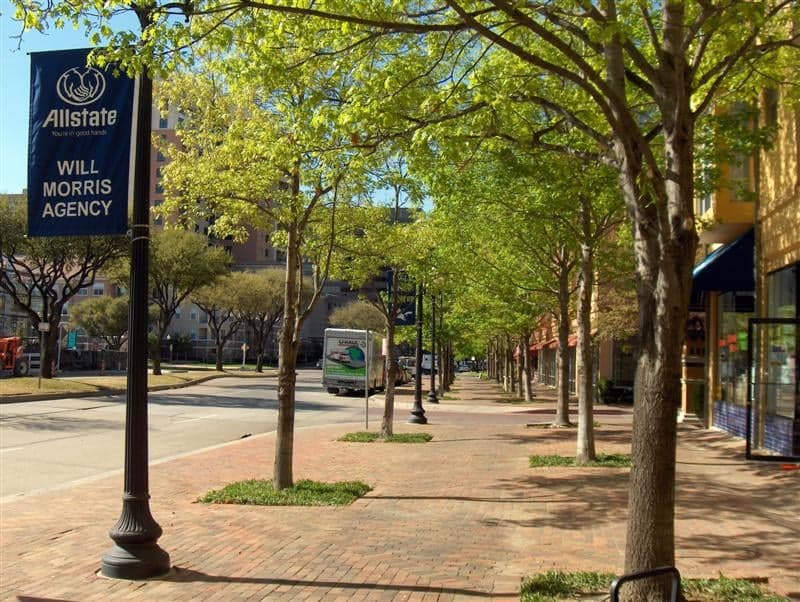
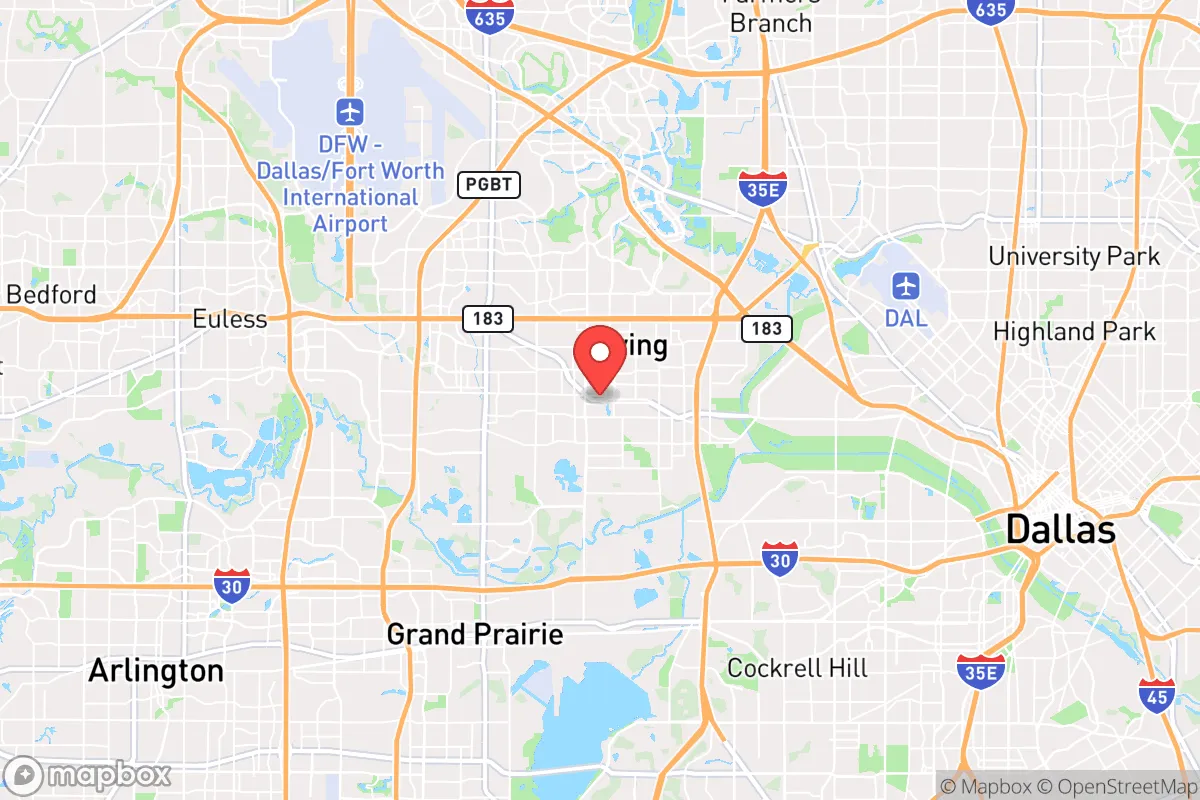
Photo: Wikipedia
Demographics of Irving, TX
Affluence Level in Irving, TX
A middle-class area roughly in line with national averages across income, home values, education, and employment.
People of Irving, TX
The people of Irving, Texas today form a dense, majority-minority population of 255,036, characterized by a distinctive three-way demographic balance: 43.0% Hispanic, 19.2% Indian (subcontinent), and 18.6% White, with 12.7% Black and 3.3% East/Southeast Asian communities. The city is one of the most foreign-born in the Dallas-Fort Worth metroplex at 29.3%, and its 41.6% college-educated rate reflects a population heavily shaped by corporate relocation and professional migration. Irving’s identity is neither a typical Sun Belt suburb nor an inner-ring urban neighborhood, but a high-density, transit-oriented employment hub where immigrant entrepreneurs and white-collar professionals coexist in distinct, self-reinforcing enclaves.
How the city was settled and grew
Irving was founded in 1903 as a railroad stop on the Chicago, Rock Island and Pacific line, named after the poet Washington Irving. The original population was overwhelmingly White and rural, drawn by cotton farming and later by the establishment of the Dallas Naval Air Station in 1941. The first residential clusters formed around the original downtown grid, now called Heritage District, where early 20th-century bungalows and storefronts still stand. A second wave arrived during the post-World War II boom, when returning veterans and defense workers settled in Plymouth Park, a mid-century subdivision of ranch-style homes built for the growing aerospace and manufacturing workforce. By 1960, Irving’s population had reached roughly 45,000, still nearly all White, and the city was a classic outer-ring suburb of Dallas.
Modern era (post-1965)
The 1965 Hart-Celler Act reshaped Irving’s population more dramatically than almost any other Texas city. The catalyst was the 1970s relocation of major corporate headquarters to the Las Colinas development, a master-planned business district within Irving. Las Colinas itself became a magnet for Indian (subcontinent) professionals in technology, engineering, and medicine, who arrived in large numbers from the 1980s onward. Today, the Indian-subcontinent population of 19.2% is heavily concentrated in Las Colinas and the adjacent Valley Ranch neighborhoods, where high-density apartments and townhomes near the DART light-rail stations serve a commuter-oriented, college-educated workforce. Simultaneously, Hispanic migration—both domestic and foreign-born—accelerated through the 1990s and 2000s, settling primarily in the older, more affordable housing stock of North Irving and the Belt Line Road corridor. The Hispanic share rose from roughly 15% in 1990 to 43.0% today, making Irving a majority-Hispanic city by 2010. Black residents, at 12.7%, are dispersed but have a visible presence in South Irving near the University of Dallas and along the State Highway 183 corridor. East/Southeast Asian communities (3.3%) are smaller and more scattered, with a modest cluster near the Irving Mall area.
The future
Irving’s demographic trajectory points toward continued diversification and spatial sorting, not homogenization. The Indian-subcontinent population is likely to grow further, driven by ongoing H-1B visa recruitment and the expansion of Las Colinas as a corporate hub for companies like ExxonMobil, Verizon, and McKesson. This group is highly educated and economically upwardly mobile, reinforcing the affluence of the Las Colinas and Valley Ranch enclaves. The Hispanic population, by contrast, is plateauing—natural increase continues, but new immigration has slowed since 2017—and is gradually assimilating into the broader metroplex economy. The White population, now just 18.6%, is aging and declining in absolute numbers, as younger White families continue to move to farther-ring suburbs like Frisco and Prosper. The Black population is stable but not growing rapidly. Over the next 10-20 years, Irving will likely become more polarized by income and ethnicity: Las Colinas will become denser and more Indian-majority, while North Irving and South Irving will remain predominantly Hispanic and Black, respectively. The city is not tribalizing into conflict, but it is sorting into distinct, self-selecting neighborhoods that rarely mix socially.
For a conservative-leaning individual or family moving to Irving today, the city offers a pragmatic, high-opportunity environment with strong schools in the Las Colinas area and a robust tax base from corporate headquarters. However, the city’s identity is fragmented—there is no single “Irving culture” but rather a collection of parallel communities. New arrivals should expect to find their niche quickly, whether in the professional Indian enclaves of Las Colinas, the established Hispanic neighborhoods of North Irving, or the older White and Black communities of South Irving. The city is becoming more diverse, more educated, and more economically stratified, but it remains a stable, family-oriented suburb with a clear trajectory toward becoming a majority-immigrant, majority-college-educated hub within the DFW metroplex.

* Values derived from national, state, county, city and local statistics and may differ in a specific area. Last updated: 2026-04-15T15:28:44.000Z
Narrative content on this page is AI-generated and may contain mistakes. Verify any details that matter before acting on them.
ReloMaps may earn a commission from affiliate links at no extra cost to you.

