Photo: Wikipedia
Political ClimatePolitical Climate in Irving, TX
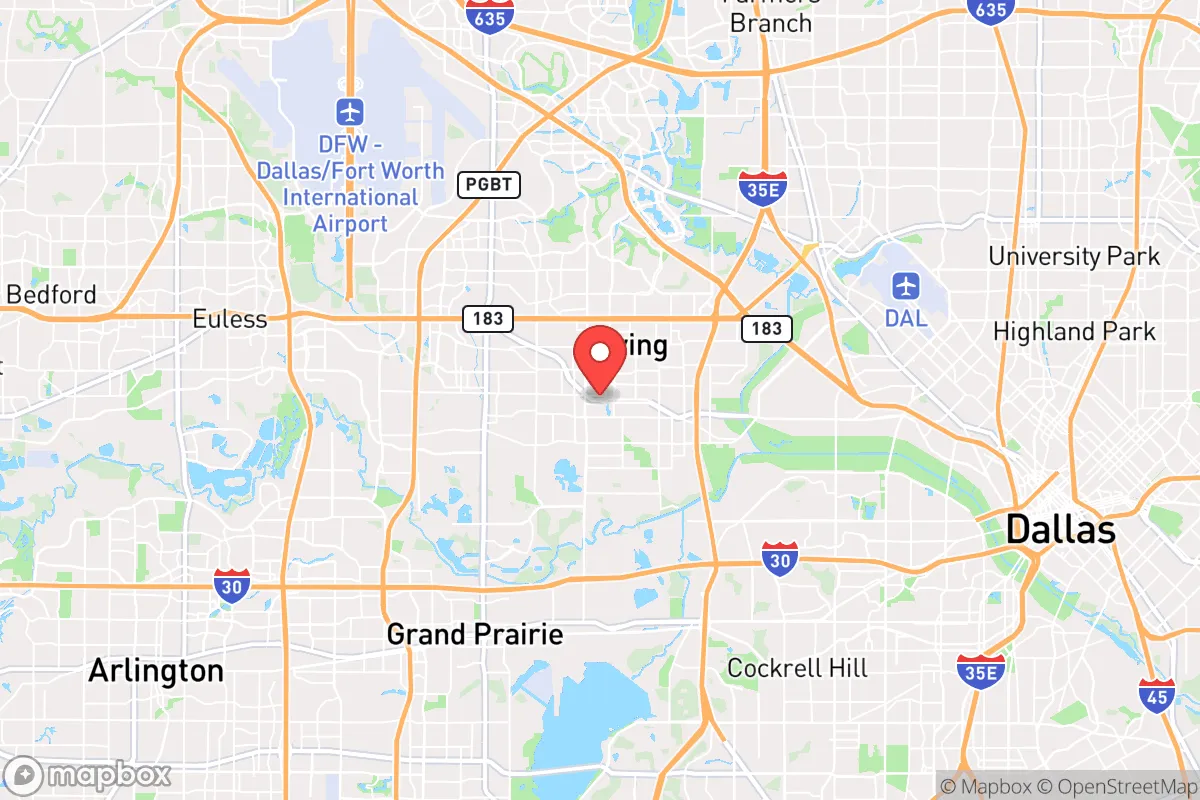
District shown is the primary district for this city’s centroid. Cities may span multiple districts.
Local Political AnalysisPolitical Analysis of Irving, TX
Irving, Texas, has a Cook PVI of D+19, meaning it leans heavily Democratic compared to the national average, and that shift has been pretty dramatic over the last decade. I remember when this area was a solid mix of conservative-leaning independents and moderate Democrats, but the political climate now feels more progressive, especially in city council races and local policy debates. The trajectory is clearly toward a more left-leaning agenda, which raises some real concerns about government overreach into personal freedoms and local autonomy.
How it compares
If you drive just a few miles north to Coppell or west to Southlake, you’ll find a completely different political vibe—those areas lean Republican, with more emphasis on limited government and individual rights. Irving stands out as a progressive island in the middle of the Dallas-Fort Worth metroplex, especially when you compare it to nearby cities like Grapevine or Flower Mound, which still hold onto more traditional values. Even within Dallas County, Irving is more liberal than suburbs like Cedar Hill or DeSoto, but it’s not as far left as Dallas proper. That D+19 rating puts it in the same league as some of the bluer parts of the county, and you can feel it in everything from zoning decisions to how the police department is funded.
What this means for residents
For folks who value personal freedoms—like the right to keep and bear arms, or the ability to make choices about healthcare without government interference—Irving’s political direction can feel like a slow squeeze. The city has embraced more progressive policies on housing and land use, and there’s been a push for higher density developments that some residents worry will erode neighborhood character and property rights. Taxpayer money is increasingly directed toward social programs and diversity initiatives, which sounds good on paper but often means less accountability and more bureaucracy. The school board has also seen a shift, with more emphasis on equity agendas over academic excellence, which is a red flag for parents who want their kids to learn critical thinking without ideological pressure.
Long-term, I see Irving continuing to drift left, especially as younger, more progressive voters move in and older conservative residents either pass away or relocate to places like Fort Worth or the exurbs. The city’s leadership seems comfortable with this trajectory, and there’s little appetite for pushing back against state-level conservative policies. That creates a tension—Irving is a blue dot in a red state, and residents often find themselves caught between local ordinances that feel overreaching and state laws that protect some freedoms. It’s not a bad place to live, but you have to keep an eye on what the city council is doing, because they’re not shy about expanding their reach into areas that used to be left to families and individuals.
One cultural distinction worth noting is Irving’s strong immigrant and refugee communities, which have shaped its political leanings. While diversity can be a strength, it’s also been used to justify policies that prioritize group rights over individual liberties. The city has also been a testing ground for “smart city” initiatives and surveillance programs, which should make anyone wary of creeping government control. If you’re looking for a place where the government stays out of your business and lets you live your life, Irving might not be the best fit anymore. But if you’re okay with a more active, progressive local government and can navigate the occasional overreach, it’s still a vibrant, affordable part of the metroplex.

State Political ClimatePolitical Climate in Texas
State Political AnalysisPolitical Environment in the State
Texas has been a reliably Republican state for decades, but the political climate is far from monolithic. The dominant coalition is a mix of rural conservatives, suburban moderates, and a growing number of libertarian-leaning transplants, but the state is also seeing a slow, steady shift toward competitiveness driven by explosive growth in its major metros. Over the last 10-20 years, the GOP’s grip has tightened in rural areas and loosened in the suburbs, creating a fascinating tension that any new resident should understand before picking a place to land.
Urban vs. rural divide
The political map of Texas is a study in contrasts. The big blue dots are Austin (Travis County) and El Paso (El Paso County), which vote reliably Democratic by 30-40 points. Houston (Harris County) flipped blue in 2018 and has stayed there, while Dallas (Dallas County) and San Antonio (Bexar County) are now solidly Democratic. The real story is the suburbs: Collin County (north of Dallas) and Fort Bend County (southwest of Houston) were once GOP strongholds but have shifted purple, with Collin County voting +5 R in 2024 after being +20 R a decade ago. Meanwhile, rural West Texas and the Panhandle—places like Lubbock, Amarillo, and Abilene—remain deeply red, often voting +40 to +60 R. The divide isn’t just about cities vs. farms; it’s about the explosive growth of the I-35 corridor and the Houston-Dallas-Fort Worth triangle, where new arrivals from California and the Northeast are reshaping the electorate.
Policy environment
Texas’s policy environment is a mixed bag for conservatives. On the plus side, there’s no state income tax, property taxes are high but capped at 10% annual growth (Proposition 4, 2023), and the regulatory posture is famously business-friendly. The state has a constitutional carry law (permitless carry, 2021), a near-total ban on abortion (trigger law effective 2022), and a Parents’ Bill of Rights (HB 900, 2023) that requires school libraries to restrict “sexually explicit” materials. On the education front, the state has expanded school choice through Education Savings Accounts (SB 1, 2023) and banned Critical Race Theory in public schools (HB 3979, 2021). However, the state also has a high property tax burden (effective rate around 1.6% of home value), and the grid is notoriously unreliable (ERCOT). Healthcare is a sore spot: Texas has the highest uninsured rate in the nation (18%), and the state has refused to expand Medicaid. Election laws have tightened: SB 1 (2021) added ID requirements for mail-in ballots, limited drive-through voting, and banned 24-hour polling places. For a conservative, the policy environment is largely favorable, but the property tax and grid issues are real pain points.
Trajectory & freedom
On balance, Texas has been moving toward more personal freedom in several key areas over the last five years, but there are concerning countercurrents. The 2021 permitless carry law expanded gun rights significantly. The 2023 ban on gender-transition procedures for minors (SB 14) and the 2023 law requiring school athletes to compete by biological sex (HB 25) were major wins for parental rights and bodily autonomy. The state also passed a law in 2023 prohibiting COVID-19 vaccine mandates by private employers (HB 4777). However, the government hasn’t exactly been small: the state has aggressively used its power to prosecute election fraud (Operation Lone Star), and the 2021 abortion ban includes civil enforcement by private citizens, which some see as a novel form of government overreach. The biggest freedom concern is property rights: the state’s use of eminent domain for the Southern border wall and for private toll roads has raised eyebrows. Overall, Texas is freer than California or New York on most metrics, but the trend is toward more state intervention in social issues, not less.
Civil unrest & political movements
Texas has seen its share of political flashpoints. The 2020 Black Lives Matter protests in Austin and Houston were large and occasionally violent, leading to property damage and a lasting police reform debate. The 2021 “People’s Budget” movement in Austin tried to defund the police but failed. On the right, the “Take Our Border Back” convoy in 2024 drew thousands to Eagle Pass and El Paso, protesting federal immigration policy. Immigration is the hottest button: Governor Abbott’s Operation Lone Star has bused over 100,000 migrants to sanctuary cities, and the state’s 2023 law (SB 4) making illegal entry a state crime is currently tied up in court. Secession rhetoric is mostly fringe, but the Texas Nationalist Movement has a small but vocal following. Election integrity remains a flashpoint: the 2020 and 2022 cycles saw multiple lawsuits over Harris County’s voting procedures, and the 2021 SB 1 was a direct response to those concerns. A new resident will notice the political tension most in the suburbs of Dallas and Houston, where yard signs and bumper stickers are more polarized than in rural areas.
Projection
Over the next 5-10 years, Texas is likely to become more competitive at the statewide level, but not necessarily more liberal. The in-migration from blue states is real—over 1 million people moved to Texas between 2020 and 2024—but many of them are conservatives fleeing high taxes and crime. The suburbs of Fort Worth and San Antonio are growing fastest, and they tend to lean center-right. The Democratic gains in Harris and Collin counties may be offset by continued Republican dominance in the exurbs and rural areas. The biggest wildcard is the Hispanic vote: Texas’s Hispanic population is growing, but it’s not monolithic—South Texas counties like Starr and Zapata have been trending right. Expect the state to remain under Republican control for the next decade, but with narrower margins. The policy environment will likely stay conservative on social issues, but property tax reform and grid reliability will become bigger priorities. A new resident moving in now should expect a state that is politically stable but increasingly contested, with a culture that values freedom but is not afraid to use government power to enforce it.
Bottom line for a new resident: If you’re a conservative looking for a state that respects gun rights, parental authority, and low taxes, Texas is still a strong bet. But don’t expect a libertarian paradise—the state government is active and interventionist on social issues, property taxes are high, and the political climate is more polarized than the “Texas is just Texas” stereotype suggests. Pick your city carefully: Lubbock or Amarillo for deep red stability, Fort Worth or San Antonio suburbs for a balanced mix, and avoid Austin or El Paso if you want to stay out of blue territory. The state is changing fast, but for now, it’s still one of the best places in the country for a conservative to build a life.
* Values derived from national, state, county, city and local statistics and may differ in a specific area. Last updated: 2026-04-15T15:28:44.000Z
Narrative content on this page is AI-generated and may contain mistakes. Verify any details that matter before acting on them.
ReloMaps may earn a commission from affiliate links at no extra cost to you.

