
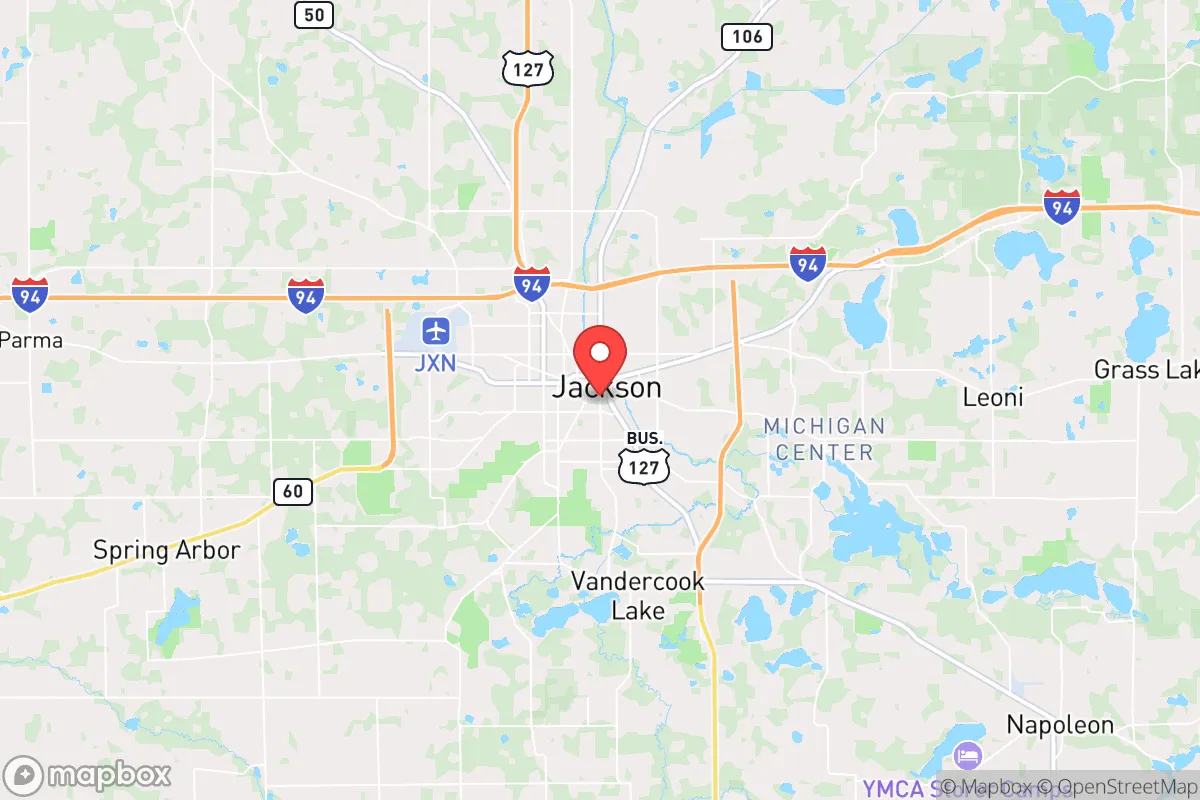
Photo: Wikipedia
Personal Sovereignty in Jackson, MI
Strong independent fundamentals that actively favor personal liberty and low regulation.
What does Personal Sovereignty tell us?
Personal Sovereignty measures your capacity for self-reliance and independence with minimal government friction. Higher scores mean fewer barriers between you and the way you want to live... but it assumes you have the space you need and good neighbors.
What does this tell us?
Personal Sovereignty measures your capacity for self-reliance and independence with minimal government friction. Higher scores mean fewer barriers between you and the way you want to live... but it assumes you have the space you need and good neighbors.
State Policy
Energy independence: Importer (20% of energy produced in-state)
Personal Liberty
Homesteading

Personal Liberty Analysis
Jackson, Michigan, offers a mixed bag for those prioritizing personal sovereignty, with the state's overall regulatory climate creating significant headwinds that must be weighed against local opportunities for self-reliance. While Michigan is not a top-tier freedom state, Jackson County's lower cost of land and relatively hands-off local enforcement in rural pockets provide a viable, if imperfect, base for those seeking to minimize government entanglement. The key is understanding where the state's thumb presses hardest and where local conditions allow you to operate with greater autonomy.
Tax burden and regulatory posture in Jackson County
Michigan's tax structure is a notable drag on personal sovereignty. The state levies a flat 4.25% income tax on all earned income, and while there is no state-level sales tax on groceries or prescription drugs, the general sales tax sits at 6%. Property taxes are the real concern: Jackson County's average effective property tax rate hovers around 1.5% of assessed value, which is above the national average. This means a $200,000 home carries an annual tax bill of roughly $3,000, a recurring cost that funds state and local programs you may not support. The regulatory posture is similarly burdensome. Michigan is a "home rule" state, meaning cities and townships can enact their own zoning and business ordinances, often adding layers of permitting and fees. For a prepper or homesteader, this translates to navigating local building codes, well and septic regulations, and sometimes restrictive land-use rules that limit what you can do with your property. The state's Department of Environment, Great Lakes, and Energy (EGLE) also enforces strict environmental regulations on everything from wetland use to wood-burning stoves, which can feel like overreach when you're simply trying to manage your own land.
Self-defense and gun law specifics in Michigan
On the positive side, Michigan is a "shall issue" state for concealed pistol licenses (CPL), meaning the county sheriff must issue a permit if you meet basic requirements—no subjective "good cause" hurdle. Jackson County's gun culture is robust, with several local ranges and a strong community of firearms owners. However, the state has moved in a restrictive direction in recent years. In 2023, Michigan passed universal background checks for all firearm purchases and a "safe storage" law that mandates firearms be locked up if a minor is present or if a resident is prohibited from possessing a gun. These laws are a clear infringement on the traditional understanding of the Second Amendment and create potential legal pitfalls for gun owners. Open carry is legal without a permit, but carrying a loaded firearm in a vehicle requires a CPL. For the survivalist, the key takeaway is that while you can still own and carry firearms, the legal landscape is shifting, and compliance requires vigilance. Stand-your-ground laws exist, but the burden of proof in a self-defense shooting can be heavy, and the state's attorney general has shown a willingness to prosecute aggressively.
Self-reliance and homesteading viability in Jackson County
This is where Jackson County shines relative to more urbanized parts of Michigan. Outside the city limits, you can find undeveloped lots starting around $5,000-$15,000 per acre, with many parcels zoned for agricultural or rural residential use. This opens the door for serious homesteading: raising livestock, growing substantial gardens, and installing off-grid systems. However, off-grid living is not straightforward. Michigan law requires a connection to the electrical grid for new construction in most townships, though some rural townships are more lenient. Solar panels are legal, but net metering rules are state-controlled and not particularly favorable for those wanting to disconnect entirely. Rainwater collection is legal for outdoor use, but using it as a primary water source for drinking requires a permit and testing. Septic systems must be approved by the county health department, which can be a costly and bureaucratic process. For the prepper, the best strategy is to buy land with an existing older home or structure that is "grandfathered" in under older, less restrictive codes, then upgrade it gradually. The local Amish and Mennonite communities in nearby Hillsdale and Lenawee counties demonstrate that a low-tech, self-sufficient lifestyle is possible, but it requires navigating the regulatory maze carefully.
Personal liberties: parental rights, medical autonomy, speech, and property
Michigan's record on personal liberties is concerning for those who value traditional autonomy. Parental rights have been under pressure: the state's 2023 "LGBTQ+ inclusive" curriculum standards mandate teaching sexual orientation and gender identity in public schools, with no opt-out provision for parents who object. This is a direct challenge to parental authority. Medical autonomy is similarly constrained. Michigan has no religious or philosophical exemption for childhood vaccine mandates in schools, and the state's emergency powers, while curtailed after COVID, remain broad. During the pandemic, Governor Gretchen Whitmer's unilateral orders shut down businesses and restricted movement, a pattern that could repeat. Free speech is protected under the First Amendment, but local "hate speech" ordinances in some cities create chilling effects. Property rights are the strongest pillar: Michigan has a robust "right to farm" act that protects agricultural operations from nuisance lawsuits, which is a boon for homesteaders. However, the state's use of eminent domain for "economic development" projects is a persistent threat, and property tax assessments can rise sharply after improvements, discouraging investment in self-reliance infrastructure.
In the broader landscape of personal sovereignty, Jackson, MI, occupies a middle tier. It is not a freehold like Idaho or Montana, where state-level preemption laws and minimal regulation create a more permissive environment. But it is also not a deep-blue coastal state where gun ownership is effectively banned and homeschooling is heavily restricted. The calculus for the survivalist or prepper is this: Jackson offers affordable land, a strong gun culture, and a community that values self-reliance, but you must be prepared to fight bureaucratic battles over zoning, taxes, and school curriculum. The state government in Lansing is actively hostile to many forms of personal autonomy, and local officials can be either allies or obstacles depending on the township. If you are willing to invest time in understanding local ordinances and building relationships with county commissioners and township boards, Jackson County can be a workable base for a sovereign lifestyle. If you want a place where the government simply stays out of your way, you will need to look further west.

* Values derived from national, state, county, city and local statistics and may differ in a specific area. Last updated: 2026-04-30T23:46:54.000Z
Narrative content on this page is AI-generated and may contain mistakes. Verify any details that matter before acting on them.
ReloMaps may earn a commission from affiliate links at no extra cost to you.

