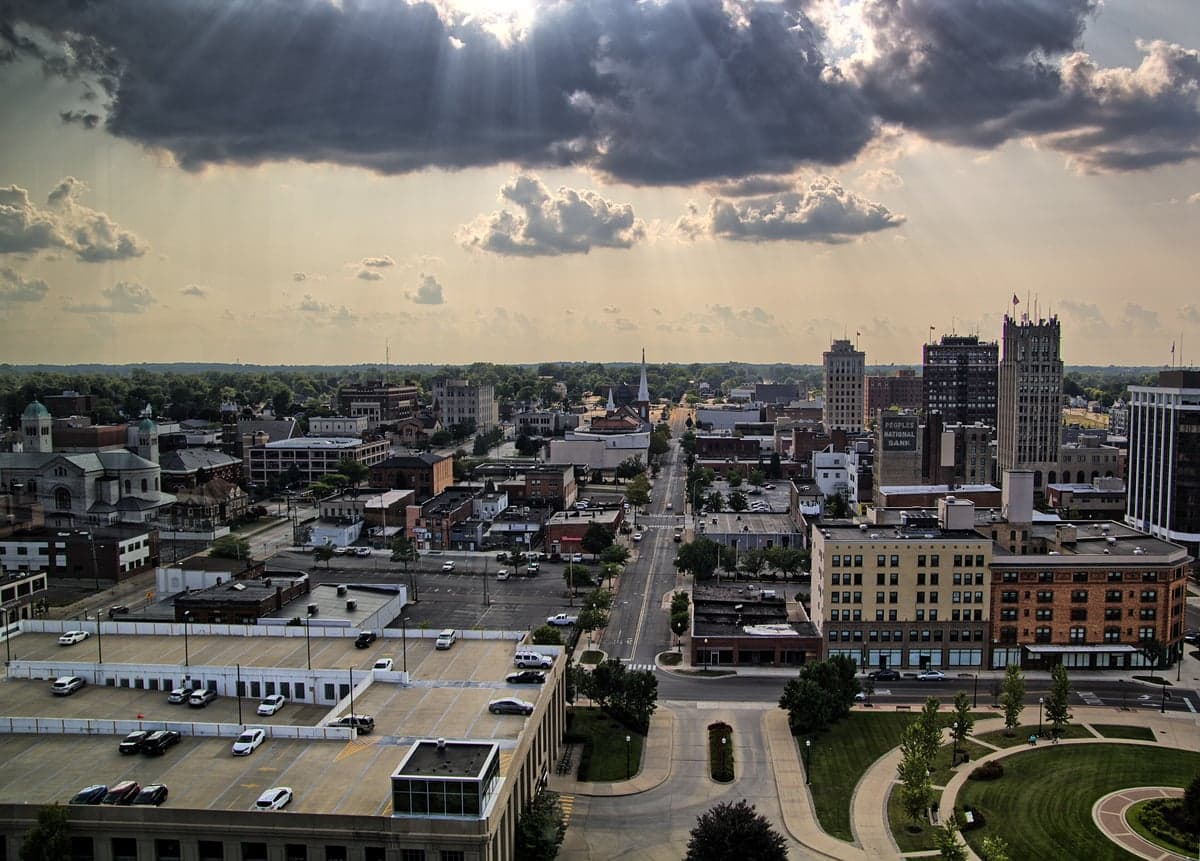
Photo: Wikipedia
Demographics of Jackson, MI
Affluence Level in Jackson, MI
A low-income area with significant economic hardship. Household wealth and educational attainment are well below national averages.
People of Jackson, MI
The people of Jackson, Michigan today form a predominantly native-born, working-to-middle-class community of 31,206 residents, shaped by a history of industrial migration and recent suburban contraction. The city is notably less diverse than the national average, with a foreign-born population of just 1.0% and a population that is 63.9% White, 20.7% Black, and 6.3% Hispanic. A distinctive marker of Jackson's identity is its low college attainment rate (15.3%), reflecting a workforce historically tied to manufacturing and trades rather than professional services, and a population that has remained remarkably stable in its core demographic character despite broader state-level shifts.
How the city was settled and grew
Jackson's original population was drawn by the promise of land and transportation. Founded in 1829 as "Jacksonburgh," the city was a planned stop on the Michigan Central Railroad, which arrived in 1841. The first major wave of settlers were Yankee Protestants from New York and New England, who established the town's civic and commercial core in what is now the Downtown Historic District, centered around the Jackson County Courthouse. These early residents built the city's first mills, foundries, and rail yards. A second, larger wave arrived between 1880 and 1920, driven by the rise of the automobile and heavy manufacturing. The Vandercook Lake area and the East Side neighborhoods (roughly east of East Avenue) were built by German, Polish, and Italian immigrants who found work at the Jackson Automobile Company, the Goodyear plant, and the extensive railroad shops. These ethnic enclaves were tight-knit, with distinct Catholic parishes and social clubs that persisted for generations. By 1950, Jackson's population peaked at over 51,000, a manufacturing boomtown where a high school diploma and a union card could secure a middle-class life.
Modern era (post-1965)
The post-1965 era brought two major demographic shifts: suburban flight and a modest influx of Black families from the rural South. The 1960s and 1970s saw the construction of Interstate 94, which accelerated the movement of White families to outlying townships like Summit and Blackman. This left Jackson's core neighborhoods—particularly the West Side (west of West Avenue) and the South Side (south of Michigan Avenue)—to absorb a growing Black population, which rose from roughly 8% in 1970 to its current 20.7%. These neighborhoods became predominantly Black and working-class, anchored by churches like the historic Second Baptist Church. Meanwhile, the city's small Hispanic population (6.3%) is concentrated in the North Side near the former Kelsey-Hayes plant, a legacy of later industrial recruitment. The East/Southeast Asian (0.4%) and Indian (0.1%) communities remain tiny and dispersed, with no distinct ethnic enclave. The foreign-born share has actually declined since 1990, as Jackson has not attracted the refugee or immigrant streams that have reshaped cities like Grand Rapids or Detroit. The dominant story of the modern era is not diversification but population loss and racial resegregation: the city has shed nearly 40% of its peak population, and the remaining White population has aged and concentrated in the Northwest Neighborhood (around the Jackson Country Club), while the Black population has become more geographically concentrated in the central and southern wards.
The future
Jackson's population trajectory points toward continued slow decline and demographic consolidation rather than diversification. The city's low college attainment and limited knowledge-economy jobs make it unlikely to attract significant international immigration; the foreign-born share is projected to remain below 2% for the foreseeable future. The Hispanic population is growing slowly (up from 4.5% in 2010), driven by natural increase and some in-migration from Southwest Michigan, but this growth is not reshaping the city's overall character. The Black population share is stable, with younger Black families moving to the South Side and East Side neighborhoods, while White families with children continue to exit to surrounding townships. The most likely scenario for 2035 is a Jackson that is slightly smaller (around 28,000-29,000), slightly more Hispanic (8-9%), and with a Black population that remains around 20-22%. The city will remain a predominantly native-born, working-class community, with a growing divide between the older, White, and more affluent Northwest Neighborhood and the younger, more diverse, and economically stressed central and southern wards.
For someone moving to Jackson now, the city offers a stable, low-cost, and culturally familiar environment for those who value a manufacturing-rooted, non-diverse community. The population is not homogenizing into a single melting pot but is instead tribalizing into distinct, geographically separate enclaves by race and class. New residents should expect a city where neighborhood choice strongly correlates with demographic identity, and where the broader trend is one of slow contraction rather than renewal.

* Values derived from national, state, county, city and local statistics and may differ in a specific area. Last updated: 2026-04-30T23:46:54.000Z
Narrative content on this page is AI-generated and may contain mistakes. Verify any details that matter before acting on them.
ReloMaps may earn a commission from affiliate links at no extra cost to you.

