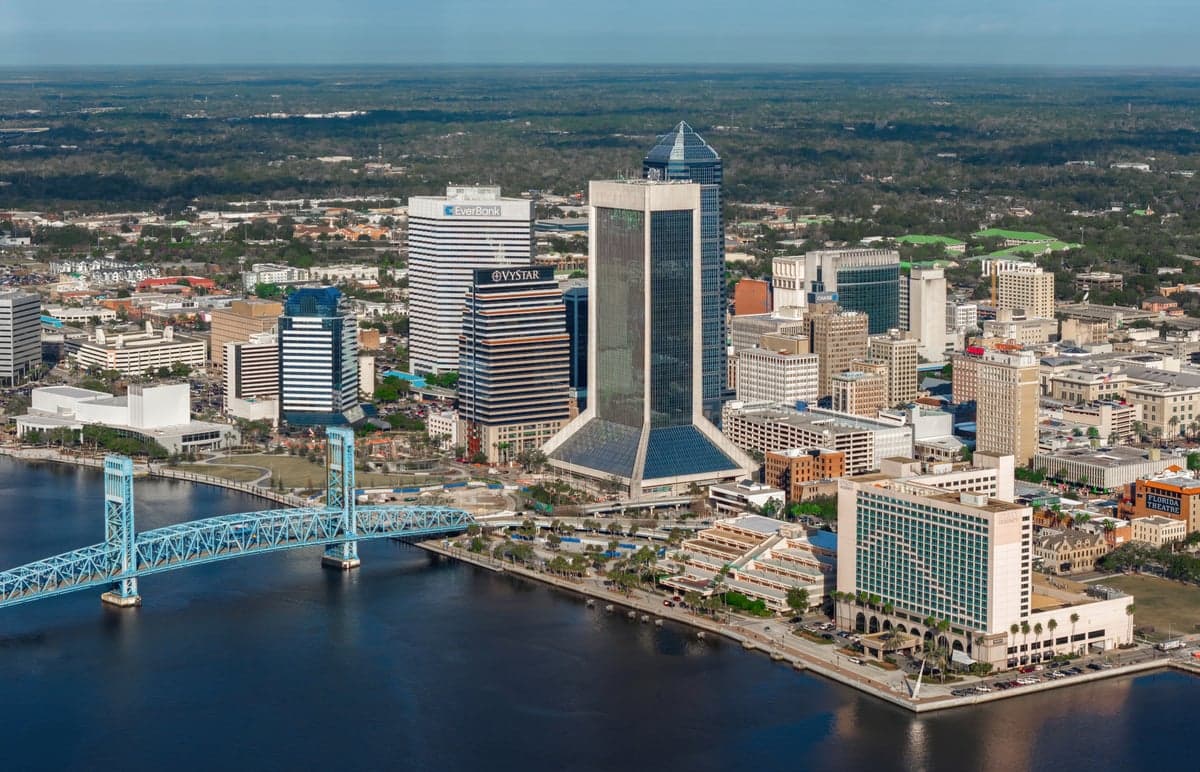
Photo: Wikipedia
Demographics of Jacksonville, FL
Affluence Level in Jacksonville, FL
A middle-class area roughly in line with national averages across income, home values, education, and employment.
People of Jacksonville, FL
The people of Jacksonville, Florida, in 2026 form a sprawling, majority-minority Southern city of nearly one million residents, defined by its stark racial geography and a lower foreign-born share (5.2%) than most large U.S. metros. The city is roughly 48% White, 30% Black, 12% Hispanic, and 5% East/Southeast Asian, with a separate Indian-subcontinent population of about 1.4%. Its identity is a blend of Deep South tradition, military and logistics industry roots, and a growing but still modest immigrant presence, creating a place where long-established Black and White communities coexist with newer Hispanic and Asian enclaves.
How the city was settled and grew
Jacksonville’s human history begins with the Timucua people, but the city’s modern population was forged by European settlement after 1821, when Florida became a U.S. territory. The city was founded in 1822 on the St. Johns River, and its early growth was driven by the timber and naval stores industries, attracting White settlers from Georgia and the Carolinas. After the Civil War, freed Black families established neighborhoods like LaVilla, which became a thriving hub of African American commerce and culture, and Durkeeville, a historically Black community built around the shipyards and railroads. The Great Migration brought tens of thousands of Black workers from the rural South between 1910 and 1960, settling in areas like Springfield and Grand Park. Meanwhile, White working-class and middle-class families moved into neighborhoods such as Riverside and Avondale, which grew with the city’s expansion as a railroad and banking center. By 1950, Jacksonville was a segregated Southern city of roughly 200,000, with a Black population of about 35% concentrated in the urban core.
Modern era (post-1965)
The 1965 Hart-Cellar Act had a limited immediate effect on Jacksonville compared to gateway cities, but it did open the door for small but steady immigrant flows. The city’s modern demographic shift is more a story of domestic migration and suburbanization. The 1968 consolidation of Jacksonville with Duval County created a massive geographic city, spurring White flight to newer suburbs like Mandarin and Southside, while Black populations remained concentrated in the Northside and urban core neighborhoods like New Town. Hispanic growth accelerated after 1990, driven by Puerto Rican and Mexican families moving for construction and service jobs, settling primarily in the Westside and Arlington areas. East/Southeast Asian communities, particularly Vietnamese and Filipino families, arrived in the 1980s and 1990s, often tied to the military presence at Naval Air Station Jacksonville and Mayport, and established clusters in the Southside near the beaches. The Indian-subcontinent population, smaller at 1.4%, grew after 2000, largely through professional migration in healthcare and IT, and is dispersed across the Southside and St. Johns County suburbs. The city’s foreign-born share remains low at 5.2%, but the Hispanic population has doubled since 2000, now at 12%, making it the fastest-growing demographic group.
The future
Jacksonville’s population is heading toward greater diversity, but the city is not homogenizing—it is tribalizing into distinct enclaves. The White share has declined from over 60% in 2000 to 47.7% today, while the Hispanic share continues to rise, projected to reach 15-18% by 2040. The Black population has remained stable at around 30%, but younger Black residents are increasingly moving to suburban areas like Northside and Westside, while older Black neighborhoods like Durkeeville and LaVilla are gentrifying. East/Southeast Asian communities are growing slowly, with the Vietnamese population aging and new Filipino arrivals tied to military rotations. The Indian-subcontinent community is small but growing through professional migration, though it remains a fraction of the size seen in tech hubs like Atlanta or Dallas. The city’s low foreign-born share means that assimilation is less of a dynamic than in immigrant-heavy metros; instead, the key trend is the suburbanization of all groups, with the urban core becoming whiter and wealthier. For a new resident, Jacksonville offers a place where racial and ethnic lines are still clearly drawn by neighborhood, but where the overall trajectory is toward a more Hispanic and Asian-influenced Southern city.
Jacksonville is becoming a more diverse but still deeply segregated Southern metropolis, where the old Black-White binary is slowly giving way to a tri-racial mix of White, Black, and Hispanic populations, with small but stable Asian and Indian communities. For someone moving in now, the city offers affordable housing and a strong job market in logistics, healthcare, and the military, but the social landscape remains fragmented by neighborhood and race, with little of the melting-pot dynamism seen in coastal gateway cities.

* Values derived from national, state, county, city and local statistics and may differ in a specific area. Last updated: 2026-04-15T23:45:06.000Z
Narrative content on this page is AI-generated and may contain mistakes. Verify any details that matter before acting on them.
ReloMaps may earn a commission from affiliate links at no extra cost to you.

