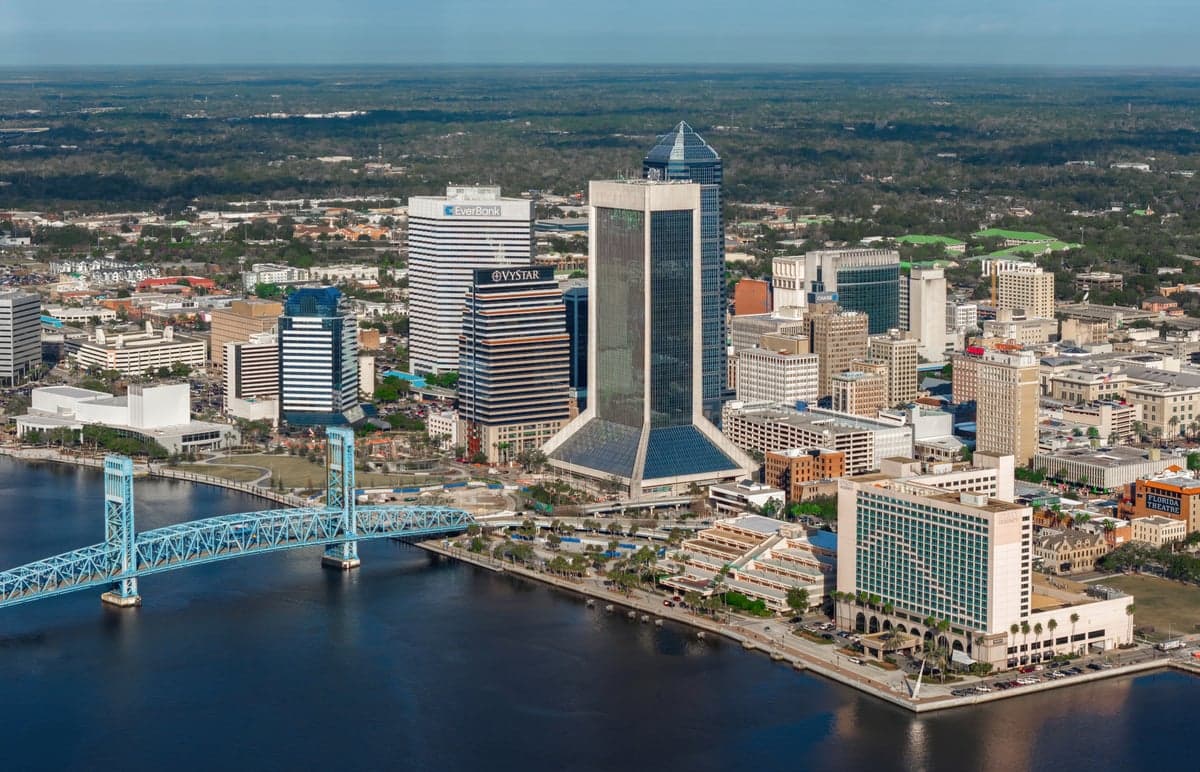
Photo: Wikipedia
Strategic Assessment of Jacksonville, FL
High tactical risk. This location is likely close to major population centers, strategic targets, or sits in a high-disaster corridor. A retreat property and careful exit planning is required.
What does the Strategic Assessment tell us?
Our Strategic Assessment grades tactical survivability of an area. Major population centers, military targets, fallout zones, natural disasters, and border exposure all drive risk — lower exposure means a more defensible position in a crisis.
This is heavily inspired by Joel Skousen's Strategic Relocation book. Highly recommended you checkout the book ($)What does this tell us?
Our Strategic Assessment grades tactical survivability of an area. Major population centers, military targets, fallout zones, natural disasters, and border exposure all drive risk — lower exposure means a more defensible position in a crisis.
This is heavily inspired by Joel Skousen's Strategic Relocation book. Highly recommended you checkout the book ($)Strategic Pillars

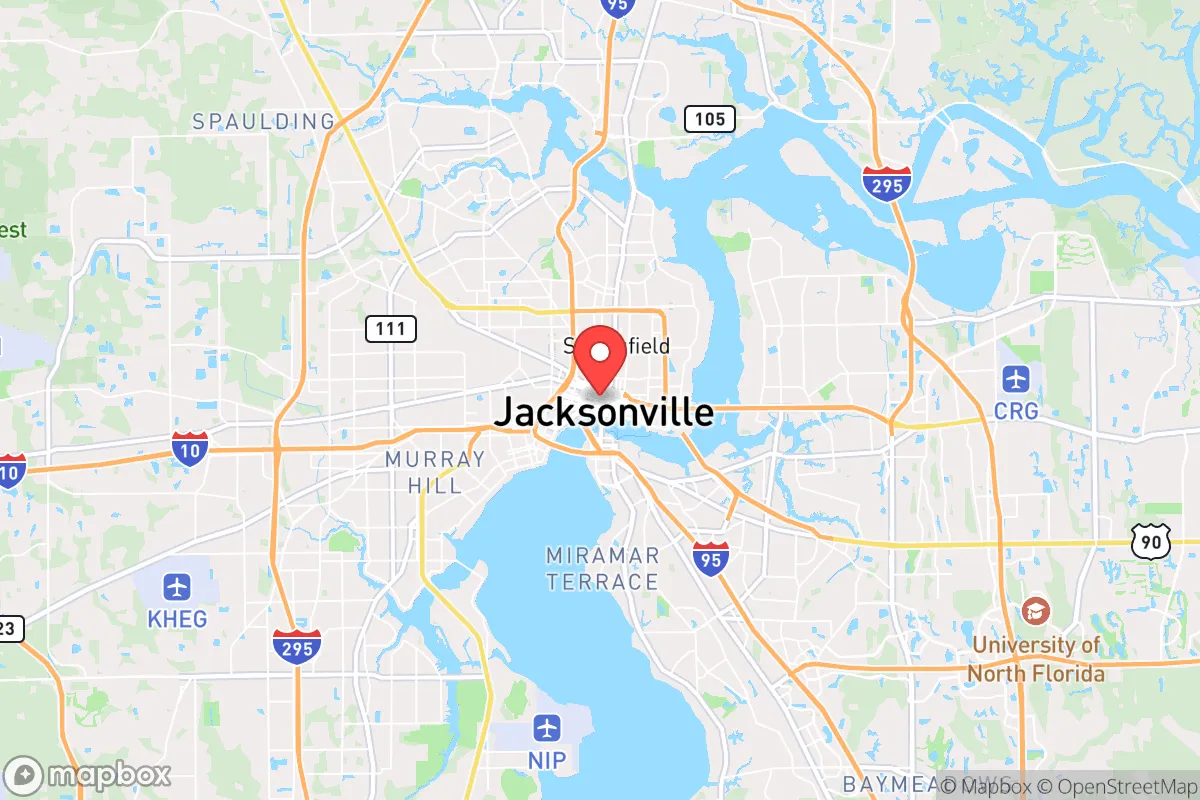
Key Distances
Regional Safe Places
Below is our recommended "safe zones" in Florida and the surrounding area based on our strategic heuristics. For most people, it's unrealistic to live in a “safe zone” full-time due to work, family or other personal reasons. They tend to be more rural. However, many of these areas are perfect for second homes and retreat properties that double as a vacation home or even a short-term rental.

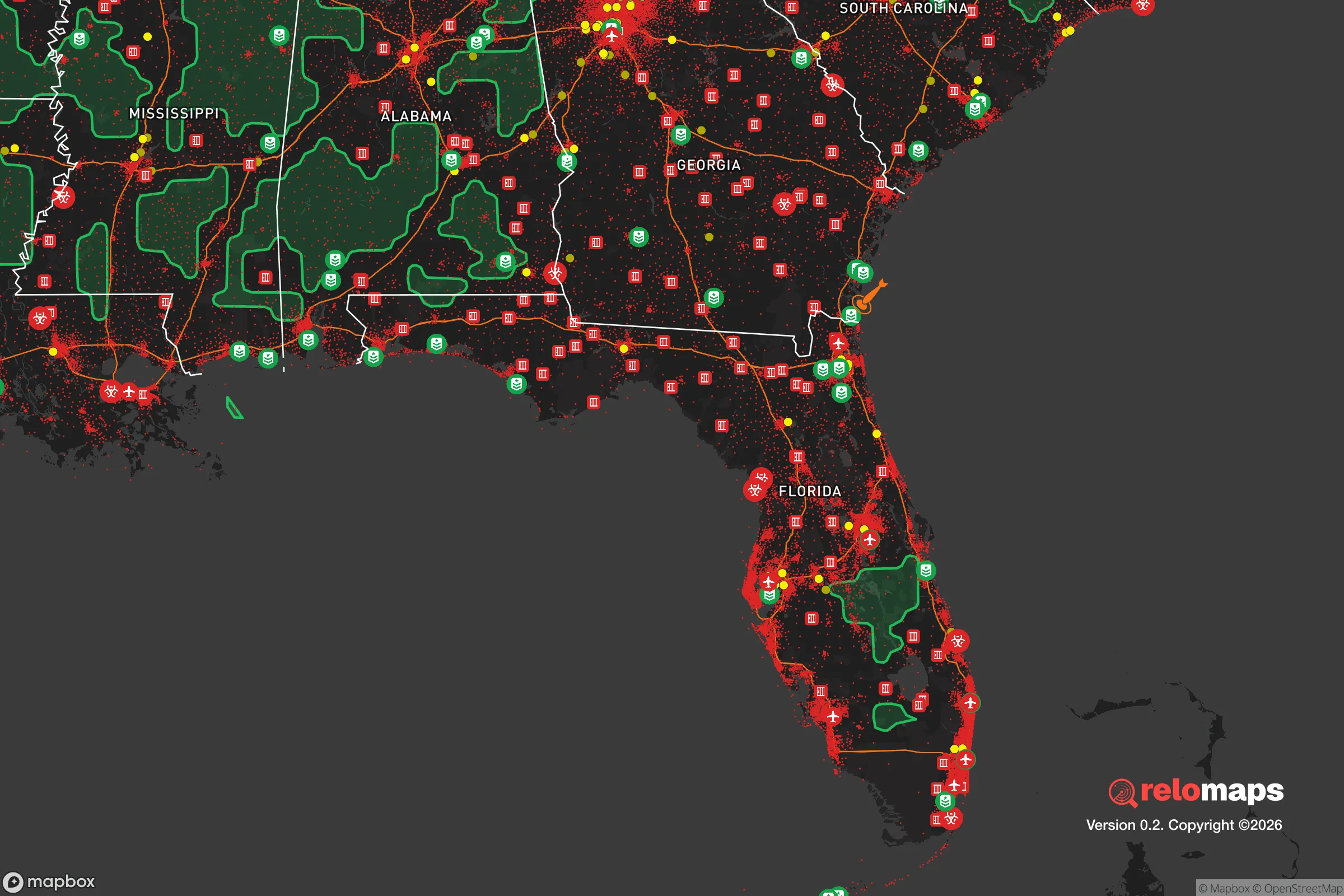


Important Note: For informational purposes only. This does not mean nothing bad ever happens in the green zones. Please use common sense. This is based on public data and modeled with AI. We tried to take a conservative approach but mistakes happen. We update this regularly as new information becomes available.
Solar Generator Recommendations
Backup power matters more here than in safer locations. We've picked three solar generators across budgets and capacity tiers — start with the budget unit if you only need a few essentials, or step up if you want to run a fridge and HVAC for days at a time.

Jackery Portable Power Station Explorer 300
Budget OptionPower on the Go: Weighing only 11 lbs, it's convenient to set up and store with book-sized foldable solar panels

BLUETTI Portable Power Station AC180
Designed for both indoor and outdoor scenarios, AC180 is highly capable as it has a robost capacity and continuous output power.

EF ECOFLOW DELTA Pro Ultra Power Station
Upgraded PickEcoFlow DELTA Pro Ultra is a whole-home energy system designed to grow with your family. Integrated with the Smart Home Panel 2, it scales to meet your evolving energy needs — keeping your home powered, intelligent, and secure through every stage of life.
We earn a commission, at no additional cost to you.
Strategic Assessment Analysis
Jacksonville, Florida, presents a mixed bag for the strategic relocator operating from a survivalist and conservative mindset. Its sheer geographic size—the largest city by land area in the contiguous United States—offers a unique buffer against the density-driven chaos of a collapse scenario, but its coastal position and proximity to major military and population centers introduce significant vulnerabilities. For the single individual or parent looking to weather civic unrest, mass casualty events, or a breakdown of national systems, Jacksonville is less a fortress and more a high-risk, high-reward staging ground that demands careful, pre-planned positioning.
Geographic position and natural advantages for long-term survival
Jacksonville’s primary strategic asset is its sprawling, low-density footprint. Unlike Miami or Atlanta, the city is a collection of distinct neighborhoods and undeveloped tracts, many of which are bordered by the St. Johns River, the Intracoastal Waterway, and the Atlantic Ocean. This water access is a double-edged sword: it provides potential escape routes by boat and a natural barrier to ground movement, but it also funnels traffic into a few choke points (bridges and highways). For a relocator, the key is to secure property west of the St. Johns River, away from the beachside tourist zones and the dense urban core. The area’s subtropical climate means a year-round growing season, which is a massive advantage for food production compared to northern states. The Floridan Aquifer provides a deep, reliable freshwater source, though well-drilling costs and saltwater intrusion near the coast are real concerns. The flat terrain is a disadvantage for defensible positions, but it also means no mountain passes to get cut off—movement is possible in multiple directions, provided fuel is available.
Risks, exposures, and proximity to fallout-relevant landmarks
This is where Jacksonville’s strategic picture gets ugly. The city is home to Naval Air Station Jacksonville and Naval Station Mayport, two of the largest Navy bases on the East Coast. In a major conflict or domestic crisis, these installations become primary targets for kinetic or cyber attack, and they will also be magnets for desperate populations seeking military protection. The nearby Port of Jacksonville (JAXPORT) is a critical logistics hub for the military and civilian supply chains, making it a high-value target. Furthermore, Jacksonville sits within a few hundred miles of Kings Bay Naval Submarine Base in Georgia (home to Trident nuclear submarines) and the Savannah River Site (a nuclear weapons facility). A major event at either location could produce fallout patterns that, depending on wind direction, could threaten Northeast Florida. The city’s coastal location also means hurricane risk is severe and annual—a Category 4 or 5 storm would collapse the power grid, disrupt water treatment, and trigger mass evacuations that clog every escape route. For the prepper, the risk of being trapped in a post-storm humanitarian crisis is very real.
Practical resilience for a relocator: food, water, energy, and defensibility
For a single individual or family willing to put in the work, Jacksonville offers a viable but demanding path to resilience. Water is the biggest win: the Floridan Aquifer is shallow and accessible, and many properties outside the city limits can support a private well. Pair that with a rainwater catchment system and you have a robust water security plan. Food production is feasible year-round, but the sandy soil requires raised beds, composting, and significant amendment. Local farmers’ markets and the proximity to agricultural areas in Putnam and Baker counties provide sourcing options for seeds, livestock, and barter goods. Energy independence is a challenge because of frequent cloud cover from storms and the risk of hurricane damage to solar panels. A propane generator with a buried tank, combined with a small solar array for low-draw needs, is the most practical setup. Defensibility is the weakest link. The flat, open terrain and lack of natural chokepoints mean you cannot rely on terrain to protect your property. A rural property with a long, visible driveway, good fencing, and a strong community of like-minded neighbors is essential. The city’s gun laws are favorable—Florida is a shall-issue state with no state-level firearm or magazine bans—but the sheer number of people fleeing the coast during a crisis will overwhelm local law enforcement. Your security plan must assume you are on your own for at least 72 hours, likely longer.
The overall strategic picture for Jacksonville is one of calculated risk with a narrow margin for error. It is not a bug-out location for the unprepared, nor is it a safe haven from national-level disruptions. Its strengths—water abundance, growing season, low density, and a conservative-leaning local culture in the outlying counties (Clay, St. Johns, Nassau)—are real but offset by its vulnerability to hurricanes, its proximity to high-value military targets, and its position on a coastal evacuation corridor. For the relocator who is serious about preparedness, the move to Jacksonville should be accompanied by a hard look at property elevation (flood zones), distance from the bases and the port, and a plan for self-sufficiency that does not rely on the grid or municipal services. If you can secure a well, solar, and a defensible property west of I-95, and you have the skills to produce your own food and defend your perimeter, Jacksonville can be a workable base of operations. If you are looking for a low-maintenance, turnkey survival location, look inland—to the Piedmont or the Appalachians. Jacksonville is for those who are willing to trade convenience for capability, and who understand that in a crisis, the ocean is both a resource and a threat.

* Values derived from national, state, county, city and local statistics and may differ in a specific area. Last updated: 2026-04-15T23:45:06.000Z
Narrative content on this page is AI-generated and may contain mistakes. Verify any details that matter before acting on them.
ReloMaps may earn a commission from affiliate links at no extra cost to you.

