Photo: Wikipedia
Personal Sovereignty in Jacksonville, FL
Viable for self-reliance. Generally workable, though some barriers may limit total independence.
What does Personal Sovereignty tell us?
Personal Sovereignty measures your capacity for self-reliance and independence with minimal government friction. Higher scores mean fewer barriers between you and the way you want to live... but it assumes you have the space you need and good neighbors.
What does this tell us?
Personal Sovereignty measures your capacity for self-reliance and independence with minimal government friction. Higher scores mean fewer barriers between you and the way you want to live... but it assumes you have the space you need and good neighbors.
State Policy
Energy independence: Importer (10% of energy produced in-state)
Personal Liberty
Homesteading

Personal Liberty Analysis
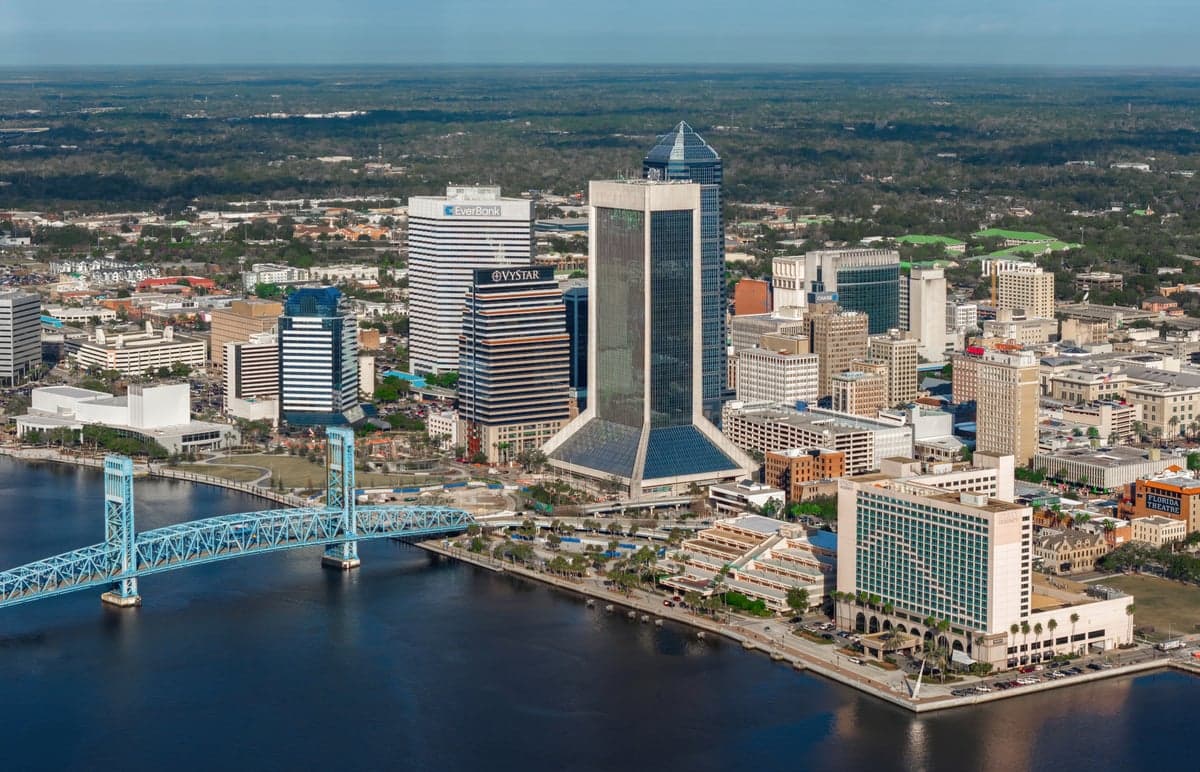
Jacksonville, Florida, offers a notably high degree of personal sovereignty compared to most major U.S. cities, largely due to Florida’s aggressive preemption laws that strip local governments of the ability to impose their own restrictive ordinances on everything from firearms to pandemic mandates. For the strategic relocator—especially those with a survivalist or prepper mindset—this means the city itself cannot easily become a local tyranny of the sort seen in places like Portland or Chicago. The state’s constitutional framework, combined with a consolidated city-county government that reduces bureaucratic layers, creates an environment where individual autonomy is the default, not the exception. However, the sheer size of Jacksonville (by land area, the largest city in the contiguous U.S.) means that practical sovereignty varies by neighborhood, with some areas feeling more like a rural homestead and others like a dense, regulated urban core.
Tax burden and regulatory posture: how Florida’s state-level policies protect your wallet and choices
Florida’s lack of a state income tax is the single most powerful tool for preserving personal sovereignty here—every dollar you earn stays in your control, not the state’s. Jacksonville’s combined state and local sales tax rate is 7.5%, which is moderate, but the absence of income tax means a household earning $75,000 saves roughly $3,000–$4,000 annually compared to a similar income in New York or California. Property taxes in Duval County average around 0.98% of assessed value, slightly below the national average, and Florida’s Save Our Homes amendment caps annual assessment increases at 3% for homesteaded properties, protecting long-term owners from tax-driven displacement. On the regulatory front, Florida has a strong preemption statute (Florida Statute 125.01) that prevents counties and cities from enacting their own occupational licensing, rental restrictions, or building codes that exceed state minimums. This means Jacksonville cannot, for example, impose its own rent control or ban short-term rentals like some coastal towns have tried. For a prepper, this translates to fewer bureaucratic hurdles when building a shed, installing solar panels, or running a home-based business—the state has your back against local overreach.
Self-defense and gun law specifics: what the Second Sanctuary means for daily carry and home protection
Jacksonville sits in Duval County, which the Florida Legislature has designated a “Second Amendment Sanctuary” county through state-level preemption—meaning local officials cannot pass any ordinance that infringes on the right to keep and bear arms. Florida is a shall-issue state for concealed carry licenses, with no discretion for local sheriffs to deny a permit if you meet the statutory requirements (age 21, no disqualifying criminal history, completion of a 4-hour safety course). The state also has a robust “Stand Your Ground” law (Florida Statute 776.013) that eliminates any duty to retreat before using deadly force in any place you have a legal right to be—your home, your car, or a public sidewalk. Open carry is generally prohibited for handguns, but long guns (rifles, shotguns) can be carried openly without a permit, which is a practical consideration for those who want to keep a defensive rifle accessible while working on their property. Importantly, Florida does not require registration of firearms, and there is no state-level waiting period for long guns (a 3-day waiting period applies to handgun purchases from licensed dealers, but private sales are unregulated). For the survivalist, this means you can build a personal armory without government tracking, and you can defend it without worrying about retreating from a threat.
Self-reliance and homesteading viability: lot sizes, zoning, and off-grid feasibility in Duval County
Jacksonville’s unique geography—the largest city by land area in the contiguous U.S. at 874 square miles—means that within its city limits you can find everything from dense urban lots to 5-acre parcels that feel like rural homesteads. Zoning in the city’s Agricultural (AGR) and Rural Residential (RR) districts allows for livestock, including chickens, goats, and even horses, with minimum lot sizes of 1 to 5 acres depending on the specific designation. The city’s code explicitly permits “urban agriculture” as a principal use, including beekeeping and aquaculture, with no special permit required for most activities. Off-grid living is legally feasible but requires navigating Florida’s building codes: the state mandates connection to municipal water and sewer if available within 300 feet of the property line, but in truly rural areas (like the northern reaches of Duval County near the Nassau County line), you can drill a well and install a septic system without municipal interference. Solar panels are fully legal and net metering is available through JEA (the municipal utility), though Florida’s net metering rules are less generous than some western states—you’ll get credit at the retail rate but only up to your monthly consumption. Rainwater collection is unrestricted, and composting toilets are permitted in areas without sewer access. For the prepper, the key takeaway is that you can achieve a high degree of self-sufficiency within city limits if you choose the right parcel, but you’ll need to be strategic about location—avoiding the dense urban core and the coastal flood zones (which come with additional FEMA-related restrictions).
Personal liberties: parental rights, medical autonomy, speech, and property protections
Florida has become a national battleground for parental rights, and Jacksonville reflects that state-level posture. The Parental Rights in Education Act (HB 1557) codifies that parents have the fundamental right to direct their child’s upbringing, education, and healthcare, and it prohibits school districts from withholding information about a child’s mental or physical health. Duval County Public Schools, the 20th largest district in the nation, has implemented policies that require parental notification for any changes in a student’s services or monitoring related to mental, emotional, or physical health—a direct check on what some see as government overreach into family matters. On medical autonomy, Florida’s emergency rule (2022) banned mask and vaccine mandates in schools and government buildings, and the state has since codified a permanent ban on vaccine passports and employer mandates for COVID-19 vaccines. This means that in Jacksonville, you cannot be denied service, employment, or entry to a public building based on vaccination status—a significant protection for those who view medical choices as private. Free speech is protected under the Florida Constitution, which explicitly states that “no law shall be passed to restrain or abridge the liberty of speech,” and Jacksonville has not enacted any local ordinances restricting public assembly or protest beyond standard time-place-manner regulations. Property rights are further strengthened by the Bert J. Harris Jr. Private Property Rights Protection Act, which allows landowners to sue if a government regulation (like zoning or environmental restrictions) reduces property value by more than 50%—a powerful check against regulatory takings. For the sovereignty-minded individual, these protections mean that your home, your children, and your medical decisions are largely shielded from the kind of local government overreach that has become common in blue states.
Overall, Jacksonville ranks among the top U.S. cities for personal sovereignty when measured against the criteria of tax burden, gun rights, homesteading feasibility, and protection from government overreach. The combination of no state income tax, strong preemption laws, Stand Your Ground protections, and a consolidated government that limits bureaucratic creep creates an environment where an individual can live with a high degree of autonomy. The city’s sheer size and diversity of zoning allow for everything from urban survivalism to rural self-sufficiency, all within the same municipal boundaries. While no location is perfect—Florida’s insurance crisis and hurricane risk are real considerations—Jacksonville offers a rare balance of freedom and practicality that makes it a strong candidate for anyone prioritizing personal sovereignty in their relocation decision.

* Values derived from national, state, county, city and local statistics and may differ in a specific area. Last updated: 2026-04-15T23:45:06.000Z
Narrative content on this page is AI-generated and may contain mistakes. Verify any details that matter before acting on them.
ReloMaps may earn a commission from affiliate links at no extra cost to you.

