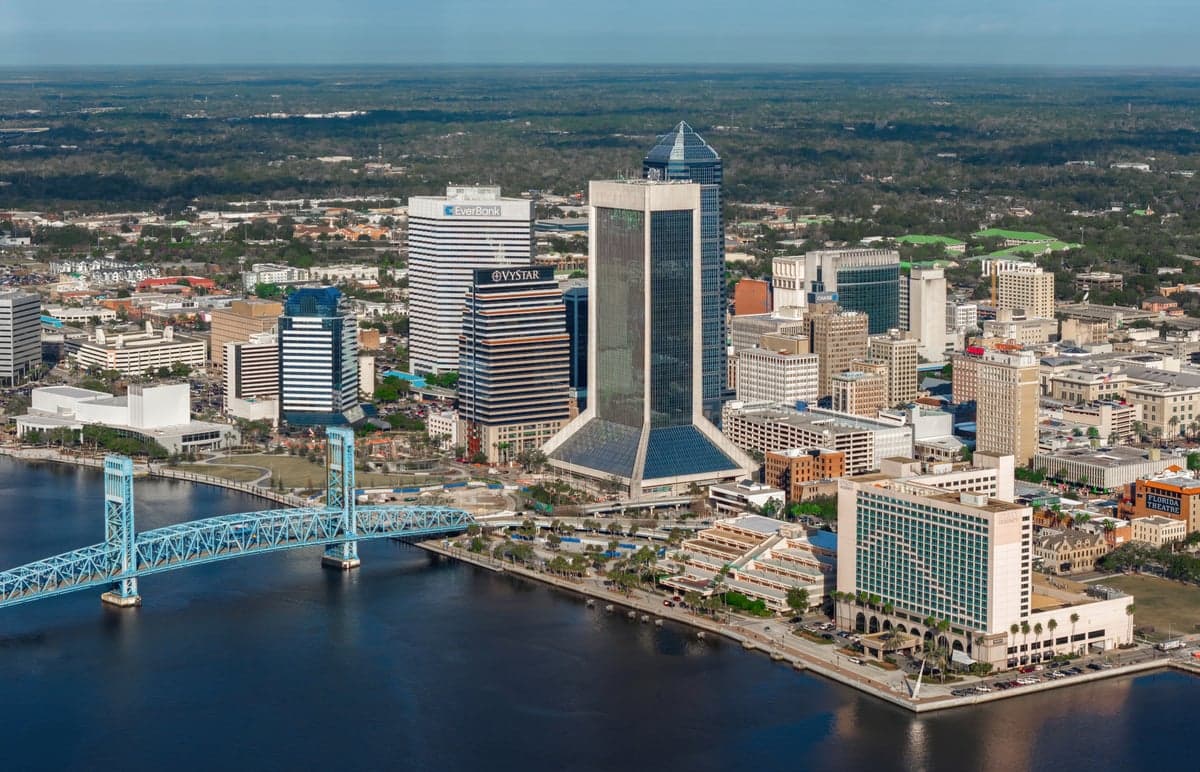
Photo: Wikipedia
Political ClimatePolitical Climate in Jacksonville, FL
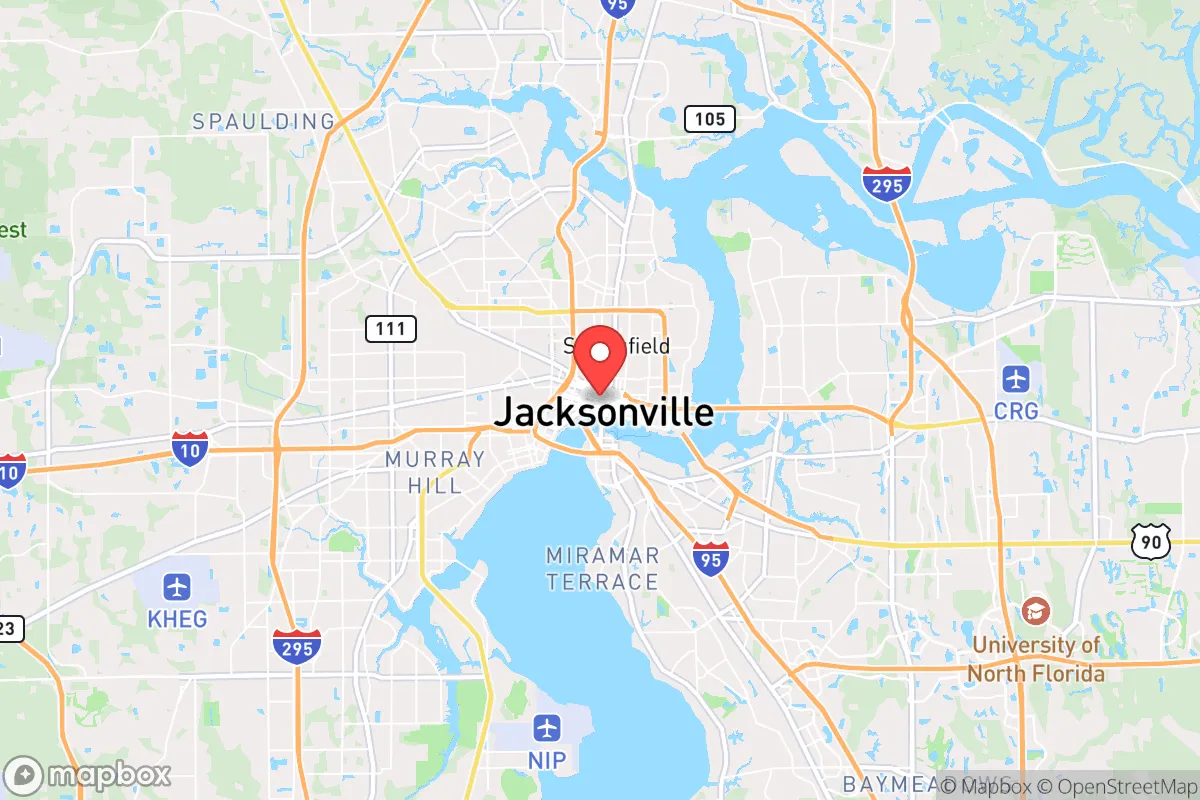
District shown is the primary district for this city’s centroid. Cities may span multiple districts.
Local Political AnalysisPolitical Analysis of Jacksonville, FL
Jacksonville has long been a reliably conservative stronghold in Florida, but like a lot of places, you can feel the ground shifting under your feet. The city sits in Duval County, which has a Cook PVI of R+5, meaning it leans about five points more Republican than the national average. That’s still solidly red on paper, but the margins have been tightening in recent cycles. In 2020, Trump still won Duval, but by a much slimmer margin than in 2016, and you see that trend continuing in local races. The real story here is the tension between the old-school, limited-government values that built this town and the influx of new residents from blue states who bring a different set of priorities. It’s not a blue wave yet, but it’s a definite purple undertow.
How it compares
Drive an hour south to St. Augustine or west to Gainesville, and you’ll see what I mean. St. Augustine’s historic district has become a magnet for progressive transplants, and the local politics there are noticeably more left-leaning, with city council debates often centering on climate activism and social justice ordinances. Gainesville is a whole different animal—a college town that votes reliably blue, with a city government that’s been pushing rent control and sanctuary city policies. Jacksonville, by contrast, still feels like the last bastion of common sense in Northeast Florida. The surrounding suburbs—places like Fleming Island, Nocatee, and St. Johns County—are even redder, with St. Johns County voting nearly 60% Republican in 2024. That’s where a lot of families have moved to escape the creeping progressive influence in the city core. The contrast is stark: you can live in a neighborhood where the HOA still enforces flagpole rules and nobody’s talking about defunding the police, then drive 20 minutes downtown and see a city council meeting where they’re debating whether to ban plastic straws or rename a street.
What this means for residents
For a long-time resident who values personal freedom and limited government, the biggest concern is the slow creep of overreach. The city has already seen pushes for mandatory paid sick leave ordinances and increased zoning restrictions that make it harder to build or renovate without endless permits. Property taxes are still reasonable compared to South Florida, but they’ve been climbing as the city expands its budget for social programs and public art projects that feel more like virtue signaling than necessity. The school board has become a battleground, with progressive candidates winning seats in 2022 and immediately pushing for curriculum changes that downplay American history and elevate critical race theory. If you’re a parent who wants your kid to learn the basics without political indoctrination, you’re now looking at private school or moving to St. Johns County. The police department, once a point of pride, is under constant scrutiny from activist groups, and while the mayor’s office has held the line on defunding, the pressure isn’t going away.
On the cultural side, Jacksonville still has a lot of what makes Florida great: no state income tax, a strong gun culture with plenty of ranges and gun shows, and a general live-and-let-live attitude in the suburbs. But the downtown area is becoming more like a mini-Atlanta, with bike lanes that nobody uses, high-rise apartments that price out locals, and a growing homeless population that the city seems unable to manage without heavy-handed ordinances. The long-term trajectory depends on whether the conservative base can hold the line in the next few election cycles. If the current trend continues, Jacksonville could look a lot like Orlando within a decade—a purple city with a blue core and red suburbs, where your rights depend on which zip code you live in. For now, it’s still a place where you can raise a family without feeling like the government is in your business, but you’ve got to keep your eyes open and your vote ready.

State Political ClimatePolitical Climate in Florida
State Political AnalysisPolitical Environment in the State
Florida has transformed from a classic swing state into a solidly Republican-leaning powerhouse over the past decade, with a registered Republican voter advantage of over 700,000 and a governor who won re-election by nearly 20 points in 2022. The dominant coalition is a mix of conservative retirees, Hispanic voters (especially in Miami-Dade and the I-4 corridor), and rural transplants from the Midwest and Northeast. The trajectory has been a sharp rightward shift since 2016, driven by a massive influx of new residents seeking lower taxes and a freer lifestyle, while the state’s Democratic Party has struggled to maintain its once-strong hold on the urban cores.
Urban vs. rural divide
The political map of Florida is a tale of three distinct regions. The urban strongholds of Miami-Dade County and Orlando (Orange County) have seen dramatic shifts: Miami-Dade, once a Democratic bastion, flipped to Trump in 2020 and again in 2024, driven by Cuban-American and Venezuelan voters who despise socialism. Meanwhile, Tampa (Hillsborough County) and Jacksonville (Duval County) are now competitive but trending red, with suburban precincts in places like St. Johns County (south of Jacksonville) voting over 65% Republican. The rural Panhandle—think Panama City and Pensacola—is deeply conservative, while the I-4 corridor from Lakeland to Daytona Beach remains the ultimate battleground, though it’s now leaning right. The only true blue holdout is Tallahassee (Leon County), a government town that votes like a college campus, but it’s an island in a sea of red.
Policy environment
Florida’s policy environment is a model of limited government, which is why it’s attracting so many relocators. There’s no state income tax, and property taxes are capped by the Save Our Homes amendment, making it a haven for homeowners. The regulatory posture is aggressively pro-business, with a right-to-work law and minimal red tape for new construction. On education, Governor Ron DeSantis pushed through the Parental Rights in Education Act (HB 1557, the “Don’t Say Gay” law) and expanded school choice via the Family Empowerment Scholarship, giving parents control over their kids’ curriculum. Healthcare is a mixed bag: Florida didn’t expand Medicaid, keeping costs lower for taxpayers, but private insurance premiums are high. Election laws were tightened with SB 90 (2021), requiring voter ID and limiting drop boxes, which has boosted confidence in election integrity. The state also preempted local gun laws with a 2011 law that makes it a felony for cities to regulate firearms—a huge win for Second Amendment supporters.
Trajectory & freedom
Florida is unequivocally becoming more free, especially compared to states like New York or California. The Constitutional Carry law (HB 543, 2023) allows permitless carry of firearms, a major expansion of gun rights. The Live Local Act (2023) preempted local zoning to fast-track affordable housing, cutting through NIMBY bureaucracy. On medical autonomy, the state banned COVID-19 vaccine mandates for private employers and schools (SB 252, 2023), and DeSantis signed the Protection of Medical Conscience Act to shield doctors from being forced to perform procedures they object to. Property rights were strengthened with the Private Property Rights Protection Act (2022), which limits eminent domain abuse. However, there are concerns about government overreach in the Disney Reedy Creek fight (2022), where the state dissolved the special district after Disney criticized the Parental Rights law—a move that some conservatives saw as a necessary check on corporate activism, but others viewed as a troubling use of state power. Overall, the trend is toward more personal liberty, but the state’s willingness to use its authority against corporations is a double-edged sword.
Civil unrest & political movements
Florida has seen its share of political flashpoints, but they’ve been largely contained. The Black Lives Matter protests in 2020 were intense in Miami and Orlando, but the state’s quick passage of the Combating Public Disorder Act (HB 1, 2021) made rioting and blocking roads a felony, effectively deterring large-scale unrest. Immigration politics are a constant issue, with Governor DeSantis busing migrants to Martha’s Vineyard and signing SB 1718 (2023), which requires E-Verify for employers and bans local “sanctuary” policies. There’s no serious secession or nullification movement, but the Florida Freedom Fund and groups like Moms for Liberty are highly active in school board elections, pushing back against CRT and gender ideology. Election integrity remains a hot topic: the 2022 midterms were widely seen as clean, but the 2020 recount in Broward and Palm Beach counties still fuels skepticism. A new resident would notice the “Don’t Tread on Me” flags flying in rural areas and the occasional protest at the state capitol, but civil unrest is far less common than in blue states.
Projection
Over the next 5-10 years, Florida will likely become even more conservative, driven by demographic trends. The influx of new residents—roughly 1,000 people per day—is overwhelmingly from high-tax, high-regulation states like New York, Illinois, and California, and they’re moving here for the freedom, not to change it. The Hispanic vote, especially in Miami-Dade and Osceola County (Orlando’s Hispanic suburbs), is shifting right as younger generations prioritize economic opportunity over identity politics. The state’s Republican supermajority in the legislature will continue to pass pro-gun, pro-life, and pro-school-choice laws. The biggest risk is a housing affordability crisis in coastal cities like Fort Lauderdale and Naples, which could fuel a backlash if the state doesn’t keep up with infrastructure. But for now, the trajectory is clear: Florida is the reddest large state in the country, and it’s only getting redder.
For a new resident, the bottom line is that Florida offers a political environment where your personal freedoms—from gun ownership to parental control over education—are protected by law and culture. You won’t find the government mandating your healthcare choices or your kids’ curriculum. The trade-off is that you’ll need to adapt to a fast-growing state with traffic, hurricanes, and a cost of living that’s rising but still far cheaper than the Northeast or West Coast. If you value liberty and want to live in a place that’s actively fighting the progressive agenda, Florida is the safest bet in the country right now.
* Values derived from national, state, county, city and local statistics and may differ in a specific area. Last updated: 2026-04-15T23:45:06.000Z
Narrative content on this page is AI-generated and may contain mistakes. Verify any details that matter before acting on them.
ReloMaps may earn a commission from affiliate links at no extra cost to you.

