
Photo: Wikipedia
Political ClimatePolitical Climate in Janesville, WI
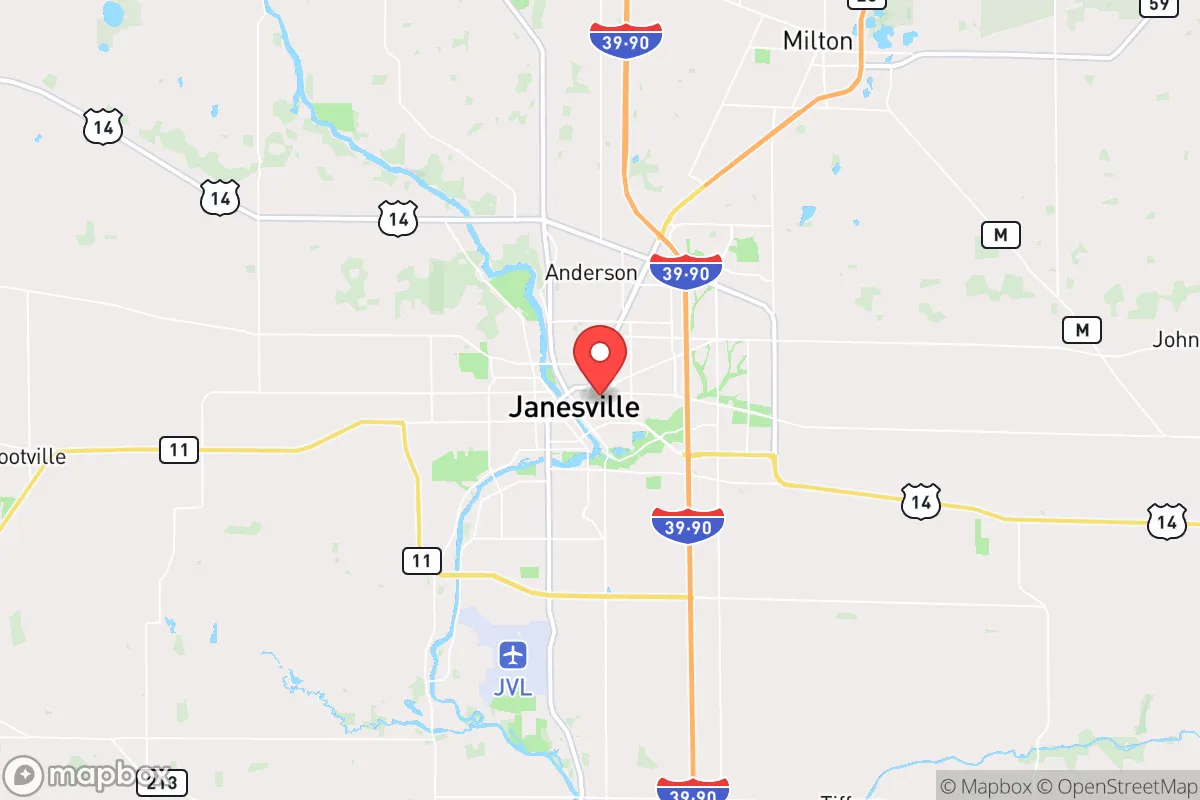
District shown is the primary district for this city’s centroid. Cities may span multiple districts.
Local Political AnalysisPolitical Analysis of Janesville, WI
Janesville sits in a political tug-of-war that’s gotten a lot more tense over the last decade. Rock County as a whole has been trending left, but Janesville itself still leans conservative, with a Cook PVI of R+2 that reflects its working-class roots and manufacturing history. That R+2 number feels about right for the city proper—it’s not a deep-red stronghold like the rural towns to the west, but it’s also not the kind of place where progressive policies get a free pass. The real story is how fast the surrounding areas are shifting, and whether Janesville can hold the line.
How it compares
Drive 15 minutes north to Beloit, and you’re in a completely different political world—Beloit’s Cook PVI is D+8, and it’s been a reliable Democratic stronghold for years. Head east toward Milton or Edgerton, and you’ll find more of that traditional, live-and-let-live conservatism that used to define Janesville. The contrast is stark: Beloit’s city council has been pushing things like sanctuary city policies and higher property taxes for social programs, while Janesville’s leadership has mostly stuck to fiscal restraint and keeping government out of local business. But I’ve seen the creep—Madison’s influence is spreading south, and every election cycle brings more door-knockers from progressive groups trying to flip Rock County. The 2024 results showed the margin tightening, and that’s a warning sign for anyone who values personal freedom over government mandates.
What this means for residents
For folks who’ve lived here a while, the biggest concern is how much the local government is willing to get involved in your daily life. Janesville has historically been a place where you could run your small business, keep your firearms, and raise your kids without a lot of bureaucratic hassle. But the recent push for stricter zoning laws, mask mandates during flu seasons, and even talk of “equity” initiatives in the school district—those are red flags. The city council is still majority conservative, but it’s a slim majority, and the progressive wing is vocal. If you’re looking to move here, you’ll want to pay attention to the school board elections and the county board races—that’s where the real battles over personal freedoms are being fought. Property taxes are moderate compared to Madison or Milwaukee, but they’ve been inching up as the city takes on more social services. The trade-off is that you still get decent roads, reliable police response, and a sense of community where your neighbors actually know your name.
One thing that hasn’t changed: Janesville is still a place where the Second Amendment is respected, and you won’t get sideways looks for having a gun rack in your truck. The local churches are still full on Sundays, and the Fourth of July parade is as American as it gets. But I’d be lying if I said I wasn’t worried about the long-term direction. The young people moving in from Madison and Chicago bring different values, and they’re voting. If you’re considering a move here, I’d say come for the affordability and the community, but keep an eye on the ballot box—because the Janesville I grew up in is fighting to stay that way.

State Political ClimatePolitical Climate in Wisconsin
State Political AnalysisPolitical Environment in the State
Wisconsin has long been a classic swing state, but over the past decade it has shifted from a true battleground to a state where Republicans hold a structural advantage in statewide races, though margins remain razor-thin. The state voted for Donald Trump in 2016 and 2024, while flipping for Joe Biden in 2020 by just over 20,000 votes, illustrating its deep partisan trench warfare. The dominant coalitions are a conservative, rural and exurban base concentrated in the WOW counties (Waukesha, Ozaukee, Washington) outside Milwaukee, and a progressive, urban stronghold in Madison and Milwaukee proper, with the rest of the state trending redder over the last 20 years.
Urban vs. rural divide
The political map of Wisconsin is a textbook case of urban-rural polarization. Milwaukee County and Dane County (home to Madison) together cast roughly 30% of the state’s votes and deliver massive Democratic margins — Milwaukee County went +40 for Biden in 2020, while Dane County was +75. Meanwhile, the WOW counties — Waukesha, Ozaukee, and Washington — are the Republican heartland, routinely delivering 60-65% of their votes for GOP candidates. The real story is the suburban and exurban shift: places like Brown Deer and Shorewood near Milwaukee have moved left, while fast-growing exurbs like Mukwonago and Hartland have hardened their conservative lean. The rural northwoods counties — Vilas, Oneida, Lincoln — have flipped from blue to red over the past two decades, driven by out-migration of younger people and in-migration of retirees seeking lower taxes and fewer regulations. The Fox Valley region, anchored by Appleton and Green Bay, remains a bellwether: Brown County went for Trump in 2024 after narrowly backing Biden in 2020, signaling that even moderate-leaning areas are trending right.
Policy environment
Wisconsin’s policy environment is a mixed bag for conservatives. On the plus side, the state has a flat income tax rate of 4.4% (down from 7.65% in 2011), and the Republican-controlled legislature has passed right-to-work legislation and constitutional carry for firearms. Property taxes are relatively moderate, with the median effective rate around 1.6%, though they vary wildly — Milwaukee County has rates near 2.5%, while rural Burnett County sits under 1.2%. The state also has a school choice program that has expanded under GOP leadership, allowing families in Milwaukee, Racine, and statewide to use vouchers for private or religious schools. On the concerning side, Governor Tony Evers has vetoed multiple Republican bills to further cut income taxes and restrict abortion, and the state still has a prevailing wage law on public projects that drives up costs. Election integrity is a flashpoint: Wisconsin uses drop boxes (allowed by the state Supreme Court in 2024 after a 2022 ban), and the Wisconsin Elections Commission remains under bipartisan control but has faced criticism for inconsistent guidance. The state also has no voter ID law for absentee ballots (only for in-person voting), which remains a concern for election security advocates.
Trajectory & freedom
Wisconsin is on a knife’s edge between expanding and contracting personal freedom. The 2023 Act 12 (the shared revenue bill) was a major win for local control, allowing counties to raise sales taxes without state approval — but it also imposed new mandates on Milwaukee, including requiring the city to hire more police officers. Gun rights have expanded: constitutional carry became law in 2023, and the state preempts local gun ordinances, meaning cities like Madison cannot ban firearms in parks or public buildings. However, the 2024 Wisconsin Supreme Court ruling that reinstated drop boxes for absentee ballots was a setback for election integrity, and the court is now considering a case that could overturn the state’s 1849 abortion ban (currently unenforceable due to a 2023 lawsuit). Parental rights in education took a hit when the Evers administration blocked a bill requiring schools to notify parents of a child’s gender identity changes — a bill that had passed the legislature. Medical freedom is mixed: the state has no mask or vaccine mandates currently, but the 2020-2021 emergency orders from Evers (including a stay-at-home order struck down by the state Supreme Court) left a bad taste for many. Property rights are generally strong, with no statewide rent control and limited zoning overreach outside of Madison and Milwaukee.
Civil unrest & political movements
Wisconsin has been a hotbed of political activism, both left and right. The 2020 Kenosha riots after the Jacob Blake shooting saw businesses burned and two people killed, with the subsequent trial of Kyle Rittenhouse becoming a national flashpoint for self-defense and Second Amendment rights. The 2021-2023 protests at the state capitol over abortion and election integrity drew thousands, with conservative groups like Wisconsin Family Action and Turning Point USA (headquartered in Milwaukee) organizing regularly. Immigration politics are relatively quiet compared to border states, but Milwaukee County has declared itself a “welcoming county” for immigrants, and the city of Madison has a sanctuary city ordinance that limits cooperation with ICE. The 2020 election integrity controversy remains a live issue: the Wisconsin Supreme Court is currently hearing a case on whether the use of private grant money (from the Center for Tech and Civic Life) to run the 2020 election was legal, and the 2024 ruling on drop boxes has energized both sides. Secession or nullification rhetoric is minimal, but there is a growing movement in northern Wisconsin to secede from the state and join Michigan’s Upper Peninsula, driven by frustration with Madison’s policies on mining and land use.
Projection
Over the next 5-10 years, Wisconsin is likely to remain a purple state with a slight red tilt, but demographic trends are concerning for conservatives. The in-migration of remote workers from Illinois and Minnesota is accelerating, particularly to Door County, Lake Geneva, and the Madison suburbs — these newcomers tend to bring their progressive voting habits with them. The 2024 state Supreme Court election gave liberals a 4-3 majority, and that court is expected to redraw legislative maps before 2026, which could flip the state Assembly and Senate to Democratic control for the first time in over a decade. The 2026 gubernatorial race will be critical: if a Republican wins, expect further tax cuts, school choice expansion, and election integrity reforms; if Evers wins again, expect a push for Medicaid expansion, renewable energy mandates, and a repeal of the state’s right-to-work law. The WOW counties are slowly diversifying and trending slightly left, while the Fox Valley and northwoods are solidifying as red strongholds. The wildcard is Milwaukee’s suburbs: places like Wauwatosa and Brookfield are becoming more competitive, with younger families moving in from the city.
For a new resident, the bottom line is this: Wisconsin offers a relatively low-tax, gun-friendly environment with strong school choice options, but the political winds are shifting. If you’re moving to the WOW counties or the Fox Valley, you’ll find a conservative community that values local control and personal freedom. If you’re moving to Madison or Milwaukee’s inner suburbs, expect a more progressive, government-heavy atmosphere. The state’s future hinges on the next few elections — if conservatives can hold the line on the Supreme Court and the governor’s mansion, Wisconsin will remain a haven for freedom. If not, expect it to drift toward the policies of Illinois or Minnesota, with higher taxes, more regulations, and less personal liberty. Choose your county wisely.
* Values derived from national, state, county, city and local statistics and may differ in a specific area. Last updated: 2026-04-21T10:28:05.000Z
Narrative content on this page is AI-generated and may contain mistakes. Verify any details that matter before acting on them.
ReloMaps may earn a commission from affiliate links at no extra cost to you.

