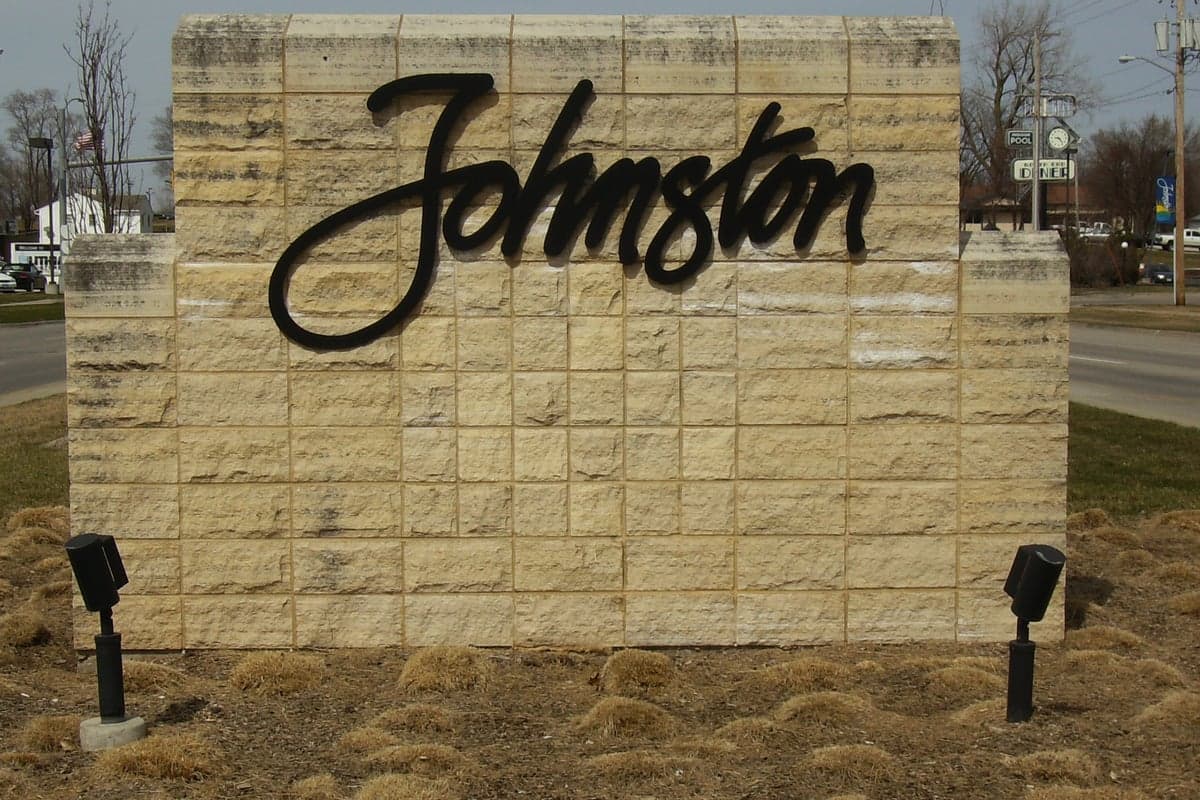
Photo: Wikipedia
Personal Sovereignty in Johnston, IA
Viable for self-reliance. Generally workable, though some barriers may limit total independence.
What does Personal Sovereignty tell us?
Personal Sovereignty measures your capacity for self-reliance and independence with minimal government friction. Higher scores mean fewer barriers between you and the way you want to live... but it assumes you have the space you need and good neighbors.
What does this tell us?
Personal Sovereignty measures your capacity for self-reliance and independence with minimal government friction. Higher scores mean fewer barriers between you and the way you want to live... but it assumes you have the space you need and good neighbors.
State Policy
Energy independence: Importer (50% of energy produced in-state)
Personal Liberty
Homesteading

Personal Liberty Analysis
Johnston, Iowa offers a notably high degree of personal sovereignty compared to many suburban enclaves, particularly for those who prioritize minimal government interference in daily life. Located just northwest of Des Moines, this community of roughly 25,000 operates under Iowa’s broadly pro-liberty state framework, which has consistently pushed back against federal overreach in areas like gun rights, parental authority, and tax policy. For a single individual or family approaching relocation from a survivalist or prepper mindset, Johnston represents a strategic balance—close enough to urban resources for supply runs and employment, yet embedded in a state that has actively worked to preserve individual autonomy against the tide of centralized control.
Tax burden and regulatory posture: how Johnston compares on fiscal freedom
Iowa’s tax environment has shifted significantly toward personal liberty in recent years, and Johnston residents benefit directly. The state enacted a flat individual income tax rate of 3.8% in 2025, with a scheduled phase-down to 3.5% by 2027—a clear departure from the progressive brackets that penalize productivity. Property taxes in Johnston run around 1.8% of assessed value, slightly above the state average, but the absence of a state-level estate or inheritance tax means your assets pass to heirs without the government taking a cut. Sales tax sits at 7% in Polk County, which includes Johnston, but essential items like groceries and prescription drugs remain exempt. From a regulatory standpoint, Iowa has aggressively rolled back occupational licensing requirements and business permitting delays, making it easier to start a side hustle, home-based trade, or small farm operation without drowning in red tape. The state’s right-to-work law further ensures that no one is forced to join or pay a union as a condition of employment—a meaningful consideration for those who view compulsory association as a violation of personal freedom.
Self-defense and gun law specifics: what Johnston residents can legally do
Iowa is a constitutional carry state, meaning that as of July 2021, any law-abiding adult 21 or older can carry a concealed firearm without a permit. Johnston residents face no additional city-level restrictions beyond state law—no magazine capacity bans, no “assault weapon” registries, and no red flag orders that allow confiscation without due process. The state preempts local governments from enacting stricter gun ordinances, so Johnston’s city council cannot unilaterally impose waiting periods or storage mandates. Stand-your-ground law applies statewide, eliminating any duty to retreat before using force in self-defense. For preppers, the practical implication is straightforward: you can maintain a fully stocked armory, carry daily for personal protection, and train on your own property without fear of arbitrary infringement. The only notable limitation is that private sales between individuals do not require a background check, though federal law still applies to licensed dealers. This legal environment places Johnston among the most firearm-friendly suburbs in the Midwest, comparable to rural Texas or Arizona enclaves.
Self-reliance and homesteading viability: lot sizes, zoning, and off-grid feasibility
Johnston’s zoning code is more permissive than many suburban communities, but it is not wide-open frontier. Standard residential lots in established neighborhoods range from one-quarter to one-half acre, which limits large-scale food production but still allows for substantial vegetable gardens, small orchards, and backyard chickens—hens are permitted without a special permit, though roosters are restricted due to noise ordinances. Newer developments on the city’s northern and western edges offer lots up to one acre, providing room for a modest greenhouse, rainwater catchment, or solar panel array. Off-grid living in the strict sense—no utility connections—is not feasible within city limits, as Johnston requires connection to municipal water and sewer for habitable structures. However, the surrounding rural areas of Polk and Dallas counties, within a 15-minute drive, offer five- to forty-acre parcels with far fewer restrictions, where well water, septic systems, and off-grid solar are standard. For the prepper who wants suburban convenience with a rural retreat option, Johnston’s position as a gateway to unincorporated farmland is a strategic advantage. The state’s favorable laws on home food processing and cottage food operations also allow residents to sell surplus produce, eggs, or baked goods directly to neighbors without heavy licensing.
Personal liberties: parental rights, medical autonomy, speech, and property
Iowa has been a battleground for parental rights, and recent legislation has tilted strongly toward family sovereignty. The state’s 2023 law requiring schools to obtain parental consent before students can change their gender identity or pronouns at school remains in effect, and Johnston’s school district has complied without the legal challenges seen in more progressive districts. Medical autonomy is similarly robust: Iowa does not mandate COVID-19 or childhood vaccinations for school attendance, and there is no state-level vaccine passport system. The governor signed a 2024 executive order prohibiting state agencies from enforcing any federal public health mandates that conflict with state law, effectively nullifying future federal overreach in health emergencies. Free speech protections are strong under both the Iowa Constitution and state statute, which explicitly prohibits public universities and colleges from restricting speech based on viewpoint—a safeguard against the campus censorship seen in blue states. Property rights are reinforced by Iowa’s strict eminent domain laws, which require a public purpose and just compensation, and by the absence of rent control or forced inclusionary zoning at the state level. For the individual who values the right to make medical decisions for their family, speak their mind without fear of government retaliation, and control their own land, Johnston sits in a state that has consistently chosen liberty over administrative convenience.
In the broader landscape of American personal sovereignty, Johnston, Iowa ranks well above the median for a suburban community. It lacks the absolute freedom of remote rural counties in Idaho or Montana, where zoning is nonexistent and the nearest sheriff is an hour away, but it compensates with a functional infrastructure that supports self-reliance without constant government intrusion. The tax burden is moderate and falling, gun rights are constitutionally protected and locally respected, and the legal framework for family autonomy and medical choice is among the strongest in the Midwest. For the strategic relocator who wants to live free but not isolated, Johnston offers a rare combination: a community that respects individual sovereignty while providing the economic and social stability that makes long-term prepping practical. The state’s trajectory suggests this freedom will expand rather than contract, making it a solid bet for those who see the current political climate as a reason to secure a more independent life.

* Values derived from national, state, county, city and local statistics and may differ in a specific area. Last updated: 2026-04-29T20:34:54.000Z
Narrative content on this page is AI-generated and may contain mistakes. Verify any details that matter before acting on them.
ReloMaps may earn a commission from affiliate links at no extra cost to you.

