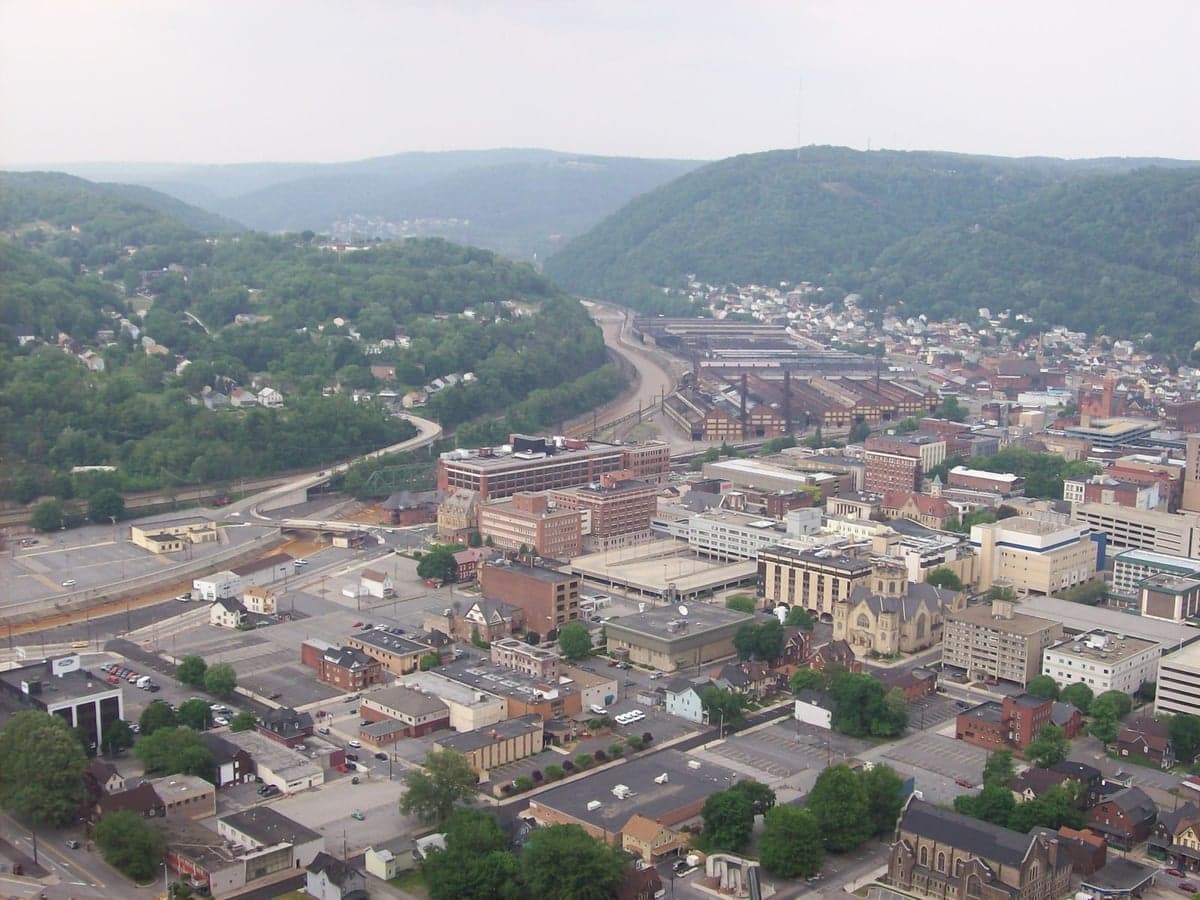
Photo: Wikipedia
Demographics of Johnstown, PA
Affluence Level in Johnstown, PA
A low-income area with significant economic hardship. Household wealth and educational attainment are well below national averages.
People of Johnstown, PA
Johnstown, Pennsylvania, is a city of 18,245 residents defined by its deep industrial roots and a population that is overwhelmingly native-born (99.3%) and predominantly white (70.1%), with a significant Black minority (13.5%) and a small but growing Hispanic community (5.5%). The city's character is shaped by a legacy of steel and coal, a shrinking but stable population, and a strong sense of place among families who have lived there for generations. It is a place where ethnic enclaves from the 19th century still echo in neighborhood names, even as the city faces the challenges of post-industrial decline and a low college attainment rate (14.9%). For a conservative-leaning audience, Johnstown represents a culturally traditional, working-class community with a distinct, hard-won identity.
How the city was settled and grew
Johnstown's population history is a story of industrial migration. The city was founded in 1800 by Joseph Johns (a Swiss-German settler) at the confluence of the Stonycreek and Little Conemaugh rivers, but its explosive growth began with the Cambria Iron Company in the 1850s. The first major wave was Welsh and English ironworkers, who settled in the Moxham neighborhood, building sturdy row houses near the mills. They were followed by German and Irish laborers, who clustered in Hornerstown and Woodvale, working the coal mines and blast furnaces. The largest wave came between 1880 and 1920, when Southern and Eastern Europeans—Italians, Slovaks, Poles, and Hungarians—arrived by the thousands to fill the growing steel mills. These groups created distinct enclaves: Italians concentrated in Cambria City (still home to the annual Italian festival), Slovaks in Morrellville, and Poles in Prospect. By 1920, Johnstown's population peaked at over 67,000, making it one of the most ethnically diverse industrial cities in Pennsylvania, with nearly every European nationality represented in a specific neighborhood.
Modern era (post-1965)
The post-1965 era brought dramatic demographic change, driven not by new immigration but by domestic out-migration and suburbanization. The collapse of the steel industry in the 1970s and 1980s triggered a population exodus: Johnstown lost over 70% of its peak population, falling from 67,000 to its current 18,245. The white population shrank fastest, as families left for jobs in the South and Midwest. The Black population, historically concentrated in the Coopersdale and Oakhurst neighborhoods (originally settled by African American workers during World War II), became a larger share of the remaining population, rising to 13.5%. The Hispanic population, now 5.5%, is a newer development, largely Puerto Rican and Mexican families moving into the West End and Downtown areas for service-sector jobs. The foreign-born population is negligible at 0.7%, and East/Southeast Asian communities (0.4%) are tiny, with no Indian subcontinent presence (0.0%). The city has not absorbed significant immigrant waves since the early 20th century; instead, it has become more racially binary (white and Black) with a small Hispanic minority, while the ethnic European neighborhoods have largely assimilated into a generic white working-class identity.
The future
Johnstown's population is projected to continue its slow decline, driven by an aging white population and limited in-migration. The city is not homogenizing into a single identity; rather, it is tribalizing along economic lines. The Westmont neighborhood (a hilltop suburb within city limits) remains predominantly white and middle-class, while Coopersdale and Oakhurst are increasingly Black and lower-income. The Hispanic community in the West End is small but stable, growing through natural increase rather than new immigration. The city's low college attainment rate (14.9%) and lack of major employers mean that young people continue to leave, and the population is aging. There is no sign of a new immigrant wave reversing the decline; the foreign-born share is among the lowest in Pennsylvania. Over the next 10–20 years, Johnstown will likely become smaller, older, and more economically stratified, with the white and Black populations remaining the dominant groups and the Hispanic share growing slowly.
For someone moving in now, Johnstown is a place where the past is still present—a shrinking, predominantly white and Black city with a strong working-class culture and a clear sense of neighborhood identity. It is not a destination for diversity or growth, but for those seeking a low-cost, traditional community with deep roots, it offers stability and a tangible connection to American industrial history. The key is to choose a neighborhood that matches one's priorities: Westmont for quiet, middle-class stability; Cambria City for historic character; or Downtown for proximity to services, albeit with higher poverty rates.

* Values derived from national, state, county, city and local statistics and may differ in a specific area. Last updated: 2026-05-01T07:24:42.000Z
Narrative content on this page is AI-generated and may contain mistakes. Verify any details that matter before acting on them.
ReloMaps may earn a commission from affiliate links at no extra cost to you.

