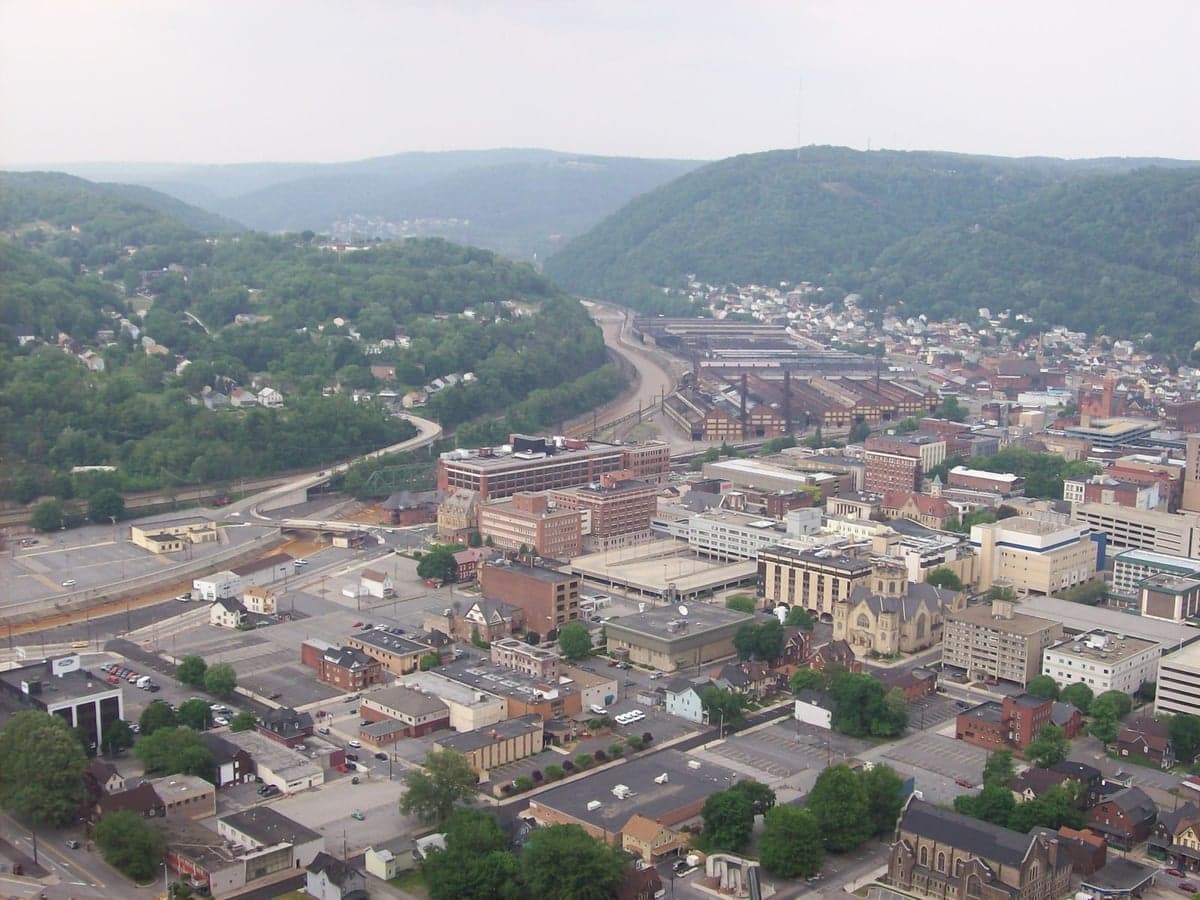
Photo: Wikipedia
Personal Sovereignty in Johnstown, PA
Strong independent fundamentals that actively favor personal liberty and low regulation.
What does Personal Sovereignty tell us?
Personal Sovereignty measures your capacity for self-reliance and independence with minimal government friction. Higher scores mean fewer barriers between you and the way you want to live... but it assumes you have the space you need and good neighbors.
What does this tell us?
Personal Sovereignty measures your capacity for self-reliance and independence with minimal government friction. Higher scores mean fewer barriers between you and the way you want to live... but it assumes you have the space you need and good neighbors.
State Policy
Energy independence: Net exporter (150% of energy produced in-state)
Personal Liberty
Homesteading

Personal Liberty Analysis
Johnstown, Pennsylvania, offers a personal sovereignty environment that is a mixed bag for the liberty-minded individual. While the city itself has seen decades of economic decline and population loss, which has paradoxically reduced some forms of government overreach, residents must contend with a state-level apparatus that is increasingly hostile to self-reliance. The key strategic advantage here is low land prices and a shrinking municipal footprint, which creates opportunities for those willing to operate below the radar, but the Commonwealth of Pennsylvania’s tax and regulatory structure demands careful navigation. For the survivalist or prepper, Johnstown represents a potential base of operations where you can acquire assets cheaply, but you must be prepared to fight for your rights at the state level.
Tax burden and regulatory posture in Pennsylvania’s Rust Belt
Pennsylvania’s tax posture is a critical factor for anyone prioritizing financial sovereignty. The state levies a flat 3.07% personal income tax and a 6% sales tax (with no local sales tax surcharge in Cambria County), which is moderate compared to high-tax states like New York or California. However, the real burden falls on property owners. Johnstown sits in the Greater Johnstown School District, where combined property tax rates can exceed 25 mills—meaning a $50,000 home (common here) costs roughly $1,250 annually in school taxes alone. This is a double-edged sword: low home prices keep the absolute tax bill low, but the millage rate is high relative to property values. On the regulatory front, Pennsylvania is not a "right-to-work" state, and the state Department of Environmental Protection (DEP) enforces strict environmental regulations that can complicate land use. For the prepper, the key takeaway is that Johnstown’s local government is relatively weak and underfunded—code enforcement is lax, and many properties operate with minimal oversight—but state-level agencies like the DEP and the Pennsylvania Game Commission have long reach. If you plan to build a bunker or modify a structure, expect to deal with state permits, not just local ones.
Self-defense and gun law specifics in Pennsylvania
Pennsylvania is a shall-issue state for concealed carry, meaning the sheriff of Cambria County must issue a License to Carry Firearms (LTCF) to any qualified applicant. There is no discretionary denial, no permit required to open carry, and no firearm registration at the state level. This is a strong point for personal sovereignty. The state preempts local gun ordinances, so Johnstown cannot enact its own bans—a critical protection against city council overreach. However, there are traps. Pennsylvania has a Universal Background Check law for handguns (private sales of handguns must go through a licensed dealer), though long gun private sales remain unregulated. The state also has a "duty to inform" law during traffic stops if you are carrying. For the survivalist, the legal landscape is favorable but not perfect. Magazine capacity is unrestricted, and there is no assault weapons ban. The biggest threat to gun rights here is not local but federal—Johnstown is within easy driving distance of Pittsburgh, a major hub for anti-gun activism, and state-level legislative battles over "red flag" laws are ongoing. As of 2026, no such law exists, but the political winds in Harrisburg are shifting. For now, you can stockpile, train, and carry with minimal interference, but monitor the state legislature closely.
Self-reliance and homesteading viability in Cambria County
Johnstown’s geography and zoning create real opportunities for self-reliance. The city itself is densely packed with narrow lots and aging row homes, but just outside city limits in Cambria County, you can find vacant lots for under $5,000 and small houses on 1-2 acres for under $100,000. Zoning in the rural townships (like Richland, Stonycreek, or Conemaugh) is minimal—most allow livestock, gardens, and accessory structures without extensive permitting. Off-grid feasibility is moderate. Pennsylvania has no statewide ban on rainwater collection, but the DEP regulates well drilling and septic systems. Solar panels are legal and net metering is available, but the state’s cloudy climate reduces efficiency. For the prepper, the biggest hurdle is the Pennsylvania Uniform Construction Code (UCC), which applies to any new dwelling or major renovation. This means you cannot simply throw up a cabin without inspections. However, many rural properties have existing "grandfathered" structures that are not up to code, and enforcement is complaint-driven. The strategic play is to buy a property with an existing house and a large barn, then use the barn for storage, workshop, and livestock without triggering new permits. Water is abundant—Johnstown sits at the confluence of the Stonycreek and Little Conemaugh rivers—but you must test for acid mine drainage, a legacy of the coal industry. Overall, homesteading is viable if you work within the system rather than against it.
Personal liberties: parental rights, medical autonomy, speech, and property
Pennsylvania’s record on personal liberties is uneven. Parental rights are strong in law but under attack in practice. The state has no "parental bill of rights" like Florida, but it does allow homeschooling with minimal oversight—you must file a notarized affidavit annually and maintain a portfolio, but there are no standardized testing requirements. Medical autonomy is a flashpoint. Pennsylvania has no vaccine mandate for adults, but it does require certain vaccines for school attendance, and exemptions are limited to medical and religious (no philosophical exemption). During the COVID era, the state imposed broad mandates that were upheld by courts, leaving a bitter taste for liberty-minded families. Property rights are relatively strong—eminent domain abuse is rare in Cambria County, and there is no statewide rent control. However, the Pennsylvania DEP has broad authority to enter private property for environmental inspections, and the Game Commission can restrict land use near waterways. Free speech is protected under the state constitution, but Johnstown is a small, insular community where social pressure can be as stifling as government action. For the prepper, the biggest concern is the lack of a state-level preemption on medical mandates—local health departments could theoretically impose restrictions, though Cambria County’s health department is underfunded and unlikely to act aggressively. The bottom line: you have more freedom here than in a coastal blue state, but less than in a true liberty haven like Idaho or New Hampshire.
Overall, Johnstown offers a strategic sovereignty profile that is best described as "low-cost, medium-freedom." The cheap real estate and weak local government create a buffer against financial overreach, but the state-level tax burden, regulatory complexity, and vulnerability to future mandates mean you cannot let your guard down. Compared to the national landscape, Johnstown ranks above the average blue city but below the average red state rural area. For the survivalist who wants to buy land cheap, build a network, and stay under the radar, it works—but only if you are willing to engage in constant political vigilance and legal compliance. The city’s decline is your opportunity, but Pennsylvania’s government is your adversary.

* Values derived from national, state, county, city and local statistics and may differ in a specific area. Last updated: 2026-05-01T07:24:42.000Z
Narrative content on this page is AI-generated and may contain mistakes. Verify any details that matter before acting on them.
ReloMaps may earn a commission from affiliate links at no extra cost to you.

