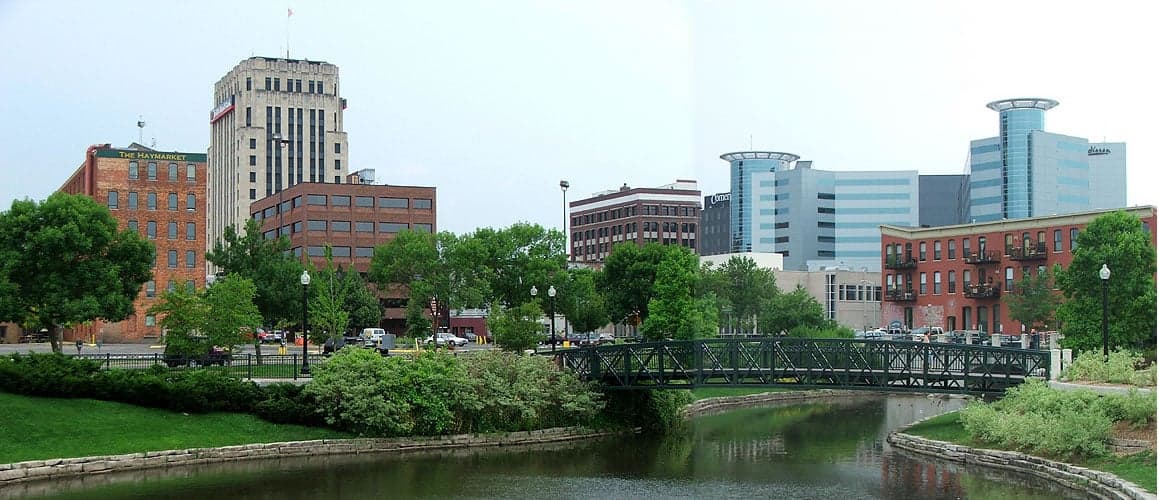
Photo: Wikipedia
Demographics of Kalamazoo, MI
Affluence Level in Kalamazoo, MI
A low-income area with significant economic hardship. Household wealth and educational attainment are well below national averages.
People of Kalamazoo, MI
Today, Kalamazoo's 73,132 residents form a moderately diverse, college-educated Midwestern city where a strong manufacturing and healthcare economy meets a growing service sector. The population is 60.2% white, 21.4% Black, 8.6% Hispanic, 1.8% East/Southeast Asian, and 0.9% Indian (subcontinent), with 5.8% foreign-born and 37.1% holding a bachelor's degree or higher. The city is known for its "Kalamazoo Promise" free college program, which has stabilized enrollment and attracted families, while its historic neighborhoods reflect distinct waves of settlement from New England Yankees to Southern Black migrants to recent Hispanic and Asian arrivals.
How the city was settled and grew
Kalamazoo was founded in 1829 by white settlers from New England and upstate New York, drawn by the fertile Kalamazoo River valley and the promise of land under the 1820 Land Act. The original village core, now the Bronson Park district, was platted by Titus Bronson, a Connecticut native, and quickly attracted Yankee farmers and merchants. By the 1840s, the Michigan Central Railroad made Kalamazoo a regional hub for wheat and lumber, drawing German and Irish immigrants who settled in the Stuart Neighborhood and Oakland-Winchell areas, building the city's first Catholic churches and breweries. The post-Civil War era brought Dutch Reformed families to the South Side, where they established Calvinist churches and the precursor to Western Michigan University. The 1900-1930 period saw a major wave of Polish and Italian immigrants, who concentrated in the Northside neighborhood, working in the paper mills and the Checker Cab Manufacturing plant. By 1950, Kalamazoo was 95% white, a classic Midwestern industrial city of 54,000.
Modern era (post-1965)
The 1965 Hart-Cellar Act and the Great Migration's later stages reshaped Kalamazoo's demographics. Between 1960 and 1980, the Black population surged from roughly 8% to over 20%, as African Americans from Mississippi, Arkansas, and Alabama moved north for jobs at the Upjohn Company (now Pfizer) and General Motors' Fisher Body plant. They settled primarily in the Northside and Eastside neighborhoods, creating a vibrant commercial corridor along North Burdick Street. White flight to suburbs like Portage and Texas Township accelerated after the 1967 Kalamazoo riots, leaving the city core increasingly Black and poor. The 1980s and 1990s brought a smaller but significant Hispanic wave, primarily Mexican and Puerto Rican families, who concentrated in the Edison neighborhood near the former Checker plant. The 2000s saw the arrival of East/Southeast Asian professionals—many Vietnamese and Korean—attracted by jobs at Stryker Corporation and Western Michigan University, settling in the West Main Hill area near the university. The Indian subcontinent community (0.9%) is smaller and more dispersed, with many working in healthcare and tech, living in the Oakland-Winchell and Milwood neighborhoods. The foreign-born share (5.8%) is below the national average, reflecting Kalamazoo's limited recent immigration compared to gateway cities.
The future
Kalamazoo's population is slowly stabilizing after decades of decline (it peaked at 85,000 in 1970). The Kalamazoo Promise, launched in 2005, has attracted middle-class families—both white and Black—back to the city, particularly to the Milwood and South Side neighborhoods, which are seeing modest gentrification. The Hispanic share (8.6%) is growing steadily through both immigration and higher birth rates, with the Edison neighborhood becoming a de facto Latino hub. The East/Southeast Asian share (1.8%) is plateauing, as Stryker and Pfizer have slowed hiring. The Indian subcontinent community (0.9%) is likely to grow slowly as healthcare and tech sectors expand. The Black population (21.4%) is aging in place, with younger Black families often choosing suburbs like Kalamazoo Township or Portage. The white share (60.2%) is declining but remains the majority, buoyed by Western Michigan University students and faculty. Over the next 10-20 years, expect Kalamazoo to become more Hispanic and slightly more Asian, while remaining a predominantly white and Black city with distinct, stable ethnic enclaves rather than full integration.
For a conservative-leaning mover, Kalamazoo offers a solid Midwestern city with a stable, if slowly diversifying, population. The Kalamazoo Promise is a powerful draw for families, and the city's neighborhoods remain distinct and walkable, though the Northside and Eastside face persistent poverty and crime challenges. The city is becoming more Hispanic and slightly more Asian, but the pace of change is gradual, and the overall character remains that of a traditional manufacturing and college town.

* Values derived from national, state, county, city and local statistics and may differ in a specific area. Last updated: 2026-04-29T19:09:31.000Z
Narrative content on this page is AI-generated and may contain mistakes. Verify any details that matter before acting on them.
ReloMaps may earn a commission from affiliate links at no extra cost to you.

