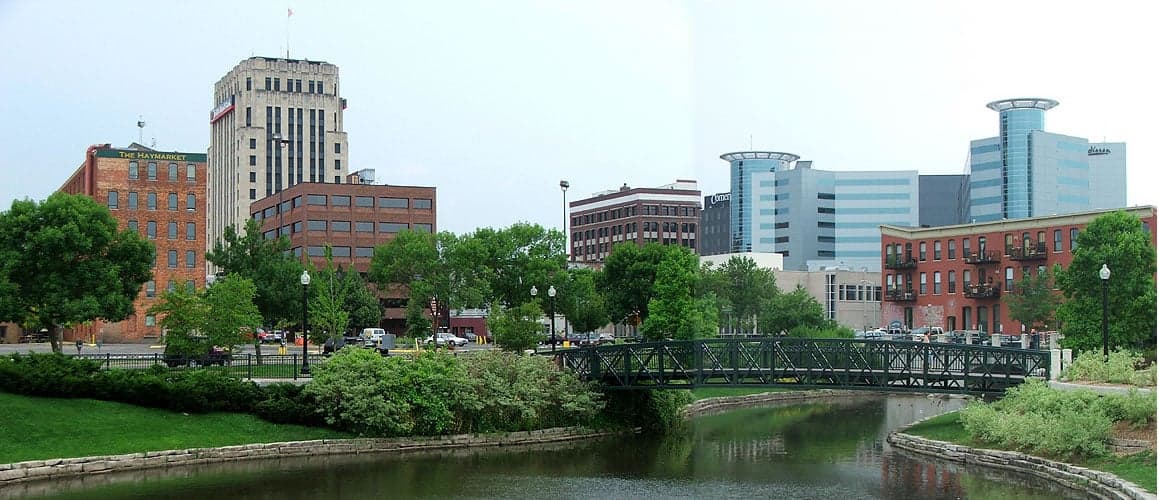
Photo: Wikipedia
Political ClimatePolitical Climate in Kalamazoo, MI
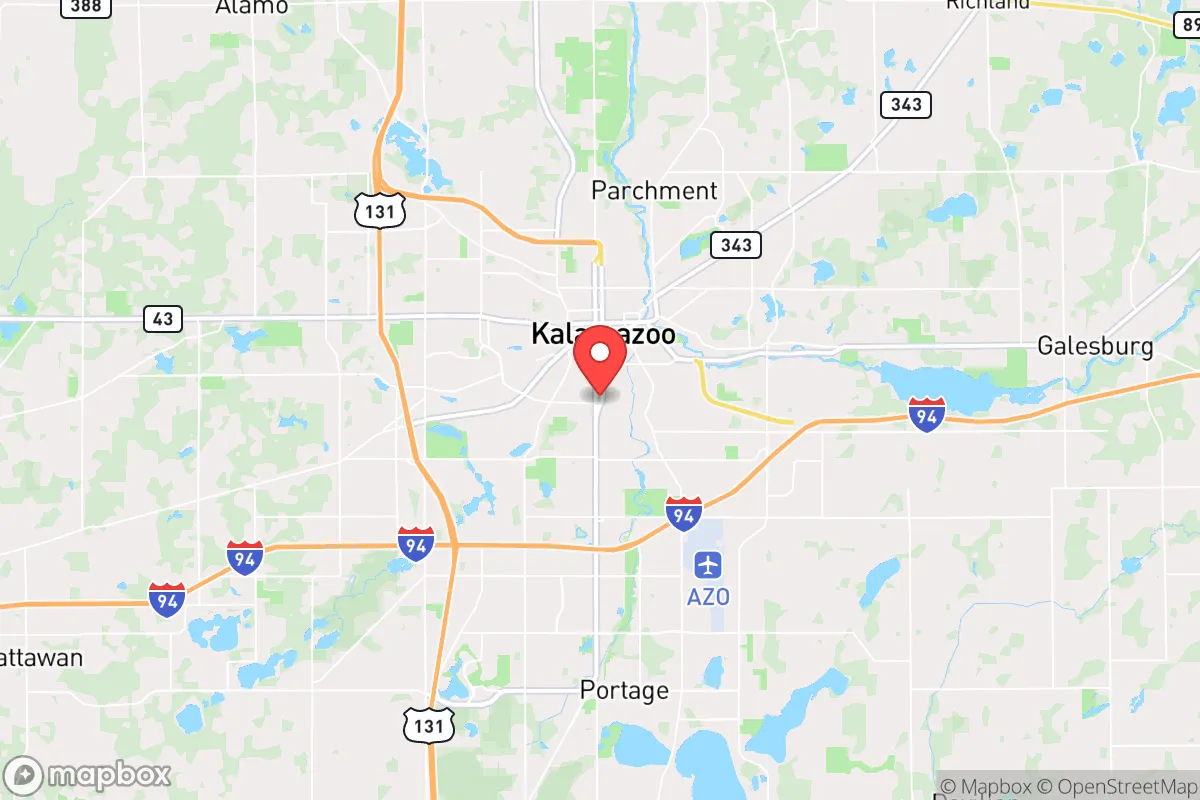
District shown is the primary district for this city’s centroid. Cities may span multiple districts.
Local Political AnalysisPolitical Analysis of Kalamazoo, MI
Kalamazoo sits in a bit of a political bubble compared to the rest of southwest Michigan. While the county as a whole leans slightly Republican with a Cook PVI of R+3, the city itself has shifted noticeably left over the past decade. If you’ve lived here as long as I have, you’ve watched the downtown core and university areas become increasingly progressive, while the surrounding townships and rural stretches—like Oshtemo, Texas Township, and even parts of Portage—still hold a more traditional, conservative line. The real tension isn’t between parties so much as it is between the city’s growing activist energy and the quieter, more skeptical suburban and rural voters who feel their values are being pushed aside.
How it compares
Drive 15 minutes in any direction and you’ll feel the difference. Head east to Battle Creek or south to Three Rivers, and you’re in communities where the political conversation is still about taxes, local control, and keeping government out of your business. Up north in Grand Rapids, you get a similar city-versus-suburbs split, but Kalamazoo’s shift feels more abrupt because the city is smaller and the progressive influence from Western Michigan University and Kalamazoo College is concentrated. In the 2020 election, Kalamazoo County went for Biden by about 14 points, but that’s almost entirely driven by the city precincts; the rural townships voted heavily for Trump. That gap has only widened since. What used to be a live-and-let-live community now feels like two different worlds sharing a ZIP code.
What this means for residents
For those of us who value personal freedoms and limited government, the trend is concerning. The city council has pushed through ordinances that expand government reach into housing, zoning, and even local business operations—things that used to be left to the market or the neighborhood. There’s a growing appetite for mandates and top-down solutions, whether it’s around energy use, rental regulations, or public health measures. Meanwhile, the county commission, which is more balanced, often finds itself at odds with the city’s agenda. That friction means you can’t assume one set of rules applies everywhere. If you live in the city limits, you’re under a more activist government; if you’re in the township, you still have a say in how your tax dollars are spent and what freedoms you keep. The long-term worry is that the city’s progressive momentum will eventually spill over into county-wide policies, especially as younger, more liberal residents move into the suburbs.
On the cultural side, Kalamazoo still has its charms—great breweries, a solid arts scene, and the Kalamazoo Promise that sends kids to college. But the political climate is becoming more polarized, and that’s starting to affect everyday life. You see it in school board meetings, in local elections, and in the way neighbors talk to each other. The old “Kalamazoo nice” is wearing thin. If you’re looking for a place where government stays out of your way and lets you live your life, the surrounding townships are still a good bet. But the city itself is on a path that many of us find hard to recognize—and harder to support.

State Political ClimatePolitical Climate in Michigan
State Political AnalysisPolitical Environment in the State
Michigan has long been a political battleground, but over the past decade it has shifted from a reliably blue state to a true purple toss-up, with a slight but concerning lean toward progressive control at the state level. The 2024 election saw Donald Trump win the state by roughly 1.5 points, a stark reversal from 2020 when Joe Biden carried it by nearly 3 points, and a far cry from the 10-point margins Democrats enjoyed in the 1990s and 2000s. However, this presidential flip masks a deeper reality: Democrats now hold a trifecta in Lansing for the first time in 40 years, having passed a sweeping progressive agenda in 2023-2024 that has many conservatives questioning whether the state is still a place where their values and freedoms are respected.
Urban vs. rural divide
The political map of Michigan is a tale of two peninsulas, but more accurately a tale of three distinct regions. The Detroit metro area, particularly Wayne County (Detroit proper), Oakland County (suburbs like Royal Oak and Ferndale), and Washtenaw County (Ann Arbor), is the engine of Democratic power, generating massive vote margins that often decide statewide races. In 2024, Wayne County alone gave Kamala Harris a 300,000-vote advantage, while Oakland County added another 100,000. Meanwhile, the western side of the state, including Grand Rapids (Kent County) and Holland, has been trending leftward as well, with Kent County flipping to Biden in 2020 and staying blue in 2024. The rural and exurban areas—the Thumb region, the Upper Peninsula, and the northern Lower Peninsula—are overwhelmingly Republican, with counties like Missaukee and Osceola routinely voting 70%+ for the GOP. The real action is in the "blue wall" counties of Macomb, Monroe, and Saginaw, which have become the ultimate swing territory. Macomb County, a working-class suburban area north of Detroit, voted for Trump in 2024 after backing Biden in 2020, reflecting the broader national trend of blue-collar voters abandoning the Democratic Party.
Policy environment
The policy landscape in Michigan has shifted dramatically since Democrats took full control in 2023. The most consequential change was the repeal of the state's "right-to-work" law, which had been a cornerstone of economic freedom for over a decade. This was paired with the restoration of prevailing wage requirements on state construction projects, effectively raising costs and unionizing more of the workforce. On taxes, the state's income tax rate was temporarily reduced from 4.25% to 4.05% due to a 2015 law that triggers cuts when revenues exceed a certain threshold, but the Democratic legislature has signaled they may repeal that trigger mechanism. Property taxes remain high, with the average effective rate around 1.5%, and there is no homestead exemption for primary residences. On education, the state has expanded the "Michigan Reconnect" program for free community college and increased funding for public schools, but parental rights have taken a hit with the passage of a comprehensive LGBTQ+ nondiscrimination law that critics argue undermines religious liberty and parental notification requirements. Election laws were also loosened with the passage of Proposal 2 in 2022, which enshrined nine days of early voting, automatic voter registration, and no-excuse absentee voting into the state constitution—changes that many conservatives worry will erode election integrity.
Trajectory & freedom
Michigan is clearly on a trajectory toward less personal freedom, particularly for conservatives. The most alarming recent development was the passage of a "red flag" law in 2023, which allows courts to temporarily seize firearms from individuals deemed a threat to themselves or others, without a criminal conviction or a full hearing. This was followed by universal background checks for all firearm purchases and a safe storage law that requires guns to be locked up when not in use. On the medical autonomy front, the state has expanded abortion access by repealing a 1931 ban and codifying the right to abortion in state law, but this has come alongside a push to mandate COVID-19 vaccines for healthcare workers and a general erosion of medical freedom. Parental rights have been under assault as well, with the state's new LGBTQ+ nondiscrimination law being interpreted by some school districts to require teachers to keep a child's gender identity secret from parents. The state also passed a "clean energy" package that mandates 100% carbon-free electricity by 2040, effectively banning new natural gas plants and imposing costly regulations on homeowners and businesses. On the positive side, Michigan has no state-level income tax on Social Security benefits, and property taxes are capped at 5% annual increases under Proposal A, providing some stability for long-term homeowners.
Civil unrest & political movements
Michigan has been a flashpoint for political activism on both sides. The 2020 "Operation Gridlock" protests at the state capitol in Lansing, where thousands of armed protesters demonstrated against Governor Gretchen Whitmer's COVID-19 lockdowns, were a defining moment for the conservative movement in the state. This led to the rise of groups like the Michigan Conservative Coalition and the Michigan Freedom Fund, which have been active in school board races and local elections. On the left, the "Wolverine Watchmen" militia plot to kidnap Governor Whitmer in 2020 highlighted the extreme fringe, but also galvanized progressive activism. Immigration politics are relatively muted compared to border states, but the city of Detroit has declared itself a "sanctuary city," and Washtenaw County has similar policies limiting cooperation with ICE. Election integrity remains a hot-button issue, with the 2020 election in Michigan being the subject of numerous lawsuits and audits, though no widespread fraud was ever proven. The 2024 election saw a smoother process, but distrust remains high, particularly in rural counties where Dominion voting machines are still viewed with suspicion. The most visible political movement right now is the "Moms for Liberty" chapter in Oakland County, which has been fighting against critical race theory and LGBTQ+ curriculum in schools, and has seen some success in local school board elections.
Projection
Looking ahead 5-10 years, Michigan is likely to become more polarized and more progressive at the state level, even as the presidential race remains competitive. The demographic trends favor Democrats: the Detroit suburbs are becoming more diverse and educated, while rural areas are shrinking. The 2024 election showed that Trump can still win the state, but the GOP's path is narrowing as the "blue wall" counties of Macomb and Saginaw become less reliable. The Democratic trifecta is likely to hold for at least the next few cycles, meaning more progressive legislation on gun control, energy mandates, and labor laws. However, there is a wildcard: the state's growing Hispanic population, particularly in the Grand Rapids area, is not voting as reliably Democratic as national trends suggest, and could become a swing bloc. For a conservative moving to Michigan, the best bet is to target the western side of the state—places like Ottawa County (Holland) or the Grand Rapids exurbs—where local governments are pushing back against Lansing's overreach. The Upper Peninsula remains a conservative stronghold, but its population is declining and its economy is struggling. The bottom line: Michigan is still a beautiful state with great outdoor recreation and a strong manufacturing base, but you'll need to be strategic about where you live and prepared to fight for your freedoms at the local level.
For a new resident, the practical takeaway is this: Michigan offers a lower cost of living than many coastal states and a genuine four-season lifestyle, but you are moving into a state where the political winds are blowing against traditional conservative values. If you choose to settle here, focus on counties like Livingston (Howell), Macomb (Armada), or Ottawa (Holland), where local school boards and county commissions are pushing back against the progressive agenda from Lansing. Be prepared for higher taxes, more regulations on your property and business, and a constant battle over your Second Amendment rights. But if you value community, hunting, fishing, and a slower pace of life, Michigan can still be a great place to raise a family—just know that you'll need to stay engaged and vote in every local election to protect what's left of your freedoms.
* Values derived from national, state, county, city and local statistics and may differ in a specific area. Last updated: 2026-04-29T19:09:31.000Z
Narrative content on this page is AI-generated and may contain mistakes. Verify any details that matter before acting on them.
ReloMaps may earn a commission from affiliate links at no extra cost to you.

