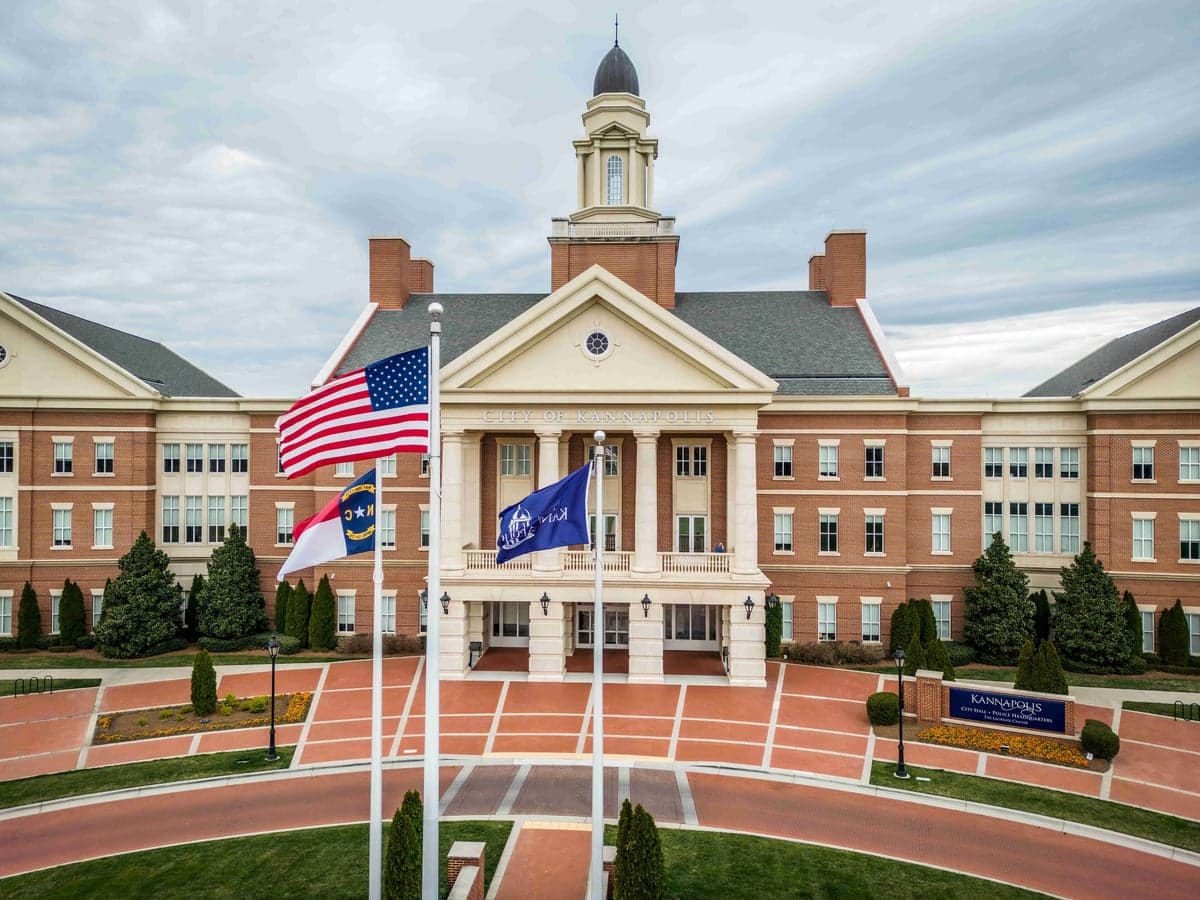
Photo: Wikipedia
Demographics of Kannapolis, NC
Affluence Level in Kannapolis, NC
A middle-class area roughly in line with national averages across income, home values, education, and employment.
People of Kannapolis, NC
Kannapolis, North Carolina is a city of 56,470 residents defined by its working-class roots and a demographic profile that is majority-white (56.2%) with a substantial Black minority (23.1%) and a growing Hispanic population (12.4%). The city’s identity remains tied to its textile-mill origins, but the population is now more diverse and suburban than at any point in its history. Foreign-born residents make up just 4.3% of the population, a relatively low share that reflects Kannapolis’s character as a domestic-migration destination rather than an international gateway. The city is denser than surrounding Cabarrus County, with a blue-collar feel that appeals to families seeking affordable housing and proximity to Charlotte’s job market.
How the city was settled and grew
Kannapolis was not a colonial settlement or a 19th-century crossroads; it was a planned company town founded in 1906 by James W. Cannon, owner of Cannon Mills. The city’s entire early population was drawn by the promise of steady work in the textile industry. Cannon built the mill and then constructed housing for workers, creating distinct neighborhoods that still bear the imprint of that era. Mill Village, the original residential core, housed the first wave of white mill workers from the surrounding rural Piedmont—families who left exhausted farms for the relative stability of mill wages. These neighborhoods were strictly segregated by race and occupation. Logan Village, built slightly later, housed skilled workers and supervisors, while Black workers were confined to Westside, a separate enclave on the western edge of town with inferior housing and no paved streets until the 1950s. By 1920, Kannapolis had grown to roughly 5,000 residents, nearly all of them tied directly to Cannon Mills. The mill’s paternalistic control extended to every aspect of life—company stores, company churches, and company housing—creating a closed, insular community that persisted for decades. The Great Depression barely slowed growth, as the mill remained open, and the population reached 18,000 by 1950. The final wave of traditional mill workers arrived in the 1950s and early 1960s, drawn from the same Appalachian and Piedmont source areas, before the industry began its long decline.
Modern era (post-1965)
The 1965 Hart-Cellar Act had little direct effect on Kannapolis, as the city never attracted significant international immigration. Instead, the post-1965 era was defined by the collapse of the textile economy and the resulting demographic churn. Cannon Mills was sold in 1982, and by the 1990s most mill jobs had vanished. The white population, which had been nearly 90% in 1970, began a slow decline as younger families left for Charlotte’s suburbs. Oakwood, a mid-century subdivision built for mill supervisors, saw its original white families gradually replaced by a mix of Black and white newcomers. The Black population, historically concentrated in Westside, began to spread into formerly white neighborhoods like Englewood and Jackson Park as housing discrimination eased and the mill’s segregationist policies faded. The Hispanic population, negligible before 1990, grew rapidly after 2000 as Latino workers arrived to fill construction and service jobs in the Charlotte metro’s expanding periphery. Downtown Kannapolis, once a white commercial district, now has a visible Hispanic presence in small businesses and rental housing. The Asian population remains tiny at 1.3% (East/Southeast Asian) and 1.0% Indian, concentrated among professionals drawn to the North Carolina Research Campus, a biotechnology hub that opened in 2008 on the site of the old mill. The college-educated share stands at 28.1%, well below the national average, reflecting the city’s persistent blue-collar character even as the economy diversifies.
The future
Kannapolis is not homogenizing into a single demographic bloc; rather, it is slowly tribalizing into distinct enclaves along lines of race and income. The white population, now 56.2%, is aging and concentrated in established neighborhoods like Mill Village and Oakwood, while younger white families increasingly choose newer subdivisions on the city’s southern edge, closer to Concord and Charlotte. The Black population, 23.1%, remains anchored in Westside and Englewood, with some upward mobility into Jackson Park. The Hispanic population, 12.4%, is the fastest-growing segment, concentrated in Downtown and the western corridor along NC-3, and is likely to reach 18-20% by 2035 through both natural increase and continued domestic migration from other parts of North Carolina. The foreign-born share, at 4.3%, is low but rising slowly, driven by Hispanic immigration rather than Asian or Indian inflows. The East/Southeast Asian and Indian communities, each around 1%, are small and stable, tied to the Research Campus and unlikely to grow significantly unless the biotech sector expands. The next 10-20 years will likely see Kannapolis become more Hispanic and more suburban, with the white share continuing a gradual decline toward 50% and the Black share holding steady. The city will remain a predominantly domestic-migration destination, not an immigrant gateway, and its blue-collar identity will persist even as the Research Campus brings a modest professional class.
For someone moving to Kannapolis now, the city offers a stable, affordable, and increasingly diverse community that retains its working-class roots. The population is not fragmenting into hostile camps, but it is sorting into neighborhoods that reflect clear racial and economic patterns. New residents should expect a place where the old mill-town culture still lingers, where Hispanic growth is reshaping the downtown, and where the biggest demographic story is the slow, steady diversification of a once-homogeneous company town. The city is becoming a more typical Southern suburb—less insular, more varied, but still grounded in the practical, family-oriented values that first drew people to the mill.

* Values derived from national, state, county, city and local statistics and may differ in a specific area. Last updated: 2026-10-10T16:27:50.000Z
Narrative content on this page is AI-generated and may contain mistakes. Verify any details that matter before acting on them.
ReloMaps may earn a commission from affiliate links at no extra cost to you.

