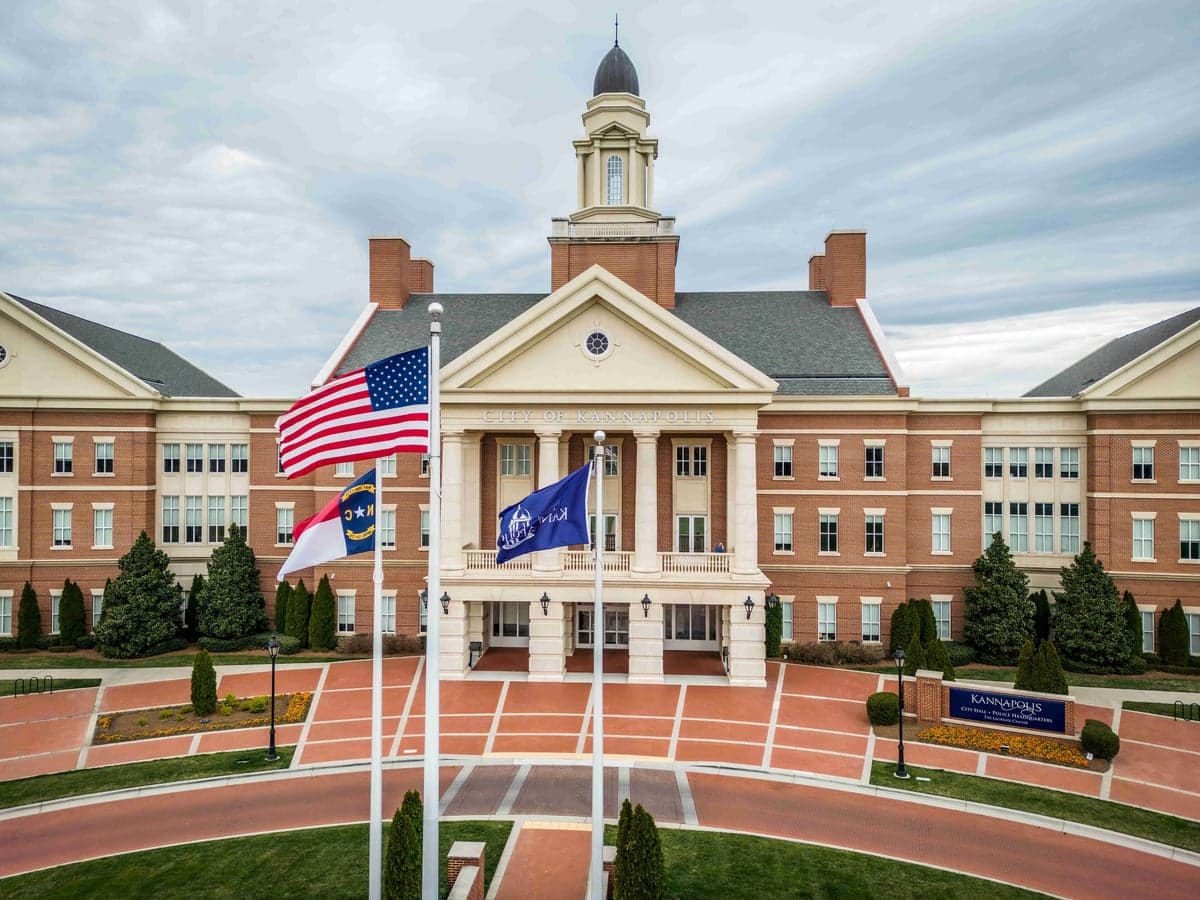
Photo: Wikipedia
Personal Sovereignty in Kannapolis, NC
Moderate friction. Expect trade-offs in some aspect of personal liberty and independence.
What does Personal Sovereignty tell us?
Personal Sovereignty measures your capacity for self-reliance and independence with minimal government friction. Higher scores mean fewer barriers between you and the way you want to live... but it assumes you have the space you need and good neighbors.
What does this tell us?
Personal Sovereignty measures your capacity for self-reliance and independence with minimal government friction. Higher scores mean fewer barriers between you and the way you want to live... but it assumes you have the space you need and good neighbors.
State Policy
Energy independence: Importer (15% of energy produced in-state)
Personal Liberty

Personal Liberty Analysis
For the individualist or prepper evaluating Kannapolis, North Carolina, the personal sovereignty environment is defined by a state-level commitment to limited government that largely overrides any municipal tendencies toward overreach. While Kannapolis itself is a growing city with typical zoning and code enforcement, North Carolina’s constitutional carry law, right-to-work status, and absence of a state income tax on a flat-rate basis create a legal foundation where self-reliance is not just tolerated but structurally supported. The key question for a survivalist-minded relocator is whether Kannapolis’s local ordinances and growth trajectory erode that foundation or leave it intact — and the answer, as of 2026, leans toward the latter, with important caveats around urban density and future annexation.
Tax burden and regulatory posture: How North Carolina’s fiscal restraint protects your autonomy
North Carolina’s tax structure is a major draw for those seeking to minimize government extraction from their labor. The state levies a flat personal income tax rate of 4.5% as of 2026, down from nearly 7% a decade ago, with a constitutional cap that prevents future legislatures from raising it above 7%. There is no state tax on Social Security benefits, and the standard deduction is generous. Property taxes in Kannapolis are set by Cabarrus and Rowan counties (the city straddles both), with rates around $0.65 to $0.72 per $100 of assessed value — well below the national average. This means a $300,000 home carries an annual tax bill of roughly $2,000, leaving more capital in your hands for supplies, land, or defensive investments. Sales tax is 7.25% (state plus local), but groceries and prescription drugs are exempt. The regulatory posture is equally favorable: North Carolina is a right-to-work state, meaning you cannot be forced to join a union as a condition of employment, and occupational licensing requirements are less burdensome than in many Northeastern states. For a prepper, this translates to fewer bureaucratic hurdles when starting a side business in trades like welding, construction, or food preservation. The state also has a relatively low minimum wage ($7.25, matching federal), which keeps labor costs down for small-scale homestead operations. However, Kannapolis’s status as a former mill town turned bedroom community means it has active code enforcement in residential areas — expect pushback if you try to run a commercial operation from a home in a subdivision. The city’s Unified Development Ordinance requires permits for structures over 200 square feet, so a large shed or workshop needs approval.
Self-defense and gun law specifics: Constitutional carry and castle doctrine in Kannapolis
North Carolina is a strong Second Amendment state, and Kannapolis residents benefit directly from that. Since 2023, the state has permitted permitless concealed carry for adults 18 and older who are legally allowed to possess a firearm — no training course, no background check beyond the purchase, and no waiting period required for handgun purchases from private sellers. The state also has a robust castle doctrine: there is no duty to retreat in your home, vehicle, or workplace, and deadly force is presumed justified if an intruder has unlawfully and forcibly entered. Stand-your-ground protections extend to any place you have a legal right to be. Kannapolis itself has no local gun ordinances that exceed state law — no magazine capacity bans, no assault weapon restrictions, and no extra registration requirements. The city’s police department, with about 100 sworn officers, has a response time averaging 8-12 minutes in suburban areas, which is decent but not instantaneous. For a prepper, this reinforces the need for personal defensive capability. One practical consideration: Kannapolis is within an hour of Charlotte, where city-owned property (like parks or government buildings) may have restrictions, but those do not apply within Kannapolis city limits. The state also allows open carry without a permit, though in practice, doing so in a growing suburban area may attract unwanted attention from neighbors or law enforcement. For those with a concealed carry permit (still available for reciprocity with other states), the training requirement is a one-time, eight-hour course. Overall, the legal framework here is permissive enough that a survivalist can maintain a well-stocked armory without fear of local overreach, provided storage complies with general safety laws.
Self-reliance and homesteading viability: Lot sizes, zoning, and off-grid feasibility in Kannapolis
Kannapolis presents a mixed picture for the serious homesteader. The city’s historic core features small lots (often 0.1 to 0.25 acres) from its mill-village origins, but newer subdivisions and annexed rural areas offer parcels from 0.5 to 2 acres. For true self-reliance — think large gardens, livestock, and rainwater collection — you will need to look at the unincorporated fringes of Cabarrus or Rowan counties, where zoning is more lenient. Within city limits, chickens are allowed (hens only, no roosters) on lots of at least 0.25 acres, and beekeeping is permitted with registration. Goats, pigs, and cattle are generally prohibited in residential zones, though horses may be allowed on lots of 2+ acres in certain agricultural-residential districts. Off-grid feasibility is limited by city code: all habitable structures must be connected to municipal water and sewer where available, and solar panels are allowed but must meet building code and HOA approval if applicable. Rainwater collection is legal for non-potable uses (irrigation, livestock) but cannot be the primary water source for a dwelling. For the prepper who wants to be truly independent, the best strategy is to buy land in the surrounding rural areas — like southern Rowan County or northern Cabarrus County — where well water, septic systems, and larger acreage (5-20 acres) are common, and then commute into Kannapolis for work or supplies. These areas have no HOA restrictions and minimal county-level building codes, allowing for earth-sheltered homes, root cellars, and off-grid power systems. The trade-off is longer drive times to grocery stores and medical facilities, but for those prioritizing sovereignty, it is a worthwhile exchange.
Personal liberties: Parental rights, medical autonomy, speech, and property protections
North Carolina has become a battleground for personal liberties, and the state’s tilt toward individual rights is generally favorable for a conservative prepper. Parental rights are strongly protected: the state’s Parents’ Bill of Rights, enacted in 2023, requires schools to obtain parental consent before administering any mental health or medical survey, and it prohibits instruction on gender identity and sexual orientation in grades K-4. Parents also have the right to review all instructional materials and to opt their children out of any activity they find objectionable. Medical autonomy is more nuanced: North Carolina has not expanded Medicaid under the Affordable Care Act (as of 2026), which limits access for low-income individuals but also reduces government entanglement in healthcare. Vaccine mandates for private employers are prohibited by state law, and there is no state-level vaccine passport system. However, the state does require certain immunizations for school attendance (with medical and religious exemptions available). For the prepper, this means you can refuse a COVID-19 or flu shot without losing your job, but you may face pushback from some healthcare providers. Free speech protections are robust, with no state-level hate speech laws that criminalize political expression. Property rights are constitutionally protected, and North Carolina has a strong eminent domain law that requires “public use” (not just public benefit) for takings, though the city of Kannapolis has used eminent domain in the past for redevelopment projects like the downtown revitalization. For a survivalist, the key risk is future zoning changes as the city grows — annexation of rural areas can bring new restrictions. The best hedge is to buy property with existing agricultural zoning or in a county with minimal land-use regulation.
Overall, Kannapolis offers a solid base for personal sovereignty compared to most urban areas in the Northeast or West Coast, but it is not a libertarian paradise. The state-level framework — constitutional carry, low taxes, parental rights, and right-to-work — provides a strong foundation for self-reliance. The city itself is moderate, with typical suburban codes that constrain full homesteading but do not actively suppress individual freedoms. For the prepper or survivalist, the smart play is to live just outside city limits in unincorporated Cabarrus or Rowan County, where you can own acreage, keep livestock, and build off-grid infrastructure without municipal interference, while still accessing Kannapolis’s jobs, schools, and healthcare. Compared to areas like Portland, Oregon, or New York’s Hudson Valley, Kannapolis is a clear win for autonomy. Compared to rural Idaho or Montana, it is a compromise — but one that offers better economic opportunity and lower isolation risk. The sovereignty here is real, but it requires strategic location choices and a willingness to stay engaged with local politics to protect it.

* Values derived from national, state, county, city and local statistics and may differ in a specific area. Last updated: 2026-10-10T16:27:50.000Z
Narrative content on this page is AI-generated and may contain mistakes. Verify any details that matter before acting on them.
ReloMaps may earn a commission from affiliate links at no extra cost to you.

