 Popular
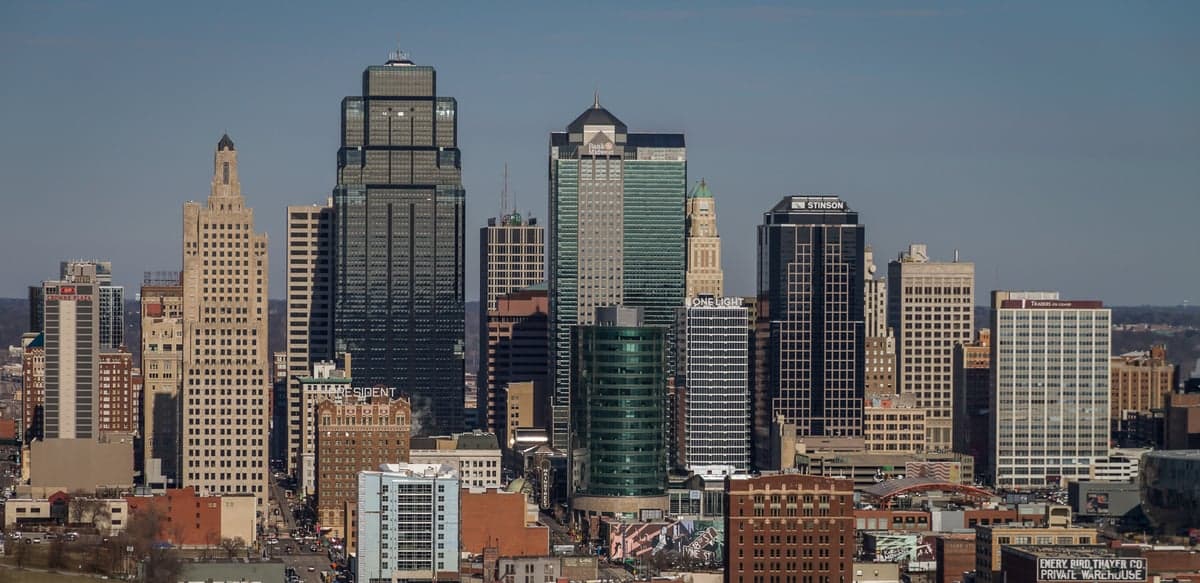
Photo: Wikipedia
Demographics of Kansas City, MO
Affluence Level in Kansas City, MO
A middle-class area roughly in line with national averages across income, home values, education, and employment.
People of Kansas City, MO
Kansas City, Missouri, is home to 508,233 residents who form a racially and economically diverse urban core within a larger metropolitan area. The city’s population is 54.5% white, 25.5% black, 12.3% Hispanic, 1.9% East/Southeast Asian, and 0.7% Indian, with only 4.2% foreign-born — a notably low share for a major U.S. city. Its character is defined by a strong Midwestern work ethic, deep-rooted neighborhood identities, and a growing tension between revitalized downtown districts and historically segregated residential areas. For conservative-leaning movers, Kansas City offers a relatively affordable, family-oriented urban environment with a modest but stable population trajectory.
How the city was settled and grew
Kansas City’s population history begins with its founding in the 1830s as a river port and trading post at the confluence of the Missouri and Kansas Rivers. The city’s early growth was driven by westward expansion, the Santa Fe Trail, and later the railroad industry, which drew a mix of Anglo-American settlers from the Upper South and Midwest, along with German and Irish immigrants who built the city’s infrastructure. By the late 19th century, the stockyards and meatpacking plants attracted a wave of Eastern European immigrants, particularly Poles and Italians, who settled in the West Bottoms and the Northeast neighborhoods like Columbus Park. The Great Migration (1910–1970) brought tens of thousands of black Americans from the rural South, who established vibrant communities in 18th & Vine and the East Side, making Kansas City a major hub of jazz and black entrepreneurship. The city’s population peaked at 507,087 in 1970, with a white majority of roughly 80% and a black minority of about 18%.
Modern era (post-1965)
After the 1965 Hart-Cellar Act, Kansas City did not experience the large-scale immigration seen in coastal cities. The foreign-born share remained below 5%, with the most notable post-1965 influx being Vietnamese refugees in the 1970s and 1980s, who settled in the Northeast and Blue Valley industrial corridors. Domestic migration patterns dominated: white flight to the Northland suburbs (Platte and Clay counties) accelerated after the 1968 riots, hollowing out the urban core and leaving the city’s population at 435,146 by 1990. The black population concentrated in the East Side and Troost Avenue corridor, while Hispanic growth — primarily Mexican and Central American — began in the 1990s, centered in the Westside and Northeast. Since 2000, the city has regained population (up from 441,545 in 2000 to 508,233 today), driven by a modest white and Hispanic return to downtown neighborhoods like the Crossroads Arts District and River Market. The East/Southeast Asian population (1.9%) remains small and concentrated in the Brookside and Waldo areas, while the Indian subcontinent population (0.7%) is scattered, with no single ethnic enclave.
The future
Kansas City’s population is slowly diversifying but remains bifurcated by race and geography. The white share has declined from 64% in 2000 to 54.5% today, while the Hispanic share has grown from 6.9% to 12.3% over the same period — the fastest-growing demographic. The black share has held steady at roughly 25%, with little net in-migration from other regions. The foreign-born share (4.2%) is unlikely to rise sharply, as the city lacks the job base or chain migration networks of gateway cities. The most likely scenario over the next 10–20 years is a gradual homogenization of the urban core (downtown, Midtown, and the Crossroads) into a younger, whiter, college-educated population (37.8% college educated), while the East Side remains predominantly black and the Northeast and Westside become increasingly Hispanic. The city is not tribalizing into distinct enclaves so much as reinforcing existing patterns, with little cross-racial mixing outside of a few gentrifying blocks.
For a conservative-leaning mover, Kansas City is becoming a more polarized place: a revitalized, amenity-rich downtown for professionals and empty-nesters, set against a struggling, underinvested East Side and a growing Hispanic working-class corridor in the Northeast. The low foreign-born share and stable black population mean less cultural churn than in coastal cities, but the city’s racial geography remains stubbornly segregated. A move here offers affordability and a strong sense of neighborhood identity, but requires accepting that the city’s demographic future is one of slow, uneven change rather than rapid transformation.

* Values derived from national, state, county, city and local statistics and may differ in a specific area. Last updated: 2026-04-30T00:39:29.000Z
Narrative content on this page is AI-generated and may contain mistakes. Verify any details that matter before acting on them.
ReloMaps may earn a commission from affiliate links at no extra cost to you.

