Photo: Wikipedia
Quality of Life in Labette County
A livable area that tracks near national norms for affordability, walkability, and neighborhood health.
What does Quality of Life tell us?
Quality of Life measures an area by evaluating factors like cost of living, nearby amenities, country club access, airport proximity, socioeconomic signals and neighborhood character. For large states, this is a general average — quality of life can vary dramatically between metro areas, suburbs, and rural communities within the same state.
What does this tell us?
Quality of Life measures an area by evaluating factors like cost of living, nearby amenities, country club access, airport proximity, socioeconomic signals and neighborhood character. For large states, this is a general average — quality of life can vary dramatically between metro areas, suburbs, and rural communities within the same state.
Cost of Living
49% below national average
184%
The Real Cost of Living in Labette County for 2026
| Tier | Individual | Family (4) |
|---|---|---|
| Survival | $12k | $22k |
| Comfortable | $20k | $30k |
| Luxury | $91k+ | $140k+ |
| Elite (Top 5%) | $107k+ | $165k+ |
Quality-of-Life Analysis
Labette County, Kansas, offers a spectrum of quality-of-life options that range from the modest urban conveniences of its historic county seat to the quiet, self-reliant rhythm of its unincorporated prairie hamlets. With an overall cost of living index at 51 (dramatically below the US average of 100), a median home value of $92,100, and a staggeringly short average commute of just over 15 minutes, the county attracts a mix of budget-conscious retirees, manufacturing and healthcare workers, and families seeking a low-stakes, land-rich lifestyle. The real choice here is between the centralized services of its larger towns and the deep affordability and solitude of its smaller communities.
Largest town(s) & population centers
Parsons, the county's largest city with roughly 10,000 residents, is the undisputed hub for employment, shopping, and services. Daily life here revolves around major employers like the Kansas Army Ammunition Plant (a significant local employer), Labette Health hospital (the region's primary medical center), and the Neosho County Community College's technical campus. Residents have access to a Walmart Supercenter, a regional hospital, and a surprising number of fast-casual dining options. The housing stock is older, with median home values hovering near the county-wide figure of $92,100, and median rent at $729. For those who need a grocery store within walking distance or a short drive to a pharmacy, Parsons is the clear choice. Altamont, the other notable population center with about 1,000 residents, operates more as a satellite bedroom community to Parsons, offering the county courthouse, a few locally-owned eateries, and a quieter but still connected daily life. Both towns provide the practical foundation of a low-cost existence: you can own a three-bedroom home here for less than the down payment on many coastal homes, and your commute to work or the grocery store rarely exceeds 10 minutes.
Smaller towns & rural pockets
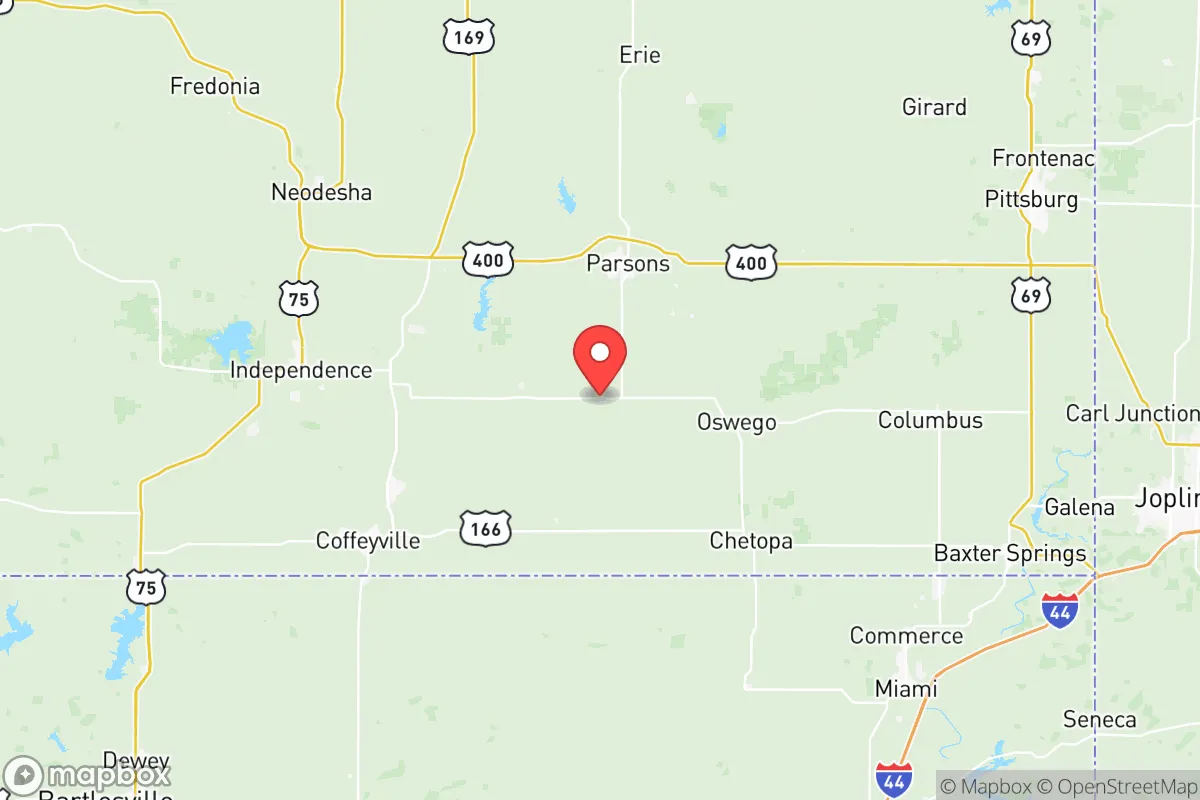
Beyond the main routes, Labette County is a patchwork of tiny incorporated towns and unincorporated places, each with a distinct character. Cherokee, a former mining town of about 650 people, sits in the far southeast corner and feels firmly rooted in its rural history, with a grain elevator and a few stop signs as its main landmarks. Oswego, the county seat, is slightly larger than Cherokee but remains a sleepy government town where the courthouse square and the old river bridge are the center of attention. Mound Valley, with a population barely over 400, is a tiny farming community where life is defined by the planting calendar and the local church. Edna (about 400 residents) and Labette (under 100) are the quietest of the county's named settlements, offering little more than a post office and a few homes on large lots. For the truly remote, unincorporated areas like Angola or Chicopee offer land parcels of five to forty acres at prices that can dip below $5,000 per acre, where the nearest paved road might be a mile away and a trip to a full-service grocery store is a 20-minute drive. These pockets are ideal for those who prioritize land, privacy, and the ability to raise animals or garden, accepting a significant trade-off in shopping, dining, and social infrastructure.
Cost & lifestyle range
The cost of living range within Labette County is remarkably narrow when compared cash-on-cash, but the lifestyle options create a genuine spread. At the upper end of convenience, a well-maintained 1,500-square-foot home in Parsons's newer subdivisions might list for $130,000–$160,000, still producing a monthly mortgage payment well below the county's median rent of $729. Here, you have the shortest commutes (often under 10 minutes) and immediate access to healthcare and groceries. At the lower end, a modest two-bedroom house in Cherokee or a fixer-upper on a few acres near Mound Valley can be purchased for $40,000–$60,000, and property taxes on such a home will often run under $600 per year. The trade-off is stark: in Cherokee, the nearest supermarket is a 15- to 20-minute drive, and employment opportunities are almost non-existent, forcing a commute to Parsons, Coffeyville, or even Joplin (Missouri, about 45 minutes away). The median county-wide utility bill for a typical 1,200-square-foot home runs about $180–$220 per month, which, combined with the low taxes, keeps the total monthly shelter cost for a paid-off home under $500. The spread, then, is not about a range of prices so much as a range of trade-offs: you trade proximity to services for more land and lower cash outlay, or vice versa.
Who thrives in Labette County? It is a place that works well for budget-conscious families who can secure local employment in healthcare or manufacturing, for remote workers seeking the lowest possible cost of living and are comfortable with limited dining and entertainment options, and for retirees or hobby farmers who want land without a mortgage. It is not well-suited for professionals requiring a walkable downtown with arts and nightlife, or for anyone who needs fast, reliable fiber internet in the far rural pockets (where DSL or satellite remain the only options). The county's enduring appeal is its raw affordability and the genuine community found in its small towns, but that appeal requires a realistic acceptance of a very quiet, car-dependent, and amenity-thin existence.

Crime in Labette County
Crime rates similar to the national median for U.S. locations.
Violent CrimeViolent Crime Analysis
Property CrimeProperty Crime Analysis
Crime Analysis
Labette County, Kansas, reports a violent crime rate of 450.2 per 100,000 residents and a property crime rate of 1,820.3 per 100,000, placing it among the more dangerous jurisdictions in the state. The county’s largest city, Parsons, drives most of the crime statistics, while smaller towns like Altamont and Chetopa experience far fewer incidents. Safety varies significantly depending on whether you live in the urbanized southeastern portion near the Oklahoma border or in the rural agricultural tracts north of U.S. Highway 400.
Crime in context
Labette County’s violent crime rate is 2.8 times the Kansas state average of roughly 390 per 100,000 and roughly 1.3 times the national average of about 370 per 100,000. The property crime rate of 1,820.3 per 100,000 sits 45 percent above the Kansas average of approximately 2,100 per 100,000. The primary driver is Parsons, a city of about 10,000 residents that accounts for roughly two-thirds of the county’s reported violent offenses, including aggravated assaults and robberies. Oswego, the county seat, records a moderate level of property crime—mostly vehicle theft and burglary—but violent incidents are rare. In contrast, Mound Valley and Dennis report crime rates near zero, with the few incidents limited to theft of agricultural equipment. The concentration of crime in Parsons reflects broader regional patterns seen across southeast Kansas, where economic disinvestment and higher poverty rates correlate with elevated crime figures.
What residents experience
When adjusting for population, a Labette County resident faces a 1-in-222 annual chance of being a violent crime victim, compared to 1-in-250 for Kansas overall and 1-in-375 nationally. Property crime risk is even higher at 1-in-55 per year, meaning a household in Parsons or Oswego stands a roughly 2 percent chance of experiencing a burglary, theft, or vandalism in any given year. The Labette County District Attorney’s office, based in Oswego, follows a tough-on-crime prosecution policy, which partially mitigates the effects of progressive judicial trends seen in larger Kansas counties. However, Parsons Municipal Court has faced criticism for lenient sentencing on drug-related property crimes, contributing to a revolving door for repeat offenders in the downtown district around 18th Street and Morgan Avenue. Residents in Chetopa report a noticeably different quality of life: the town’s low population density and strong neighborhood watch program—organized through the Chetopa Methodist Church—keep most crime at the level of minor trespassing and occasional domestic disputes.
Neighborhood-level variation is stark within Labette County. The highest-risk blocks are concentrated in northern Parsons, particularly the area bounded by Main Street, 18th Street, and the railroad tracks, where many renter-occupied units and vacant properties exist. Western Parsons, near the golf course and Labette Community College, sees substantially fewer incidents. Altamont, with its tree-lined streets and active civic association, records violent crime rates roughly 90 percent lower than Parsons, and property crime is almost entirely non-violent, such as unlocked vehicle entries. Residents considering a move to Labette County should prioritize towns like Altamont, Chetopa, or the rural townships near Edna if safety is the primary concern, while acknowledging that these areas may offer fewer employment and retail amenities than Parsons. Property crime rates in the county’s unincorporated areas have risen slightly since 2022 due to increased copper theft from vacant farm buildings, but overall, these incidents rarely escalate to violence.
* Values derived from national, state, county, city and local statistics and may differ in a specific area. Last updated: 2026-09-15T08:26:12.000Z
Narrative content on this page is AI-generated and may contain mistakes. Verify any details that matter before acting on them.
ReloMaps may earn a commission from affiliate links at no extra cost to you.

