Photo: Wikipedia
Political ClimatePolitical Climate in Labette County
Showing district-level results — no local-only data available.
Local Political AnalysisPolitical Analysis of Labette County
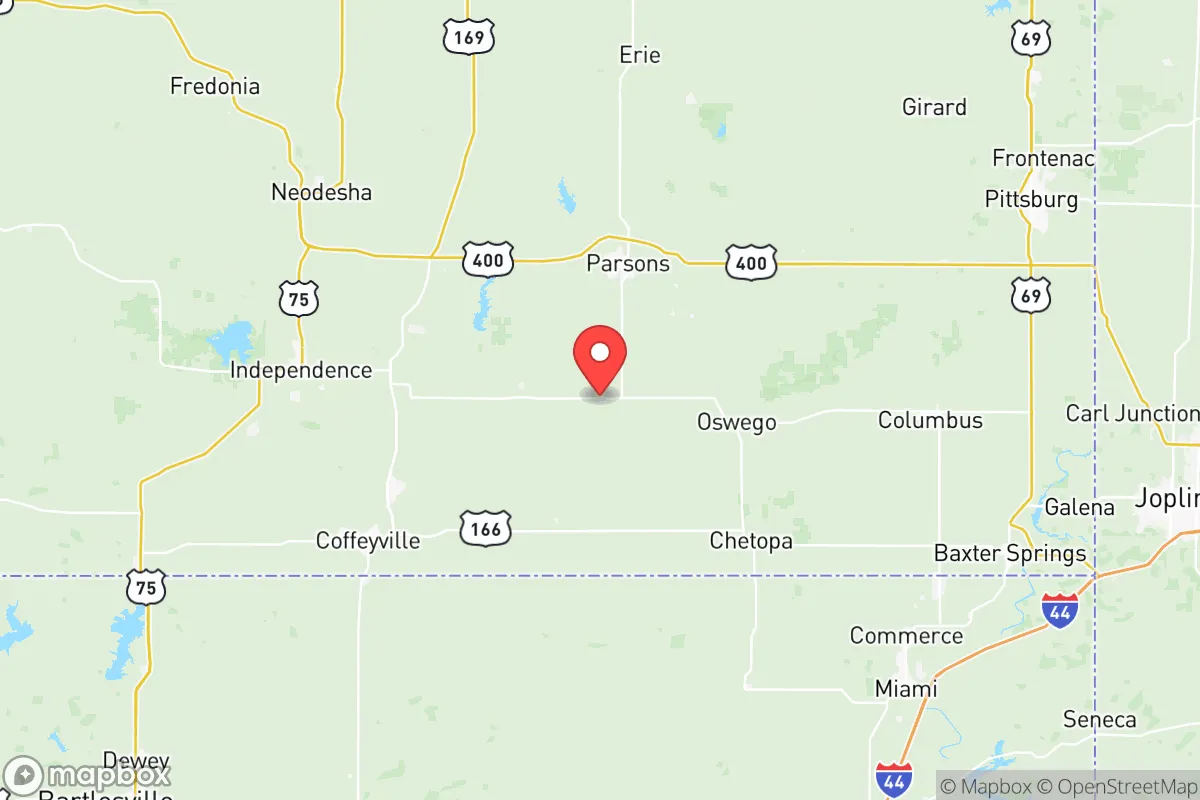
Labette County, Kansas, sits solidly in the Republican column, with a Cook Partisan Voting Index of R+10. That is one point more conservative than the state of Kansas as a whole, which carries an R+9 rating. However, this is not a monochrome red county. If you look close, the political picture gets more interesting, especially depending on which town you are standing in. The county seat, Oswego, tends to be reliably red, while the larger city of Parsons, with its history of railroad and manufacturing labor, has pockets that lean blue, particularly around the university and downtown precincts. Altamont and Chetopa are more mixed, often swinging with statewide and national trends.
How it compares
Statewide, Kansas is a deep red state, but the Republican grip has been loosening slightly in recent suburban and exurban shifts around Johnson County. Labette County has not followed that trend. If anything, the county's red lean has held steady or strengthened relative to the state, particularly in the 2020 and 2022 cycles. While the statewide PVIs only differ by one point, the actual voting patterns diverge more clearly in down-ballot races. Labette tends to vote for conservative candidates for county commission and sheriff by wider margins than the state average for similar offices. The swing precincts are not in the rural areas, interestingly—they are in Parsons' middle-class neighborhoods like the area around 18th Street and Grand Avenue, where ticket-splitting is more common. In 2022, that precinct went about 52% Republican, while the rest of the county was closer to 65%.
What this means for residents
For conservative residents, Labette County feels like a welcoming place where their values are the baseline. Local government, school board, and law enforcement leadership in Oswego and Altamont tend to align with that worldview, and there is little friction in daily life. For liberal residents, the reality is more nuanced. They are not a marginalized minority—roughly 35–40% of voters in Parsons and Chetopa lean Democratic, and Parsons has a small but active progressive community centered around the Parsons Public Library, the arts scene, and the local farmers' market. However, liberal residents often find that local policy debates, especially around tax levies, economic development incentives, and land use, are dominated by conservative voices. The practical effect is that liberal residents tend to organize around single issues (like school funding or infrastructure) rather than party identity, and they often find common ground with moderate Republicans on fiscal matters.
Culturally, Labette County feels more like a stubborn mix of rural Kansas and small-city pragmatism than a reflection of either Kansas City or Wichita. There is none of the libertarian strain you see in parts of western Kansas, nor the urban-suburban cultural divide of the big cities. What stands out is a strong sense of localism—people here care more about who fixes the roads in Montgomery County than about the national political drama, though they vote accordingly. Policy-wise, the county has avoided some of the more contentious statewide fights over property tax rate caps and school voucher expansion, often taking a moderate, wait-and-see approach. The school board in Parsons, for example, has been conservative but not combative, approving budgets that maintain programs without making political statements. Over the next few cycles, expect Labette to remain R+9 or R+10, but watch the bedroom communities around the Parsons airport for growth of young families that might nudge things a point or two to the left in local races.

State Political ClimatePolitical Climate in Kansas
State Political AnalysisPolitical Environment in the State
Kansas is a solidly Republican state with a Cook PVI of R+9, meaning it votes about nine points more Republican than the national average in presidential elections, but don't let that single number fool you into thinking it's a monolith. The state's political center of gravity has been steadily pulling rightward over the past two decades, driven by a deepening rural-urban divide and a series of very conservative state-level policy moves, but it's also home to some surprisingly competitive pockets, especially in the suburbs of Kansas City and around Topeka. For a relocator, understanding Kansas politics means understanding that the conservative dominance is real, but so are the internal tensions—between libertarian-leaning and socially conservative wings of the GOP, and between the sprawling agricultural west and the more moderate east.
Urban vs. rural divide
The political map of Kansas is essentially a story of blue islands in a red sea. Johnson County, the wealthy and growing suburban ring south of Kansas City, is the state's most populous county and the primary engine of Democratic votes; it voted for Joe Biden in 2020 after backing George W. Bush twenty years prior, a dramatic suburban shift that mirrors national trends. The only other reliably Democratic strongholds are Wyandotte County (Kansas City, KS) and Douglas County (Lawrence, home to the University of Kansas), both of which vote blue by wide margins. The rest of the state—hundreds of miles of wheat fields, feedlots, and small towns—votes overwhelmingly Republican. Counties like Seward County (Liberal) and Finney County (Garden City) were once competitive because of their large Hispanic populations and meatpacking workforces, but they have shifted right in recent cycles, reflecting a national trend among working-class Latino voters in rural areas. Sedgwick County (Wichita) is the key swing region: Wichita itself is a purple city with a sizable Democratic base, but the surrounding suburban and exurban precincts in Newton, Andover, and Derby are deeply red. In 2022, the governor's race saw Democratic Governor Laura Kelly win a second term by carving out strong margins in Johnson County and Wichita while holding her losses in rural areas to within 20 points—a strategy that has become the blueprint for statewide Democrats.
Policy environment
Kansas has one of the most conservative policy landscapes in the Midwest, built on a foundation of low taxes, limited regulation, and a strong tilt toward local control. The state eliminated its income tax on most LLCs and sole proprietorships in 2012 (the heavily debated "LLC loophole") and has been steadily cutting income tax rates ever under a series of Republican supermajorities. There is no state income tax on Social Security benefits, a significant draw for retirees considering Manhattan, Hutchinson, or the Wichita suburbs. Sales tax rates are relatively high, especially in rural areas where local governments rely on them heavily, and property taxes are moderate but have been rising in fast-growing Johnson County. On regulation, Kansas is a right-to-work state, has weak environmental permitting requirements, and permits concealed carry without a license (constitutional carry, enacted in 2015). The state's education policy is a major flashpoint: the legislature has passed laws limiting how race and gender can be taught in K-12 classrooms (HB 2169), expanded school voucher programs, and cut taxes on private school tuition. Healthcare policy remains polarized—Kansas expanded Medicaid for a brief period in 2017 via a bipartisan push, but the Supreme Court struck it down, and Governor Kelly has been unable to get it through the legislature. On election law, Kansas requires a government-issued photo ID to vote (one of the strictest in the country) and banned many forms of ballot harvesting; there are no automatic voter registration provisions, and same-day registration is not available.
Recent policy direction
Over the past five years, the state has moved decisively in a more conservative direction on nearly every front a relocator might care about. In 2022, the Kansas legislature passed a flat income tax bill, rejected Medicaid expansion for the tenth time, and enacted a near-total abortion ban (SB 540), which was then ratified by voters in a statewide referendum in August 2022—a major national moment that saw the "Value Them Both" amendment fail 41-59, meaning abortion rights are protected under the state constitution for now, but the legislative battle continues. On gun rights, Kansas already has some of the permissive laws in the nation, including permitless concealed carry, a Castle Doctrine law, and no "red flag" law. On education and parental rights, the state passed "Parents Bill of Rights" legislation in 2022, requiring schools to notify parents about classroom content and establishing a process for parents to object to materials. On property rights, Kansas has a strong eminent domain law that favors private landowners, and there is no statewide rent control. On free speech, the legislature recently debated but did not pass a social media "censorship" bill, and there have been no major surveillance or data privacy laws enacted. The biggest battle in 2024 was over a property tax relief package aimed at seniors and at agricultural land, reflecting the legislature's primary focus on lowering taxes and limiting government growth.
Civil unrest & political movements
Kansas has a low-intensity but persistent tradition of both left and right activism. The most visible flashpoint in recent memory was the 2022 abortion referendum, which generated massive voter turnout and large protests on both sides across the state, particularly in Overland Park, Lawrence, and downtown Wichita. The state has also seen periodic clashes over vaccine mandates during the pandemic, with large rallies at the statehouse in Topeka opposing school and workplace mask requirements. Immigration politics is a growing edge: in 2024, the Republican-led legislature debated a bill, modeled on Texas's SB 4, to allow state law enforcement to enforce federal immigration law, though it did not pass. Garden City and Dodge City have become de facto sanctuary communities because local law enforcement there refuses to cooperate with ICE detentions due to staffing concerns and community trust, creating ongoing tension with the state capital. On the right, the "Kansas Republican Assembly" is a powerful state-level faction pushing for purity on social issues, especially anti-abortion and school choice. On election integrity, the 2022 primaries saw multiple county-level GOP officials challenge the state's vote-counting procedures, though no widespread fraud has ever been substantiated. A new resident is unlikely to see or experience any sustained civil unrest day-to-day, but the politics are visible in campaign signs, local news coverage, and occasional protest events around major statehouse decisions.
Projection
Over the next five to ten years, Kansas is likely to remain a solidly red state, but it will become more internally contested around the I-35 corridor stretching from Kansas City to Wichita. The biggest demographic shift is the continued suburbanization of Johnson County, which is attracting moderate and even some left-leaning professionals moving from Kansas City, Missouri; this area is likely to flip from purple to blue in state legislative races over the next decade, giving Democrats a foothold to challenge the GOP supermajority. Meanwhile, the rural parts of the state are losing population and aging, which makes their political power per capita higher but their numerical weight declining. In-migration patterns are modest—Kansas attracts fewer out-of-state movers than neighboring Colorado or Missouri—but those who do come tend to be attracted to the low cost of living and rural culture, leaning conservative. The wildcard is the energy transition: Kansas has massive wind power potential, and the state's renewable energy sector is growing, which could either bring in a more environmentally-minded population or spark a new political cleavage. Expect the legislature to continue pushing on tax cuts and school choice, and expect battles over abortion and election laws to remain front-page news. A relocator moving to Wichita, Manhattan, or prime Johnson County suburbs like Leawood or Overland Park should plan for a political environment that feels like two different states—conservative in every county outside the metro core, but with a vibrant and increasingly influential blue minority in the urban and suburban centers.
For a newcomer, the bottom line is that Kansas offers a living environment where conservative policies are the norm, particularly on taxes, guns, and education, but it's not a "safe" red state if you're looking for cultural uniformity. The suburbs of Johnson County and Wichita are politically mixed and have become household names in state political coverage, while the rural towns remain deeply and predictably Republican. If you're a conservative moving in, you'll find your priorities reflected in state law and a fast-moving legislative agenda; if you're a moderate or liberal, you'll find a strong and active Democratic opposition in the cities, but you should be prepared for policy outcomes that often tilt strongly right. The experience is genuinely different depending on whether you settle in Lawrence, Overland Park, Wichita, or a small town like Hays, Emporia, or Pratt—that's the real political geography of Kansas.
* Values derived from national, state, county, city and local statistics and may differ in a specific area. Last updated: 2026-09-15T08:26:12.000Z
Narrative content on this page is AI-generated and may contain mistakes. Verify any details that matter before acting on them.
ReloMaps may earn a commission from affiliate links at no extra cost to you.

