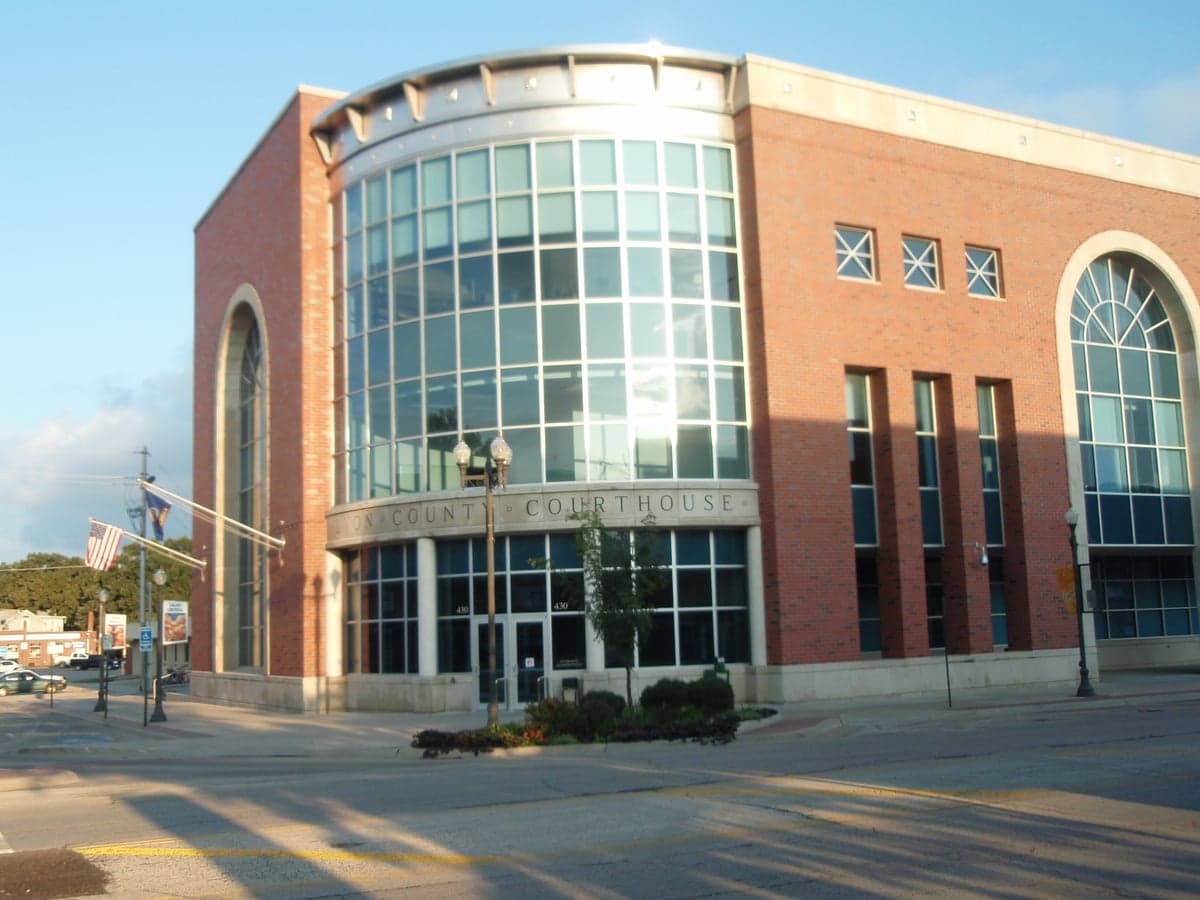
Photo: Wikipedia
Demographics of Lyon County
Affluence Level in Lyon County
A middle-class area roughly in line with national averages across income, home values, education, and employment.
People of Lyon County
Lyon County, Kansas, today is a predominantly white, working-class community of 32,145 residents, anchored by the regional hub of Emporia and shaped by a history of railroad, ranching, and manufacturing. The county’s population is notably more Hispanic (23.4%) than the state average, reflecting a long-standing agricultural labor draw, while the foreign-born share sits at 6.6%. With a college education rate of 27.7%, the county leans practical and trade-oriented, and its political character is reliably conservative, though the growing Hispanic population is beginning to diversify the electorate and cultural landscape.
Settlement & growth (pre-1960)
Before American settlement, the land that is now Lyon County was part of the ancestral territory of the Kansa (Kaw) and Osage nations, who used the Flint Hills for seasonal bison hunting. The area was formally acquired by the United States through the 1808 Osage Treaty and the 1825 Kansa cession, opening it to Euro-American settlement. The first permanent American settlers arrived in the 1850s, primarily from the Upper South and Ohio Valley—Kentucky, Missouri, and Indiana—drawn by the promise of cheap land under the 1854 Kansas-Nebraska Act. These early pioneers were largely of Scots-Irish and English stock, and they established the first towns along the Neosho River, including Emporia (founded 1857) and Americus (1857). Emporia quickly became the county seat and a commercial center, thanks to its location on the Santa Fe Trail and later the Atchison, Topeka and Santa Fe Railway, which arrived in 1869.
The railroad boom of the 1870s and 1880s brought a second wave of settlers: German-speaking immigrants from the Volga River region of Russia, known as Volga Germans. These families, seeking religious freedom and agricultural land, established tight-knit farming communities in the southern part of the county, particularly around Hartford (founded 1859) and Neosho Rapids (1857). They brought with them hard-wheat farming techniques and a strong work ethic that shaped the county’s agricultural identity. A smaller number of Czech and Polish immigrants also arrived during this period, settling in Emporia and working in the railroad yards and flour mills. By 1900, the county’s population had reached roughly 25,000, with Emporia serving as a regional rail and trade hub.
The early 20th century saw the rise of the cattle industry in the Flint Hills, with ranchers grazing herds on the native bluestem grasses. This period also brought a modest influx of African American families during the Great Migration (1910–1940), who moved from the Deep South to work on the railroad and in the packing plants of Emporia. However, the Black population never exceeded 3% of the county total, and today it stands at 1.6%. The Dust Bowl and Great Depression of the 1930s hit the county hard, causing a population decline that lasted into the 1950s, as many farm families left for California or urban centers. The post-World War II era brought a modest recovery, driven by the expansion of Emporia State University (founded 1863) and the growth of manufacturing, including the construction of a large Tyson Foods plant in the 1960s.
Modern era (post-1965)
The 1965 Hart-Cellar Act had a delayed but significant impact on Lyon County. The most visible change has been the growth of the Hispanic population, which rose from under 5% in 1980 to 23.4% today. This wave began in the 1970s and accelerated in the 1990s, driven by recruitment for agricultural labor—particularly in the Tyson Foods poultry plant and in the region’s feedlots and dairy operations. The majority of these immigrants are of Mexican origin, with smaller numbers from Central America. They have concentrated in Emporia, where a vibrant Hispanic commercial corridor has developed along Commercial Street and around the 6th Avenue area. The city’s public schools now serve a student body that is over 40% Hispanic, and Spanish-language signage is common in many businesses.
Domestic migration patterns have been less dramatic. Lyon County has not experienced the rapid Sun Belt growth seen in Johnson County or the Kansas City suburbs. Instead, it has seen a slow, steady out-migration of younger, college-educated residents to larger metros, offset by a modest inflow of retirees and remote workers seeking the lower cost of living. The East/Southeast Asian population (1.2%) is small and primarily tied to Emporia State University, with a handful of faculty and international students from China, Korea, and Vietnam. The Indian subcontinent population (0.3%) is even smaller, consisting mainly of medical professionals at Newman Regional Health and a few tech workers. The Black population has remained stable at 1.6%, concentrated in Emporia’s older neighborhoods near the railroad tracks.
Suburbanization has been limited. Unlike the sprawling suburbs of Topeka or Wichita, Lyon County’s growth has remained centered on Emporia, with only modest development in unincorporated areas. The towns of Reading (founded 1857) and Allen (1854) have seen population declines, as younger residents move to Emporia or leave the county entirely. The county’s overall population peaked at 35,108 in 1960 and has since declined to 32,145, reflecting the broader rural depopulation trend across the Great Plains.
The future
Lyon County’s demographic future is likely to be one of slow diversification and modest decline. The Hispanic population is the only segment showing significant growth, and it is projected to reach 30–35% of the county total by 2040, driven by higher birth rates and continued immigration for agricultural and manufacturing work. This growth is already reshaping Emporia’s cultural identity, with bilingual education programs, Hispanic-owned businesses, and a growing Catholic parish. However, the county’s white population is aging and declining, as younger whites leave for college and careers elsewhere. The Black, Asian, and Indian populations are expected to remain small, as the county lacks the economic pull to attract significant new immigration from those groups.
The cultural identity of Lyon County is likely to become more polarized between the older, conservative white population and the younger, more family-oriented Hispanic community. While there is some assimilation—many second-generation Hispanics are bilingual and identify as Kansan—the two groups remain largely separate in social and civic life. The county’s political character, currently solidly Republican, may shift slightly as the Hispanic electorate grows, though many Hispanic voters in the region lean conservative on economic and social issues. The next 10–20 years will likely see Emporia become a more distinctly bicultural city, while the outlying towns continue to shrink and homogenize.
For someone moving to Lyon County today, the bottom line is this: you are entering a community that is stable but slowly changing, where the cost of living is low and the pace of life is rural, but where the cultural and political landscape is becoming more complex. The county offers a strong sense of place and a connection to the Flint Hills, but it is not a growth area—it is a place of modest decline and gradual diversification, where the future will be shaped by the integration of a growing Hispanic population into a historically white, conservative society.

* Values derived from national, state, county, city and local statistics and may differ in a specific area. Last updated: 2026-05-23T10:40:30.000Z
Narrative content on this page is AI-generated and may contain mistakes. Verify any details that matter before acting on them.
ReloMaps may earn a commission from affiliate links at no extra cost to you.

