 Popular
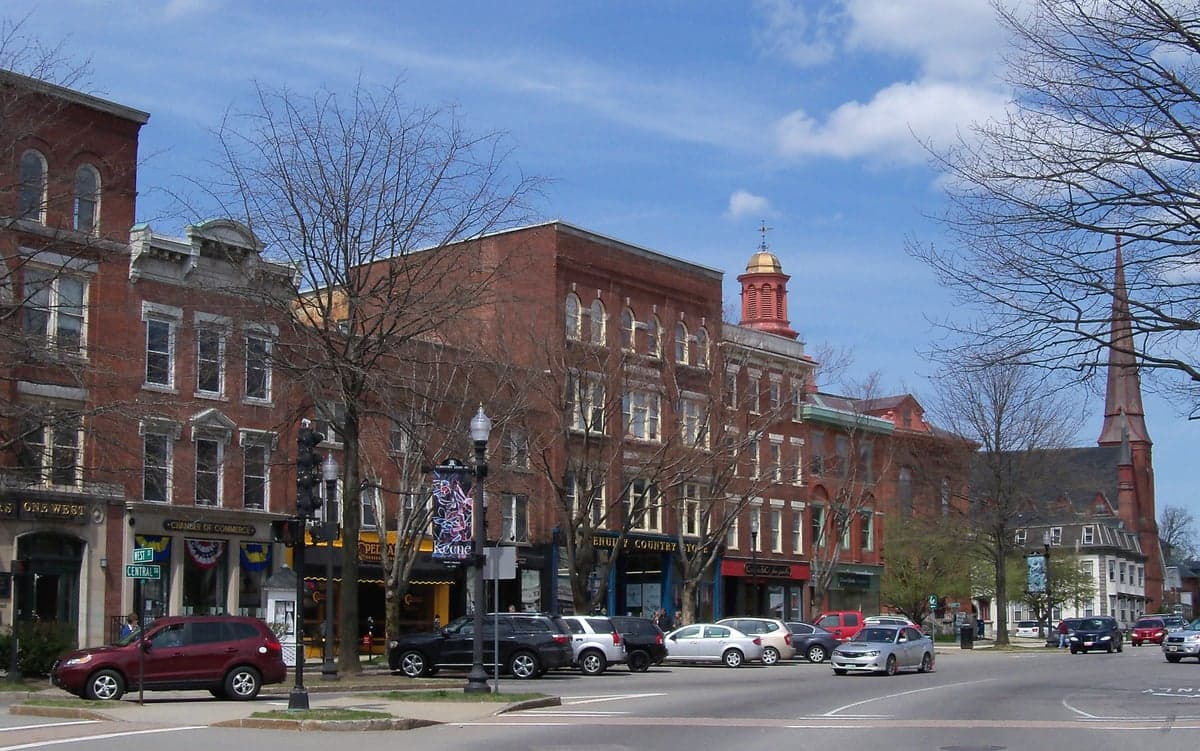
Photo: Wikipedia
Demographics of Keene, NH
Affluence Level in Keene, NH
A middle-class area roughly in line with national averages across income, home values, education, and employment.
People of Keene, NH
The people of Keene, New Hampshire, today number 22,923, forming a predominantly white (91.7%) and highly educated (43.4% college-educated) community in the Monadnock Region. The city’s identity is shaped by a deep Yankee-Protestant foundation, a 19th-century industrial boom that drew Irish and French-Canadian workers, and a modern stability marked by very low foreign-born (2.0%) and Hispanic (2.3%) populations. Keene is a place where historic ethnic enclaves have largely assimilated, leaving a culturally homogeneous, civically engaged population centered on Keene State College and regional healthcare employment.
How the city was settled and grew
Keene was chartered in 1753 as part of a land grant to English colonists from Massachusetts and Connecticut, who cleared the Ashuelot River valley for farming. The original settlers were Congregationalist Yankees who built the town around the Central Square common, which remains the historic heart. The first major demographic shift came with the industrial revolution: by the 1830s, the Ashuelot River powered textile mills, shoe factories, and foundries. This drew Irish immigrants in the 1840s-1850s, who settled in Mechanic Street and Washington Street neighborhoods near the mills, forming St. Bernard’s Parish. A second wave of French-Canadian mill workers arrived from Quebec between 1870 and 1910, clustering in West Keene around the St. Joseph’s Church area, where French was spoken in homes and stores into the 1950s. By 1900, Keene’s population had grown to roughly 10,000, with these two Catholic ethnic groups living alongside the Yankee majority in distinct, but not segregated, neighborhoods.
Modern era (post-1965)
After the Immigration and Nationality Act of 1965, Keene saw almost no new foreign-born influx—the foreign-born share today is just 2.0%, far below the national average. Instead, the post-1965 story is one of domestic in-migration and suburbanization. The city’s manufacturing base declined in the 1970s and 1980s, but Keene State College expanded, drawing students and faculty from across New England. This created a college district around Appian Way and Winchester Street, where rental housing and student-oriented services dominate. Meanwhile, families moved outward: North Keene (Route 12A corridor) and West Keene (near the Keene Country Club) developed as middle-class subdivisions, absorbing white-collar workers commuting to Dartmouth-Hitchcock Keene and C&S Wholesale Grocers. The city’s racial composition has remained remarkably stable: the white share dropped only from 97% in 1990 to 91.7% today, with the small non-white population consisting of East/Southeast Asian communities (0.3%) and Indian-subcontinent residents (0.2%)—mostly professionals at the hospital or college—and a Black population of 1.5%, many of whom are military-affiliated or college staff living in the Colony Mill area and downtown apartments. The Hispanic share (2.3%) is largely second- and third-generation families from Puerto Rico and Mexico, concentrated in West Keene rental stock near the former mill buildings.
The future
Keene’s population is aging and slowly shrinking—down from 23,409 in 2010—with a median age of 40.5. The foreign-born share is projected to remain below 3% through 2035, as the city lacks the industrial or agricultural jobs that attract new immigrants. The East/Southeast Asian and Indian communities are small and stable, tied to professional positions at the hospital and college, and are likely to assimilate into the broader white-collar class rather than form distinct ethnic enclaves. The Hispanic population is growing modestly (from 1.8% in 2010 to 2.3% today), but remains dispersed across West Keene and the downtown rental market. The most significant demographic trend is the continued out-migration of young families to lower-cost towns like Swanzey and Marlborough, while Keene itself becomes more dominated by college students, retirees, and healthcare workers. The city is homogenizing, not tribalizing—neighborhoods are defined more by income and housing stock than by ethnicity.
For a conservative-leaning mover, Keene offers a stable, safe, and culturally cohesive environment where the population is overwhelmingly native-born, English-speaking, and civically engaged. The trade-off is a low-growth, aging demographic profile with limited ethnic diversity and a shrinking tax base. New arrivals will find a community that values its historic character and local institutions, but should expect little change in the city’s demographic makeup over the next decade.

* Values derived from national, state, county, city and local statistics and may differ in a specific area. Last updated: 2026-05-02T05:42:10.000Z
Narrative content on this page is AI-generated and may contain mistakes. Verify any details that matter before acting on them.
ReloMaps may earn a commission from affiliate links at no extra cost to you.

