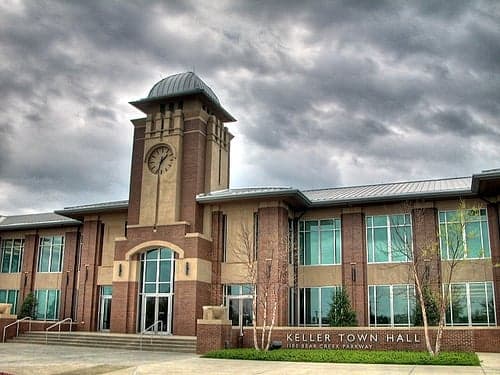
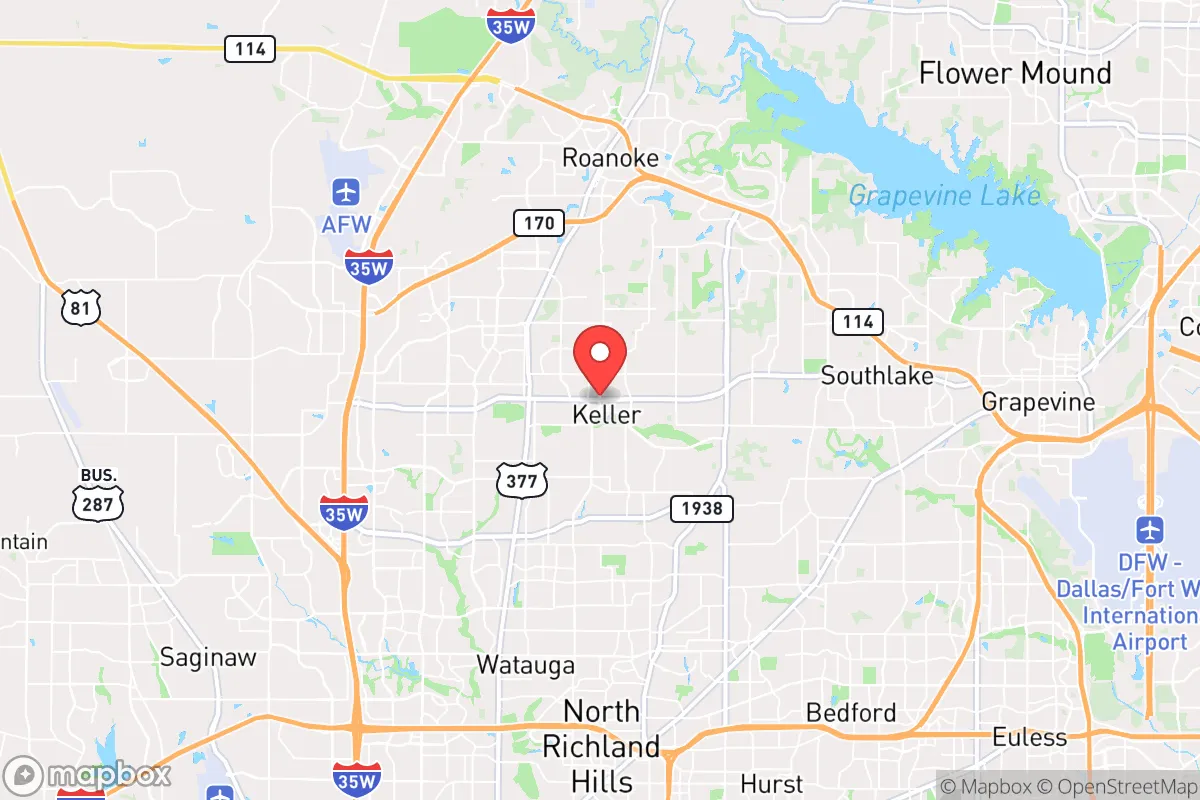
Photo: Wikipedia
Demographics of Keller, TX
Affluence Level in Keller, TX
A wealthy area with high-earning, well-educated households. Incomes, home values, and educational attainment meaningfully outpace national averages.
People of Keller, TX
The people of Keller, Texas, today form a predominantly white, highly educated, and family-oriented community of roughly 45,600 residents, characterized by a notably low foreign-born share of just 4.7% and a strong conservative political culture. The city’s identity is rooted in its history as a quiet farming crossroads that transformed into an affluent, master-planned suburb of Fort Worth, attracting families seeking large homes, top-rated schools, and a low-crime environment. Distinctive markers include a high college attainment rate of 60.1%, a significant Indian-subcontinent population of 3.4% that has grown alongside the tech economy, and a smaller East/Southeast Asian community at 2.7%. The Hispanic population, at 10.7%, and the Black population, at 2.7%, round out a demographic profile that remains less diverse than the broader Dallas-Fort Worth metroplex.
How the city was settled and grew
Keller’s original population was drawn by the promise of fertile blackland prairie soil and the arrival of the Rock Island Railroad in the 1880s. The town was formally platted in 1881 by a railroad surveyor, Charles Keller, and the first settlers were predominantly Anglo-American farmers from the Upland South—Tennessee, Kentucky, and Missouri—who established cotton and grain operations. The historic Old Town Keller district, centered around the original depot on Johnson Road, became the commercial and social hub for these early families, many of whom built the wood-frame homes that still line Rufe Snow Drive. The community remained a small, insular farming village through the first half of the 20th century, with the population barely exceeding 500 by 1950. No significant waves of European immigration or non-white settlement occurred during this period; the population was almost entirely native-born white Protestants.
Modern era (post-1965)
The post-1965 transformation of Keller began in earnest in the 1980s and accelerated through the 1990s, driven by the expansion of the Dallas-Fort Worth metroplex and the construction of State Highway 170 (now Keller Parkway). The city’s population exploded from roughly 1,500 in 1970 to over 45,000 by 2020, fueled almost entirely by domestic white flight from older Fort Worth neighborhoods and by corporate relocations to the DFW area. The dominant wave was composed of middle- and upper-middle-class white families seeking new construction in master-planned subdivisions. The Hidden Lakes neighborhood, developed around a private lake and golf course, became a magnet for executives and professionals, while Bellaire Estates and Woodland Hills attracted families drawn to the Keller Independent School District’s reputation. The Indian-subcontinent population, now 3.4% of the city, began arriving in the 2000s, concentrated in newer developments like Prescott Estates and Oakmont, where many work in information technology and engineering roles in nearby Fort Worth and Las Colinas. The East/Southeast Asian community, at 2.7%, is similarly clustered in these newer subdivisions, often in dual-income professional households. The Hispanic population, at 10.7%, has a longer presence, with some families tracing roots to the original railroad workers, but most growth has come from domestic migration into more affordable sections of the city, such as the Keller Crossing area. The Black population, at 2.7%, remains small and is dispersed across newer developments rather than forming a distinct enclave.
The future
Keller’s population trajectory points toward continued slow growth, likely reaching 50,000 by 2035, but with a notable demographic plateau rather than rapid diversification. The city is largely built out, with few remaining large tracts for development, meaning future population change will come from infill and teardown-rebuild projects rather than new subdivisions. The white share, currently 76.8%, is expected to decline gradually as older residents age in place and younger families are priced out by rising home values—median prices now exceed $600,000. The Indian-subcontinent and East/Southeast Asian communities are likely to grow modestly, as professionals continue to be attracted by the school system and commute times to tech corridors, but the low foreign-born share (4.7%) suggests Keller is not a primary destination for new immigrants. The Hispanic population may increase slightly through natural growth, but the city’s high housing costs will limit significant in-migration. The city is not tribalizing into distinct ethnic enclaves; rather, it is homogenizing into a uniformly affluent, conservative suburb where income, rather than ethnicity, is the primary sorting mechanism. For a newcomer moving in now, Keller offers a stable, low-diversity environment with excellent schools and a strong sense of community rooted in its historic small-town character, but with limited demographic change on the horizon.
In sum, Keller is becoming a mature, built-out suburb where the population is stabilizing around a high-income, highly educated, and predominantly white core, with modest growth from professional Indian and East/Southeast Asian families. The city’s future is one of demographic continuity rather than transformation, making it a predictable choice for conservative families seeking a proven suburban lifestyle.

* Values derived from national, state, county, city and local statistics and may differ in a specific area. Last updated: 2026-04-14T19:59:02.000Z
Narrative content on this page is AI-generated and may contain mistakes. Verify any details that matter before acting on them.
ReloMaps may earn a commission from affiliate links at no extra cost to you.

