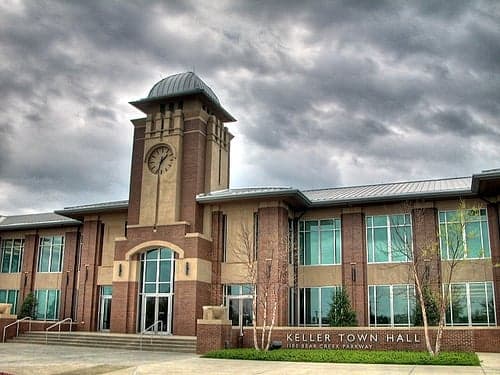
Photo: Wikipedia
Political ClimatePolitical Climate in Keller, TX
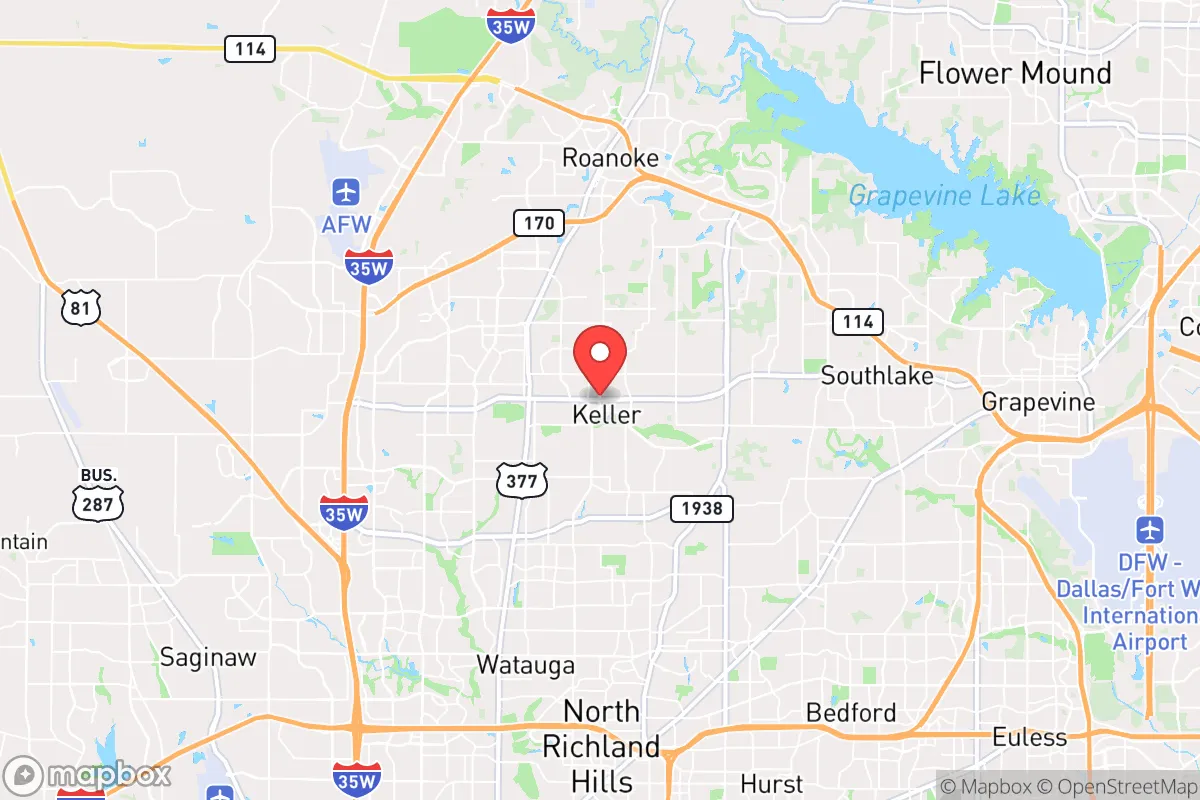
District shown is the primary district for this city’s centroid. Cities may span multiple districts.
Local Political AnalysisPolitical Analysis of Keller, TX
Keller, Texas, has long been a solidly conservative stronghold, and that hasn’t changed much despite the rapid growth around the Dallas-Fort Worth metroplex. The Cook Partisan Voting Index (PVI) of R+7 tells you the basics: this is a place where Republican candidates typically win by comfortable margins, and the local culture reflects that. But if you’ve lived here for a while, like I have, you’ll notice the political winds are shifting—not enough to flip the town blue, but enough to make you pay attention. The real story is how Keller’s conservative roots are being tested by the influx of new residents from more progressive areas, and how the local government is handling the pressure to change.
How it compares
Drive ten minutes east to Southlake, and you’ll find a similar R+7 vibe, but with a bit more of a polished, corporate-conservative feel. Head south to Fort Worth proper, and you’re in a different world entirely—Tarrant County as a whole is trending purple, with Fort Worth’s urban core leaning left. Keller, by contrast, feels like a holdout. It’s not as aggressively red as, say, the rural towns west of here like Aledo or Weatherford, where you’ll see more “Don’t Tread on Me” flags than campaign signs. But compared to the increasingly progressive suburbs closer to Dallas, like Coppell or Carrollton, Keller is a breath of fresh air for those who value limited government and personal responsibility. The contrast is stark: in Keller, you can still have a conversation about property rights or school curriculum without being labeled an extremist.
What this means for residents
For folks who’ve been here a decade or more, the biggest concern is the slow creep of government overreach into everyday life. The city council and school board have mostly held the line on things like mask mandates and critical race theory, but the battles are getting louder. You see it in the local elections—more candidates running on “inclusive” platforms that sound an awful lot like the same progressive talking points that have wrecked other suburbs. The property tax situation is another red flag: as the area grows, the city keeps finding new ways to spend your money, and the conservative reflex to cut taxes is getting weaker. If you value your Second Amendment rights, Keller is still a safe bet—the city hasn’t gone the way of some Texas towns that try to create their own gun ordinances. But the long-term trend is concerning. The next five years will tell us whether Keller stays a place where personal freedoms are respected, or if it starts mirroring the overreach we see in places like Austin.
On the cultural side, Keller still feels like a community where neighbors look out for each other, and the local churches and civic groups are the backbone of social life. The school district, Keller ISD, has been a battleground, but so far, parents have managed to keep the focus on academics rather than social engineering. The biggest policy distinction you’ll notice is the lack of a citywide noise ordinance or strict HOA-style rules on property use—people here still believe you should be able to do what you want on your own land, within reason. That’s getting harder to maintain as more people move in from places where government is expected to solve every problem. If you’re thinking of relocating here, know that Keller is still a conservative haven, but it’s not immune to the pressures that are reshaping Texas. Keep an eye on the local elections, and get involved if you want to keep it that way.

State Political ClimatePolitical Climate in Texas
State Political AnalysisPolitical Environment in the State
Texas has been a reliably Republican state for decades, but the political landscape is more complex than a simple red-state label suggests. The state’s overall partisan lean is still solidly to the right, with Republicans holding every statewide office and both chambers of the legislature, but the margin of victory has tightened in presidential elections—from a 16-point win for Trump in 2016 to a 5.5-point win in 2024. Over the last 10-20 years, the dominant coalition has been a mix of rural conservatives, suburban moderates, and business-friendly libertarians, but rapid in-migration from blue states and demographic shifts in the major metros are slowly chipping away at that foundation. If you’re looking for a place where government stays out of your life and your wallet, Texas still delivers, but you need to know where the cracks are forming.
Urban vs. rural divide
The political map of Texas is a tale of three worlds: the deep-red rural and exurban counties, the deep-blue urban cores, and the purple suburbs that decide elections. The big metros—Houston, Dallas-Fort Worth, San Antonio, and Austin—are the engines of Democratic growth. Harris County (Houston) and Dallas County have flipped from competitive to reliably blue over the past decade, while Travis County (Austin) is now one of the most liberal jurisdictions in the South. Meanwhile, the rural Panhandle, East Texas, and the Hill Country remain staunchly Republican. Lubbock, Midland, and Tyler are conservative strongholds where Trump won by 30-40 points. The real battleground is the suburbs: Collin County (north of Dallas), Denton County, and Fort Bend County (southwest of Houston) have shifted from +20 Republican to single-digit margins. In 2024, Collin County went for Trump by only 8 points, down from 18 in 2016. If you’re moving to Texas for the politics, the suburbs are where the fight is happening—and where you’ll notice the most change in your daily life.
Policy environment
Texas’s policy environment is defined by a low-tax, low-regulation posture that has attracted businesses and families for decades. There is no state income tax, and property taxes are high but capped at 10% annual growth for homesteads (Proposition 4, 2023). The regulatory climate is business-friendly, with no state-level minimum wage above the federal $7.25 and right-to-work laws that keep unions weak. On education, the state has expanded school choice through Education Savings Accounts (HB 3, 2023) and charter schools, though rural districts have pushed back. Healthcare policy is a mixed bag: Texas did not expand Medicaid under the ACA, keeping the uninsured rate at 18% (highest in the nation), but the state has invested in rural hospital funding and telehealth. Election laws have tightened since 2021 (SB 1), requiring photo ID for voting, limiting drive-through and 24-hour voting, and banning unsolicited mail-in ballot applications. For a conservative, the policy environment is still a net positive—low taxes, light regulation, and a government that mostly stays out of your business—but the property tax burden and lack of healthcare access are real trade-offs.
Trajectory & freedom
The trajectory of freedom in Texas is a mixed bag, and it depends on which freedom you’re talking about. On the positive side, the state has expanded gun rights significantly: permitless carry (HB 1927, 2021) allows any law-abiding adult to carry a handgun without a license, and the state preempts local gun ordinances. Parental rights were strengthened with the passage of the “Parental Bill of Rights” (HB 5, 2023), which requires schools to notify parents about medical and mental health services and prohibits instruction on sexual orientation or gender identity in elementary grades. Medical autonomy took a hit with the near-total abortion ban (SB 8, 2021, and the trigger law in 2022), which conservatives see as protecting life but which also restricts personal medical decisions. Property rights are strong, with no state-level rent control and limited eminent domain abuse. On the concerning side, the state has increased government surveillance with the creation of a border security fund and the deployment of state troopers and National Guard to the border, which some see as federal overreach. The biggest threat to freedom in Texas is the growing property tax burden—while rates are capped, appraisals have soared, and the state has not yet passed a meaningful income tax replacement. If you’re moving here for freedom, you’re getting more on guns and parenting, but less on taxes and medical choice.
Civil unrest & political movements
Texas has seen its share of political flashpoints, and a new resident will notice the tension, especially in the cities. The 2020 Black Lives Matter protests in Austin and Dallas were large and occasionally violent, leading to property damage and a lasting police reform debate. The “Defund the Police” movement gained traction in Austin, where the city council cut the police budget by $150 million in 2020, only to restore it after a crime spike. On the right, the “Constitutional Carry” movement succeeded in 2021, and the “Save Our Schools” movement has mobilized parents against critical race theory and gender ideology in schools. Immigration politics are front and center: Governor Abbott’s Operation Lone Star has bused migrants to blue cities, and the state has passed laws (SB 4, 2023) making illegal entry a state crime, which is being challenged in court. Secession rhetoric is mostly fringe, but the Texas Nationalist Movement has a small but vocal following. Election integrity remains a hot-button issue: the 2020 election saw a lawsuit from the state to throw out votes in four counties, and the 2021 voting law (SB 1) was passed over Democratic walkouts. If you’re moving to a blue city like Austin or Houston, you’ll see progressive activism regularly; in the suburbs, it’s more of a quiet cultural war over school boards and library books.
Projection
Over the next 5-10 years, Texas is likely to become more politically competitive, but not necessarily more liberal. The in-migration from California, New York, and Illinois is bringing a mix of conservatives fleeing blue-state policies and liberals seeking jobs and lower taxes. The net effect is a slow purple shift in the suburbs, but the rural areas are not going anywhere. The state’s Hispanic population, long assumed to be a Democratic voting bloc, is actually trending more conservative, especially in the Rio Grande Valley—Starr County flipped from +5 Clinton in 2016 to +15 Trump in 2024. The biggest wildcard is the urban core: if Austin and Houston continue to grow and turn out high Democratic margins, the state could become a toss-up by 2032. However, the Republican legislature is likely to continue gerrymandering and passing voter ID laws to maintain control. For a new resident, expect the policy environment to remain conservative for at least the next decade, but the cultural and political battles will intensify, especially in the suburbs. If you’re moving to a red county like Montgomery County or Parker County, you’ll feel little change; if you’re moving to Travis County or Harris County, you’ll be in a blue bubble that feels increasingly like a blue state.
Bottom line for a new resident: Texas is still a conservative state where your taxes are low, your gun rights are strong, and your kids’ school is likely to reflect your values—but you need to pick your county carefully. The urban cores are becoming progressive strongholds, the suburbs are battlegrounds, and the rural areas are rock-solid red. If you want the Texas of 2010, move to Lubbock or Tyler. If you want a place that’s still conservative but with more diversity and opportunity, look at Collin County or Comal County. Just know that the political winds are shifting, and the fight over the soul of Texas is only going to get louder.
* Values derived from national, state, county, city and local statistics and may differ in a specific area. Last updated: 2026-04-14T19:59:02.000Z
Narrative content on this page is AI-generated and may contain mistakes. Verify any details that matter before acting on them.
ReloMaps may earn a commission from affiliate links at no extra cost to you.

