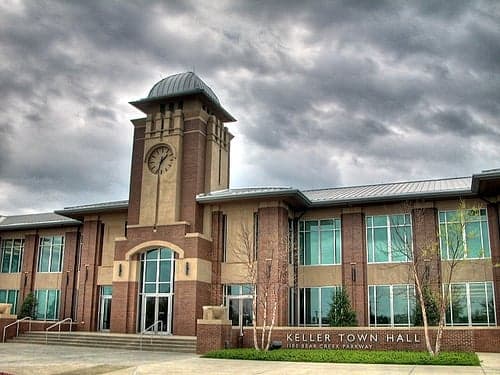
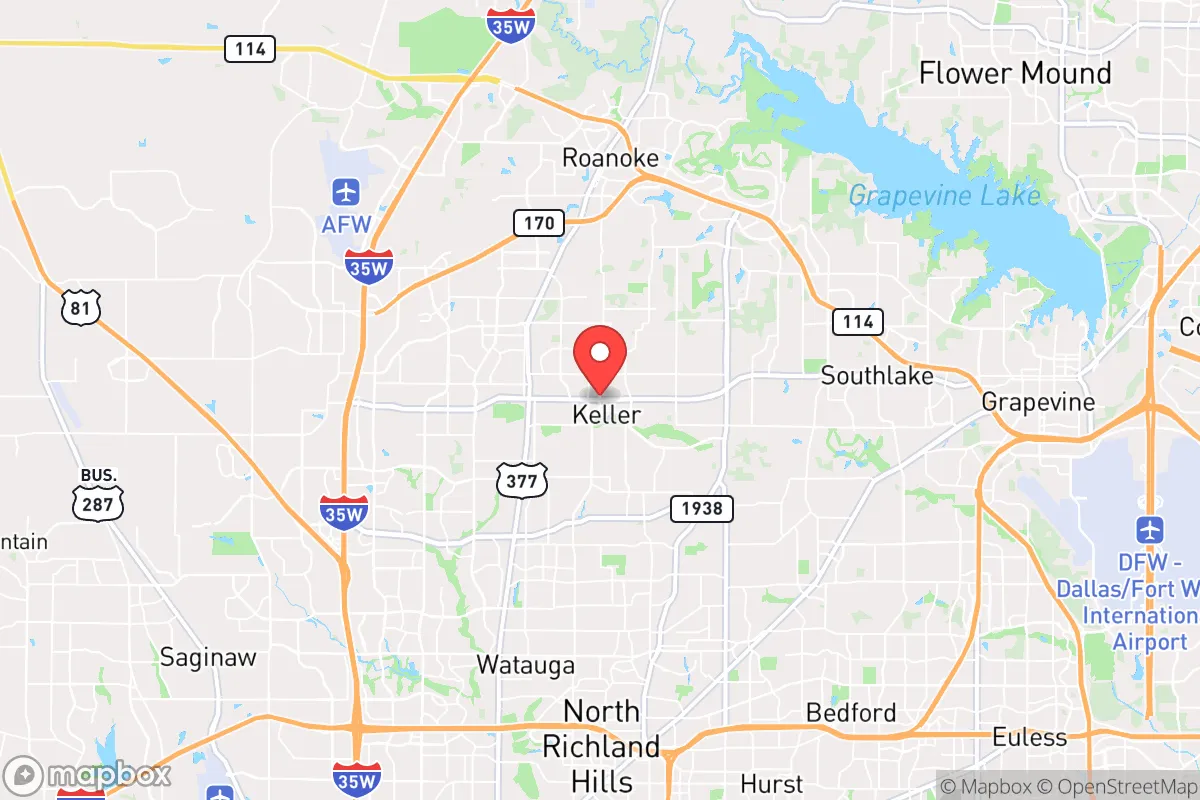
Photo: Wikipedia
Personal Sovereignty in Keller, TX
Strong independent fundamentals that actively favor personal liberty and low regulation.
What does Personal Sovereignty tell us?
Personal Sovereignty measures your capacity for self-reliance and independence with minimal government friction. Higher scores mean fewer barriers between you and the way you want to live... but it assumes you have the space you need and good neighbors.
What does this tell us?
Personal Sovereignty measures your capacity for self-reliance and independence with minimal government friction. Higher scores mean fewer barriers between you and the way you want to live... but it assumes you have the space you need and good neighbors.
State Policy
Energy independence: Net exporter (220% of energy produced in-state)
Personal Liberty
Homesteading

Personal Liberty Analysis
Keller, Texas, offers a notably high degree of personal sovereignty, particularly for those who view local control and minimal government interference as essential safeguards in an increasingly uncertain national landscape. As a suburban enclave within the Dallas-Fort Worth metroplex, Keller benefits from Texas’s strong preemption laws that limit city-level overreach on issues like firearms, property use, and taxation, while simultaneously maintaining a relatively low municipal footprint. For the survivalist or prepper-minded individual, this translates into a legal environment where personal preparation, self-defense, and economic self-reliance are not just tolerated but structurally supported by state law, even if the suburban setting imposes some practical constraints compared to rural Texas counties.
Tax burden and regulatory posture: How Keller compares to surrounding cities
Texas’s lack of a state income tax is the foundational advantage for anyone seeking to maximize retained earnings for preparedness investments—whether that’s land, supplies, or training. Keller’s total property tax rate hovers around 2.1% to 2.3% of assessed value, which is competitive within Tarrant County and slightly below the DFW suburban average. The city operates under a home-rule charter that generally favors low business regulation and streamlined permitting for residential improvements, though homeowners should note that Keller enforces standard subdivision covenants more strictly than unincorporated areas. Sales tax in Keller is 8.25%, the state maximum, but this is offset by the absence of any municipal income or inventory taxes. For a prepper, the key regulatory win is Texas’s limited government zoning philosophy: while Keller has zoning, it does not impose the kind of draconian land-use restrictions seen in states like California or Oregon. There are no city-level rent control ordinances, no energy efficiency mandates that force costly retrofits, and no bans on natural gas hookups—all of which preserve homeowner autonomy. The city’s budget is lean, with public safety consuming roughly 40% of expenditures, and there is no local equivalent of a “business license” for most home-based enterprises, which matters if you plan to run a side operation like firearms training or food preservation classes from your property.
Self-defense and gun law specifics: Castle Doctrine, permitless carry, and local enforcement
Texas law provides a robust framework for self-defense that directly empowers Keller residents. The state’s Castle Doctrine (Penal Code §9.32) eliminates any duty to retreat in one’s home, vehicle, or workplace, and Keller police have a documented record of respecting this statute—there are no local ordinances that attempt to undermine it. Since 2021, permitless carry (constitutional carry) has been legal for anyone 21 or older who can legally possess a firearm, meaning no government permission slip is needed to carry openly or concealed in Keller. The city itself does not maintain a gun registry, ban magazine capacities, or restrict ammunition types, and local law enforcement has publicly stated they will not enforce federal firearm regulations they deem unconstitutional. For preppers, this means you can stockpile ammunition, own NFA items (suppressors, short-barreled rifles) with proper federal paperwork, and train on your own property without fear of local harassment. Keller’s proximity to Defender Outdoors in Fort Worth and multiple private ranges within 20 minutes makes regular practice feasible. The only notable limitation is that Keller is a suburban city with a police department that responds quickly to shots-fired calls, so rural-style open-range shooting on your own lot is not practical unless you own acreage outside city limits. Still, for a conservative-leaning individual, the legal posture here is among the strongest in the nation for a city of its size.
Self-reliance and homesteading viability: Lot sizes, zoning, and off-grid feasibility
Keller’s residential lots average 0.25 to 0.5 acres in most subdivisions, with some older neighborhoods offering up to 1-acre parcels. This is sufficient for substantial gardening, rainwater catchment, and small livestock like chickens or rabbits, but not for larger animals or serious agricultural self-sufficiency. The city’s zoning code permits backyard chickens (hens only, no roosters) with a permit, and beekeeping is allowed under specific setback rules. However, Keller does not allow goats, pigs, or cattle on standard residential lots, and there are no provisions for tiny houses or RV dwelling as permanent residences. Off-grid feasibility is limited by city code: all homes must be connected to municipal water and sewer, and solar panels are permitted but must meet HOA aesthetic guidelines in many subdivisions. For a prepper, this means Keller is best viewed as a base camp for suburban resilience rather than a full homestead. The real advantage is that Texas law prohibits HOAs from banning vegetable gardens, clotheslines, or rain barrels outright, though they can impose reasonable restrictions. If full off-grid living is your goal, look to unincorporated Parker or Wise counties 30 minutes west, where 5+ acre parcels with no zoning are common. Keller works well for the person who wants a defensible suburban home with deep pantry storage, a greenhouse, and a well-stocked workshop, but not for those seeking total independence from municipal infrastructure.
Personal liberties: Parental rights, medical autonomy, speech, and property protections
Texas has become a national leader in protecting parental rights, and Keller residents benefit directly. The state’s Parental Bill of Rights (SB 1878) ensures that parents have the final say over their children’s medical care, education, and religious upbringing, and Keller ISD has a conservative school board that generally defers to parental authority. There are no local mask mandates, vaccine requirements for school attendance, or curriculum that overrides parental values—a stark contrast to blue-state jurisdictions. Medical autonomy is similarly strong: Texas law prohibits any state or local mandate for COVID-19 vaccines or treatments, and Keller has no city-level health orders that restrict personal medical choices. For the prepper, this means you can stockpile prescription medications (with a valid prescription), own medical equipment like defibrillators or oxygen concentrators, and practice holistic or alternative medicine without fear of SWAT raids. Free speech protections are robust under both the Texas Constitution and local practice; Keller has no hate speech ordinances, no “misinformation” boards, and no restrictions on political signage beyond standard time/place limits. Property rights are protected by Texas’s strong eminent domain laws that require full market value compensation and public necessity, and Keller has not engaged in the kind of abusive land grabs seen in some cities. The only friction point is that HOAs in some Keller subdivisions can impose restrictive covenants on things like vehicle storage, exterior modifications, and landscaping—so buyers should vet HOA documents carefully before purchasing.
In the broader context of American personal sovereignty, Keller ranks well above the national average and significantly above any city in the Northeast or West Coast. The combination of Texas’s constitutional carry, parental rights laws, low taxation, and limited municipal overreach creates an environment where a prepared individual can operate with minimal government friction. The trade-off is that Keller is still a suburban city with HOAs, zoning, and municipal utilities, so it will never match the autonomy of a rural compound in Montana or Idaho. For the conservative-leaning prepper who needs proximity to employment, healthcare, and supply chains while maintaining a high degree of personal freedom, Keller represents a top-tier urban-adjacent option—a place where you can live strategically without constantly fighting city hall. The key is to buy in a neighborhood with minimal HOA restrictions and to understand that true self-reliance here means being prepared to navigate suburban rules while leveraging state-level protections to their fullest extent.

* Values derived from national, state, county, city and local statistics and may differ in a specific area. Last updated: 2026-04-14T19:59:02.000Z
Narrative content on this page is AI-generated and may contain mistakes. Verify any details that matter before acting on them.
ReloMaps may earn a commission from affiliate links at no extra cost to you.

