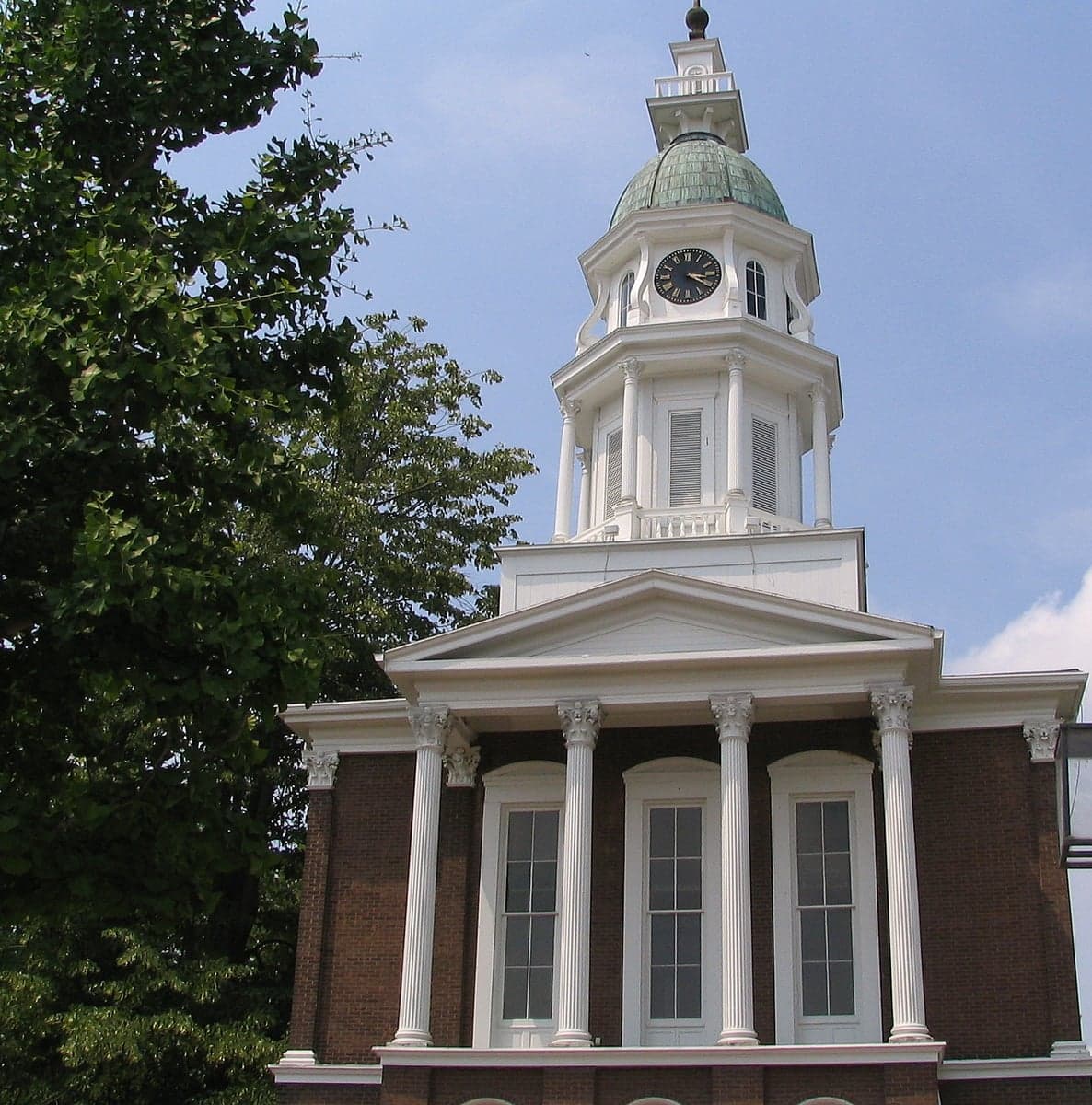
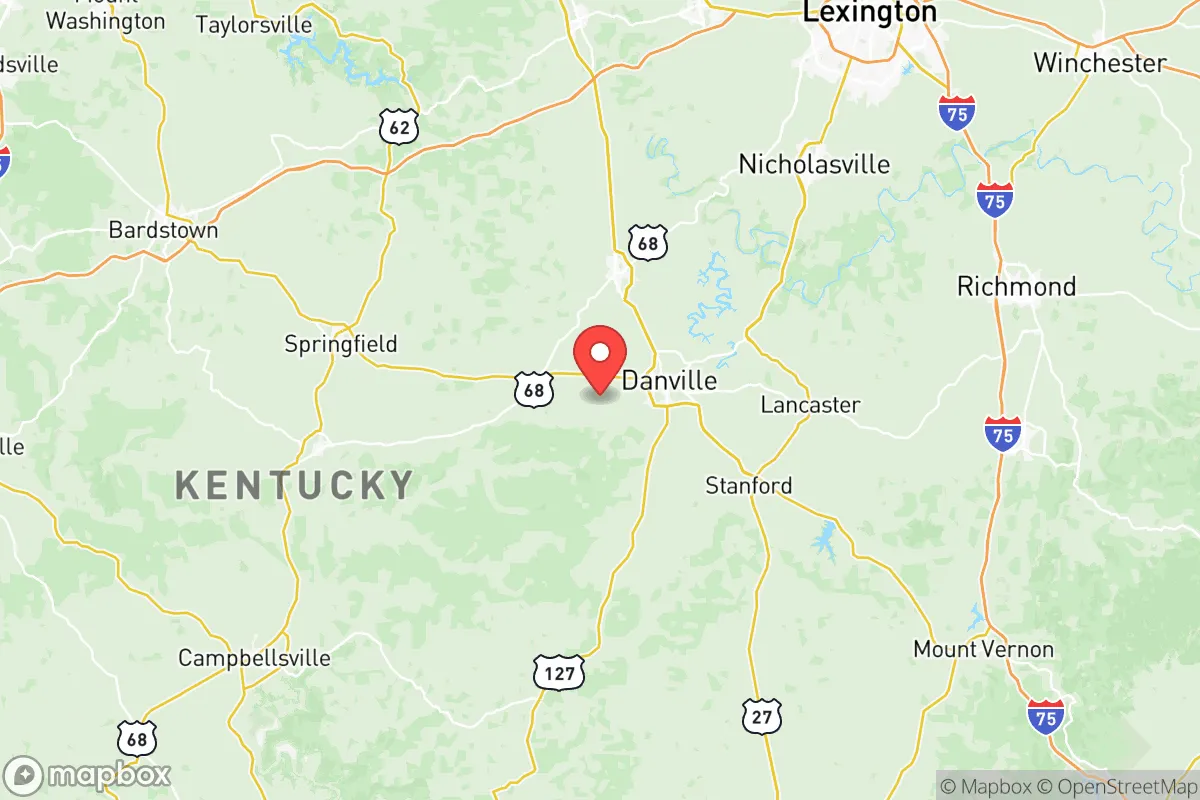
Photo: Wikipedia
Political ClimatePolitical Climate in Boyle County
Showing district-level results — no local-only data available.
Local Political AnalysisPolitical Analysis of Boyle County
Boyle County, anchored by the city of Danville, is a solidly Republican area with a Cook Partisan Voting Index (PVI) of R+23, making it significantly more conservative than the state of Kentucky as a whole, which sits at R+15. This isn't a recent shift; the county has been trending red for decades, but the margin has widened noticeably since the 2010s. In the 2024 presidential election, Donald Trump carried Boyle County with roughly 68% of the vote, outperforming his statewide margin by about 5 points. The real story, though, is the internal variation—Danville itself is a blue dot in a red sea, while the surrounding small towns and unincorporated areas are deeply conservative.
How it compares
The R+23 PVI means Boyle County is about 8 points more Republican than the statewide average. To put that in perspective, while Kentucky as a whole is reliably red, Boyle County votes like a deep-red rural district even though it contains a small city. The contrast is most visible within the county itself. Danville's precincts, particularly those around Centre College and the historic downtown, often vote Democratic by 10-15 points, reflecting the influence of the college and a more educated, professional class. In the 2024 election, Danville's 1st and 2nd precincts went for Kamala Harris. Meanwhile, the rural precincts in Parksville, Perryville, and the areas around Herrington Lake routinely deliver 75-80% of their votes to Republican candidates. The swing precincts are the newer subdivisions on the outskirts of Danville—places like the areas near the Boyle County High School—where the vote is often within 5 points, reflecting a mix of young families and retirees.
What this means for residents
For conservative residents, Boyle County feels like a natural fit. Local government, from the fiscal court to the school board, is dominated by Republicans. The county's tax policies are generally low, and the political culture emphasizes limited government and traditional values. You'll find strong support for the Second Amendment and a general skepticism of state-level mandates from Frankfort. For liberal residents, the reality is more nuanced. Danville provides a genuine enclave of progressive thought, with active Democratic clubs, a visible LGBTQ+ community, and a city council that has occasionally passed resolutions on social issues. However, outside of Danville, being openly liberal can feel isolating. The county's Republican lean means that statewide Democratic candidates, like Andy Beshear, often underperform here relative to their statewide totals—Beshear lost Boyle County by about 12 points in 2023, even as he won Kentucky by 5. This creates a dynamic where local politics are heavily one-sided, but the city of Danville offers a counterbalance that makes the county feel less monolithic than its PVI suggests.
One cultural distinction that sets Boyle County apart from other R+23 areas is the influence of Centre College. The college brings in a steady stream of faculty, staff, and students from across the country, many of whom are more liberal. This has created a visible, if small, progressive community that punches above its weight in local discourse. You'll see it in the local newspaper's letters to the editor, in the programming at the Norton Center for the Arts, and in the occasional city council debate over a social issue. For the long term, the county's political trajectory seems locked in: the rural areas will only get redder as the population ages, while Danville's blue precincts may hold steady or even grow slightly as the college expands. The result is a county that votes like a deep-red rural area but lives like a place with a genuine, if small, political diversity—a reality that both conservatives and liberals here have learned to navigate with a fair amount of mutual tolerance, at least in day-to-day life.

State Political ClimatePolitical Climate in Kentucky
State Political AnalysisPolitical Environment in the State
Kentucky is a deeply conservative state, with a Cook Partisan Voting Index of R+15, meaning it votes about 15 points more Republican than the national average. The state has shifted sharply rightward over the past two decades, driven by the collapse of the old Democratic machine in rural areas and the realignment of white working-class voters. In 2000, Kentucky was a competitive swing state that voted for George W. Bush by just 6 points; by 2024, Donald Trump carried it by over 25 points. The dominant coalition is a mix of rural and small-town conservatives, evangelical Christians, and a growing number of suburban ex-urbanites, while the Democratic base is increasingly confined to Louisville, Lexington, and a handful of college towns.
Urban vs. rural divide
The political map of Kentucky is a stark study in contrast. The two major population centers, Louisville (Jefferson County) and Lexington (Fayette County), are solidly Democratic, with Louisville voting about 60% Democratic in recent presidential elections and Lexington around 55-58%. These cities are home to the state’s major universities (University of Louisville, University of Kentucky), a growing professional class, and a significant African American population in Louisville’s West End. Outside these islands, the state is overwhelmingly Republican. The rural counties of Eastern Kentucky—places like Pikeville, Hazard, and Prestonsburg—were once Democratic strongholds (the "Solid South" legacy) but have flipped hard, often voting 75-80% Republican. The Bluegrass region around Frankfort and Bowling Green is reliably red, with Bowling Green (home to Western Kentucky University) showing a slight purple tint. The northern suburbs of Covington and Florence, across the Ohio River from Cincinnati, lean Republican but are more moderate than the rest of the state. The key takeaway: if you live in a city of over 50,000, you’re in a blue bubble; anywhere else, you’re in deep red territory.
Policy environment
Kentucky’s policy environment is shaped by a Republican supermajority that has controlled both chambers of the General Assembly since 2017, and a governorship that flipped to Democrat Andy Beshear in 2019 (he won re-election in 2023). This divided government creates a unique dynamic: the legislature passes conservative bills, and the governor often vetoes them, only to be overridden. The state has a flat income tax that is being phased down from 5% to 4% by 2026, with a goal of elimination. There is no state-level property tax, but local property taxes are moderate. Kentucky is a right-to-work state (passed in 2017) and has a "stand your ground" self-defense law (enacted in 2022). On education, the state has a robust school choice movement—the legislature passed a charter school law in 2017 (though no charters have opened yet) and created education savings accounts (ESAs) in 2022, which were struck down by the state Supreme Court in 2024. The state has a near-total abortion ban (trigger law from 2019, with no exceptions for rape or incest, only to save the mother’s life). Election laws have tightened: voter ID is required, and the legislature passed a 2021 law limiting absentee voting and early voting windows. For a conservative relocator, the tax and regulatory environment is favorable; for a liberal one, the social policies are restrictive.
Recent policy direction
The last five years have seen a flurry of legislation that signals where Kentucky is headed. On gun and self-defense law, the 2022 "stand your ground" law removed the duty to retreat, and the state has permitless carry (constitutional carry) since 2019. On parental and education rights, the 2022 "Parents’ Bill of Rights" (HB 563) requires schools to notify parents of any curriculum involving sexuality and allows parents to opt their children out. The 2023 "Don’t Say Gay" style law (SB 150) bans classroom instruction on sexual orientation and gender identity in grades K-5 and restricts transgender youth access to bathrooms and sports. On speech and privacy, Kentucky has no broad surveillance law, but the state passed a 2023 law (HB 5) banning TikTok on government devices and restricting data collection by tech companies. On medical and bodily autonomy, the near-total abortion ban is the headline, but the state also passed a 2023 law (SB 47) banning gender-affirming care for minors, overriding the governor’s veto. On property rights, Kentucky is a "Dillon’s Rule" state, meaning local governments have limited autonomy, which has frustrated some property owners in liberal cities. On taxation, the income tax phase-down is real, but the state also expanded the sales tax to include some services (like streaming and ride-sharing) in 2022. On voting and ballot access, the 2021 law (SB 1) reduced early voting from 21 days to 14, eliminated same-day registration, and required a photo ID. The overall direction is toward a more conservative, limited-government posture, but with a strong emphasis on social regulation.
Civil unrest & political movements
Kentucky has seen its share of political flashpoints. The 2020 protests in Louisville over the death of Breonna Taylor were among the largest in the nation, with months of demonstrations, clashes with police, and a heavy National Guard presence. This created a lasting divide: Louisville’s liberal base became more activist, while rural Kentucky hardened its support for law and order. The state has a visible "constitutional sheriff" movement, with several sheriffs in Eastern Kentucky publicly refusing to enforce certain federal gun laws. Immigration politics are less intense here than in border states, but there is a vocal opposition to any sanctuary policies—none exist in Kentucky, and a 2023 law (HB 7) bans local governments from adopting them. Election integrity controversies flared after 2020, with Republican legislators holding hearings and passing the 2021 voting restrictions, though no widespread fraud was ever documented. The state also has a small but active secessionist movement in the form of the "State of Franklin" proposal, which seeks to carve a new state out of Eastern Kentucky and parts of Tennessee—this is fringe but reflects deep distrust of both Louisville and Washington. A new resident in Louisville will see progressive activism; in rural areas, you’ll see "Don’t Tread on Me" flags and a strong gun culture.
Projection
Over the next 5-10 years, Kentucky is likely to become even more Republican, but with a twist. In-migration is modest—the state is not a boom destination like Texas or Florida—but the people moving in tend to be retirees from the Midwest and conservatives from blue states, reinforcing the red lean. The urban centers of Louisville and Lexington will remain blue, but their growth is slow, and the state legislature is likely to continue preempting their progressive policies (e.g., banning local minimum wage hikes, restricting local gun laws). The income tax phase-down will continue, making the state more attractive to businesses, but the social policies (abortion ban, anti-LGBTQ laws) may deter some younger, educated workers. The biggest wildcard is the coal economy in Eastern Kentucky, which is in terminal decline; if the region doesn’t diversify, it could become a depopulated, even more radicalized area. The Democratic Party’s best hope is to hold the governorship (Andy Beshear is popular), but the legislature will remain solidly Republican. For a relocator, expect a state that is stable, conservative, and increasingly resistant to national Democratic trends.
For a new resident, the bottom line is this: if you are a conservative, you will find a state that aligns with your values on taxes, guns, education, and social issues, with a government that is actively moving in your direction. If you are a liberal, you will find a state where your vote in Louisville or Lexington matters locally, but your influence on state policy is minimal and likely to shrink. The practical takeaway is that Kentucky offers a low-cost, low-regulation environment with a strong sense of community, but the political climate is unapologetically red, and that is unlikely to change in the foreseeable future.
* Values derived from national, state, county, city and local statistics and may differ in a specific area. Last updated: 2026-07-30T23:51:38.000Z
Narrative content on this page is AI-generated and may contain mistakes. Verify any details that matter before acting on them.
ReloMaps may earn a commission from affiliate links at no extra cost to you.

