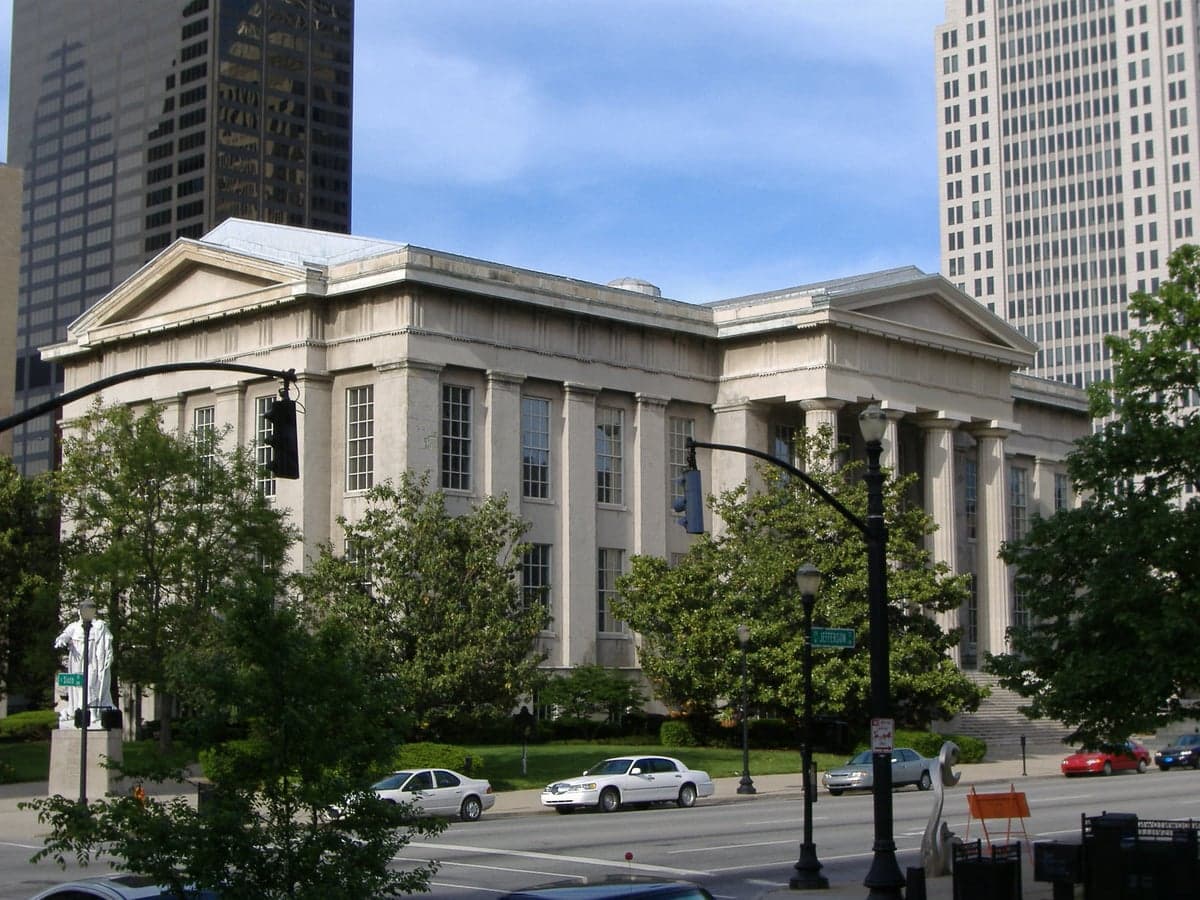
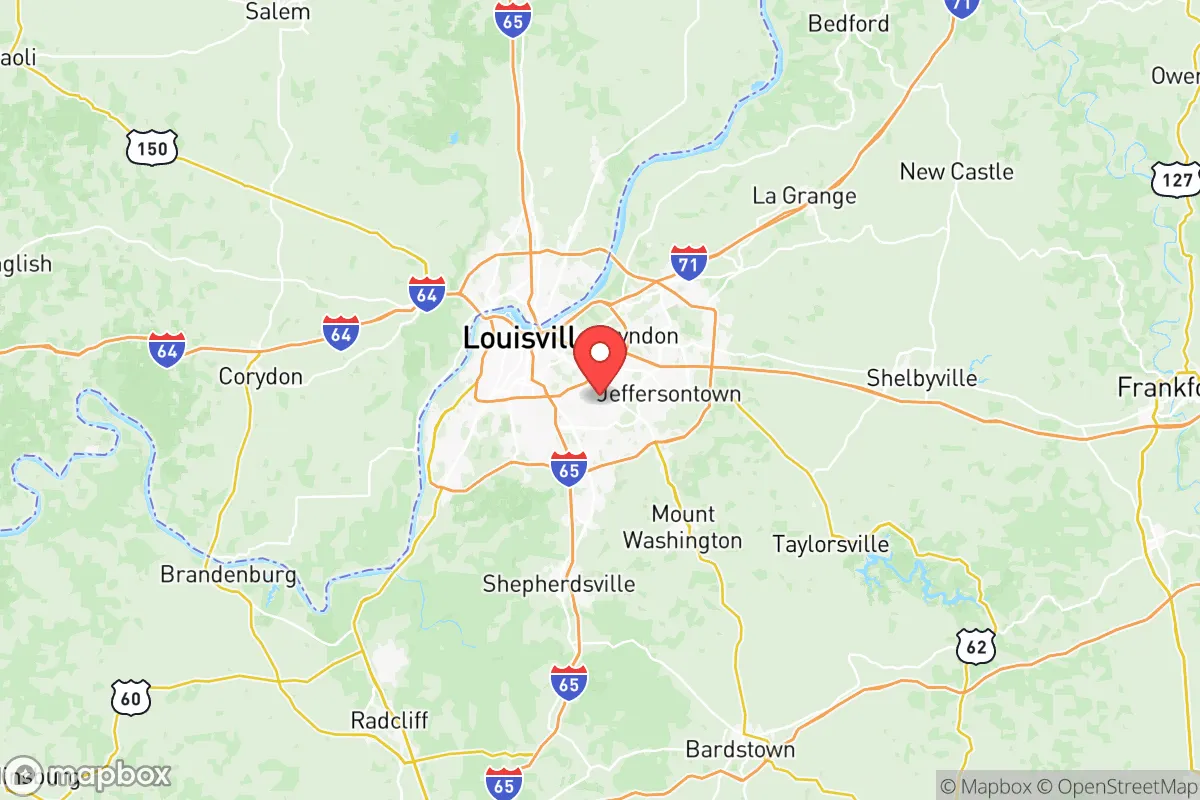
Photo: Wikipedia
Demographics of Jefferson County
Affluence Level in Jefferson County
A middle-class area roughly in line with national averages across income, home values, education, and employment.
People of Jefferson County
The people of Jefferson County, Kentucky, are predominantly native-born and rooted in a history of European settlement, African American migration, and recent but modest international diversification. With a population of 777,392, the county is 63.3% White and 21.7% Black, reflecting its legacy as a border South urban center, while a growing Hispanic population of 7.8% and smaller East/Southeast Asian (1.7%) and Indian subcontinent (1.2%) communities signal gradual change. The foreign-born share stands at just 5.3%, well below the national average, giving the county a distinctly American, Midwestern-Southern character centered on Louisville and its surrounding suburbs.
Settlement & growth (pre-1960)
Before European settlement, the area now known as Jefferson County was hunting and warring ground for the Shawnee, Cherokee, and other Native nations, who used the Ohio River corridor for travel and trade. No permanent Native villages stood on the site of present-day Louisville, but the region was contested territory between tribes and, later, European powers. French explorers claimed the area in the 17th century, but no French settlement took root; the land passed to British control after the French and Indian War and then to the United States after the Revolution.
Permanent American settlement began in 1778, when George Rogers Clark established a fort on Corn Island in the Ohio River and founded Louisville, named for King Louis XVI of France in recognition of French aid during the Revolution. The earliest settlers were overwhelmingly of English and Scots-Irish stock, migrating from Virginia, Maryland, and Pennsylvania via the Wilderness Road and the Ohio River. These families took up land grants in what are now the neighborhoods of Portland and Butchertown, and they established a frontier trading post that grew into a river port. By 1800, Louisville had become a key hub for the flatboat and keelboat trade, and its population swelled with merchants, craftsmen, and laborers from the Upper South.
The 1830s through the 1850s brought the first major wave of European immigrants. German Catholics and Lutherans arrived in large numbers, settling in Butchertown, Germantown, and the area around St. Joseph's Church, where they worked as butchers, brewers, and bakers. Irish immigrants, fleeing the Great Famine, concentrated in Portland and the west end of Louisville, building the city's canals and railroads. By 1860, one in three Louisvillians was foreign-born, a share that would not be matched again until the 21st century. The city also had a substantial free Black population before the Civil War, centered in the Smoketown and Russell neighborhoods, many of whom worked as skilled artisans and domestic servants.
After the Civil War and through the early 20th century, Jefferson County's population grew steadily with domestic migration. Freed slaves and their descendants moved from rural Kentucky and Tennessee into Louisville's West End, particularly the Russell and California neighborhoods, creating a vibrant Black commercial and cultural district along Walnut Street (now Muhammad Ali Boulevard). The Great Migration (1910–1970) brought tens of thousands of Black Southerners to the county, seeking industrial jobs in Louisville's tobacco, bourbon, and manufacturing plants. At the same time, a smaller wave of Jewish immigrants from Eastern Europe settled in the South End and along Preston Street, establishing synagogues and businesses. Suburbanization began in earnest after World War II, with returning veterans and their families moving to new developments in Shively, St. Matthews, and Jeffersontown, drawn by VA loans and the construction of the Watterson Expressway.
Modern era (post-1965)
The 1965 Hart-Cellar Act ended national-origin quotas and opened immigration from Asia, Latin America, and Africa, but Jefferson County's foreign-born share remained low compared to coastal metros. The most visible post-1965 change has been the growth of the Hispanic population, which now stands at 7.8%. Mexican and Central American immigrants began arriving in the 1990s, drawn to construction, landscaping, and food-processing jobs, and they concentrated in the South End neighborhoods of Okolona and Fairdale, as well as in the city of Shively. A smaller but established Puerto Rican community lives in the Parkland area. Hispanic-owned businesses, Catholic parishes with Spanish-language masses, and annual festivals like the Fiesta de la Independencia have become fixtures in these corridors.
East/Southeast Asian communities, comprising 1.7% of the population, are a more recent and more suburban phenomenon. Vietnamese refugees arrived after 1975, settling initially in the South End and later moving east to Middletown and the Hurstbourne area, where they opened restaurants and nail salons. A smaller Chinese and Korean professional class, many employed in healthcare and engineering at companies like Humana and GE Appliances, lives in the East End suburbs of Prospect and Anchorage. Indian subcontinent immigrants (1.2% of the population) are overwhelmingly professionals in medicine, IT, and academia, concentrated in the East End around Lyndon and the Norton Commons development; they maintain active cultural organizations and temples but are residentially dispersed rather than clustered in a single enclave.
Domestic migration has also reshaped the county since 1965. The decline of Louisville's manufacturing base in the 1980s and 1990s slowed in-migration from the Rust Belt, but the county has attracted a steady stream of retirees and remote workers from the Midwest and Northeast, drawn by lower housing costs and a lower cost of living. Suburbanization has continued outward: the population of the city of Louisville proper has stagnated, while suburbs like Jeffersontown, Mount Washington (in adjacent Bullitt County), and the East End have grown. The 2003 merger of Louisville city

* Values derived from national, state, county, city and local statistics and may differ in a specific area. Last updated: 2026-05-12T12:12:53.000Z
Narrative content on this page is AI-generated and may contain mistakes. Verify any details that matter before acting on them.
ReloMaps may earn a commission from affiliate links at no extra cost to you.

