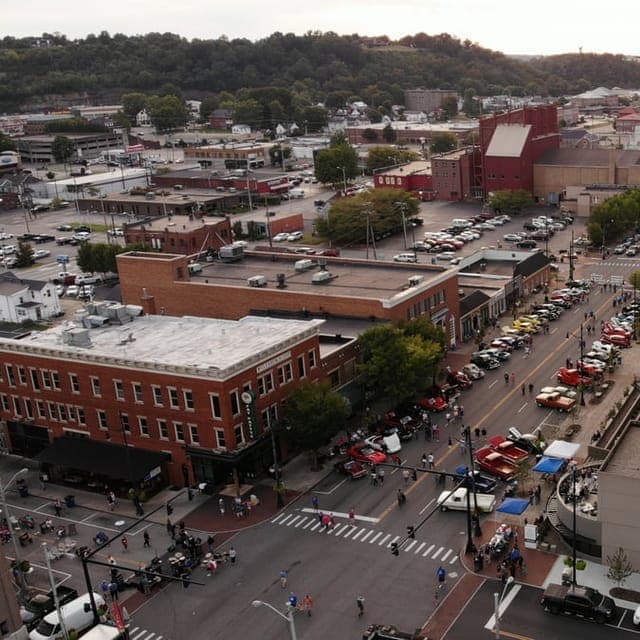
Photo: Wikipedia
Demographics of Kentucky
Affluence Level in Kentucky
A middle-class area roughly in line with national averages across income, home values, education, and employment.
People of Kentucky
Kentucky’s 4.5 million residents are predominantly native-born, with only 2.6% foreign-born, making it one of the most ethnically homogeneous states in the U.S. outside of New England. The population is 82.3% White, 7.8% Black, and 4.7% Hispanic, with small but growing East/Southeast Asian (1.0%) and Indian-subcontinent (0.5%) communities. The state’s identity is rooted in a deep Scots-Irish and English heritage, shaped by rural traditions, evangelical Christianity, and a fierce independence that still defines its political and social character. Kentucky remains a place where family ties and local roots matter more than in much of the country, and where newcomers are often measured by how well they fit into existing communities rather than how quickly they change them.
Settlement & growth (pre-1960)
Before European arrival, Kentucky was a contested hunting ground rather than a permanent home for Native nations. The Shawnee from the north and the Cherokee from the south used the region for seasonal hunting, but no large, settled agricultural tribes existed here when the first white explorers arrived. The Iroquois claimed the land by conquest but did not occupy it, leaving Kentucky as a sparsely populated buffer zone between warring tribes. This vacuum made it one of the first frontiers of American westward expansion.
The first permanent European settlers were not Spanish or French colonists, but English-speaking pioneers who crossed the Appalachian Mountains after the American Revolution. Beginning in the 1770s, Daniel Boone blazed the Wilderness Trail through the Cumberland Gap, leading families from Virginia, North Carolina, and Pennsylvania into the Bluegrass region. These were overwhelmingly Scots-Irish and English settlers—Presbyterian and Baptist farmers seeking cheap land and freedom from coastal elites. They founded Harrodsburg (1774) and Boonesborough (1775), and by 1792 Kentucky had enough population to become the 15th state. The early economy was subsistence farming, tobacco, and hemp, with enslaved Black labor already present from the start.
The 19th century brought two major waves. First, the antebellum plantation boom (1820–1860) saw wealthy Virginians and Marylanders move into the central Bluegrass, bringing large numbers of enslaved African Americans to work tobacco and thoroughbred horse farms. This created a Black population that reached 20% of the state by 1860, concentrated in Lexington, Louisville, and the fertile inner counties. Second, after the Civil War, German and Irish immigrants arrived to work in the growing cities. Germans settled heavily in Covington and Newport (across the Ohio River from Cincinnati), building breweries and Catholic parishes. Irish immigrants dug canals and built railroads, settling in Louisville’s Irish Hill neighborhood and Lexington’s Irish enclaves. By 1900, Kentucky was still 85% rural, but Louisville had become a major Ohio River port with a diverse working class.
The 20th century saw two countervailing trends. The Great Migration (1910–1970) pulled tens of thousands of Black Kentuckians out of the rural south and into Louisville and Lexington, but also out of the state entirely to northern industrial cities. Kentucky’s Black population share actually declined from 11% in 1910 to 7% by 1970 as out-migration exceeded in-migration. Meanwhile, Appalachian coal mining (1910–1950) drew poor white farmers from the mountains into company towns like Harlan and Pikeville, creating a distinct regional culture of union activism and evangelical religion. The post-World War II era saw the rise of suburban Louisville and the growth of Bowling Green as a manufacturing center, but Kentucky remained overwhelmingly white, native-born, and rural through 1960.
Modern era (post-1965)
The 1965 Hart-Cellar Act had a muted effect on Kentucky compared to coastal states. The foreign-born population remained below 3% through 2020, and the state did not experience the mass immigration waves that transformed Texas, California, or New York. However, two specific immigrant groups have established visible communities since the 1980s. Hispanic immigrants, primarily from Mexico and Central America, began arriving in the 1990s to work in Louisville’s meatpacking plants, Lexington’s horse farms, and Bowling Green’s automotive factories (home to a major GM Corvette plant). The Hispanic share rose from 0.6% in 1990 to 4.7% today, with the largest concentrations in Shelbyville (15% Hispanic) and Louisville’s South End. A smaller but notable East/Southeast Asian community (1.0%) formed around Louisville’s universities and medical centers, with Vietnamese and Chinese families settling in the Highlands and East End. The Indian-subcontinent population (0.5%) is heavily concentrated in Lexington and Louisville, drawn by tech and healthcare jobs.
Domestic migration has been more transformative than immigration. Since 1970, Kentucky has experienced steady in-migration from the Rust Belt—particularly Ohio, Michigan, and Indiana—as retirees and manufacturing workers sought lower costs and milder winters. Bowling Green grew from 36,000 in 1970 to 75,000 today, driven by auto manufacturing and a growing Hispanic workforce. Lexington expanded from 108,000 to 323,000, absorbing suburban sprawl into Fayette and surrounding counties. The most dramatic shift has been the suburbanization of Louisville, where the city proper lost population while the surrounding counties (Oldham, Bullitt, Shelby) boomed with white flight and new subdivisions. The Black population has suburbanized as well, with middle-class Black families moving to Louisville’s East End and Lexington’s Hamburg area.
The future
Kentucky’s demographic future is one of slow, incremental change rather than rapid transformation. The foreign-born share is projected to rise to 4–5% by 2040, driven primarily by Hispanic growth in manufacturing and agricultural counties. The Hispanic population is not forming isolated enclaves but is dispersing across the state, with significant presence in Louisville, Lexington, Bowling Green, and smaller towns like Russellville and Mayfield. This suggests assimilation into the broader white working class is likely, as intermarriage rates are high and Spanish-language retention is lower than in the Southwest. The East/Southeast Asian and Indian communities will grow modestly, tied to university and healthcare expansion, but will remain small and concentrated in professional corridors.
The larger story is internal homogenization. Kentucky’s white population is aging and rural counties are depopulating, while the urban crescent from Louisville through Lexington to Northern Kentucky absorbs most growth. The state is becoming more polarized between a liberal-leaning, college-educated urban core and a deeply conservative, evangelical rural periphery. The Black population is stable at 7–8%, but is increasingly suburban and middle-class, reducing the historic urban-rural racial divide. The next 10–20 years will likely see Kentucky remain one of the whitest, most native-born states in the nation, with Hispanic growth slowly diversifying the margins but not fundamentally altering the state’s cultural DNA.
For someone moving to Kentucky today, the state offers a stable, family-oriented environment where community ties are strong and change is gradual. The population is overwhelmingly American-born, English-speaking, and Christian, with a conservative social ethos that dominates outside of Louisville and Lexington. Newcomers will find a place where history is still alive in the landscape—from the pioneer forts of Harrodsburg to the horse farms of Lexington—and where the people, for better or worse, remain deeply rooted in the land their ancestors settled two centuries ago.

Most Diverse Cities in Kentucky
Most Homogenous Cities in Kentucky
* Values derived from national, state, county, city and local statistics and may differ in a specific area. Last updated: 2026-04-18T22:38:41.000Z
Narrative content on this page is AI-generated and may contain mistakes. Verify any details that matter before acting on them.
ReloMaps may earn a commission from affiliate links at no extra cost to you.

