
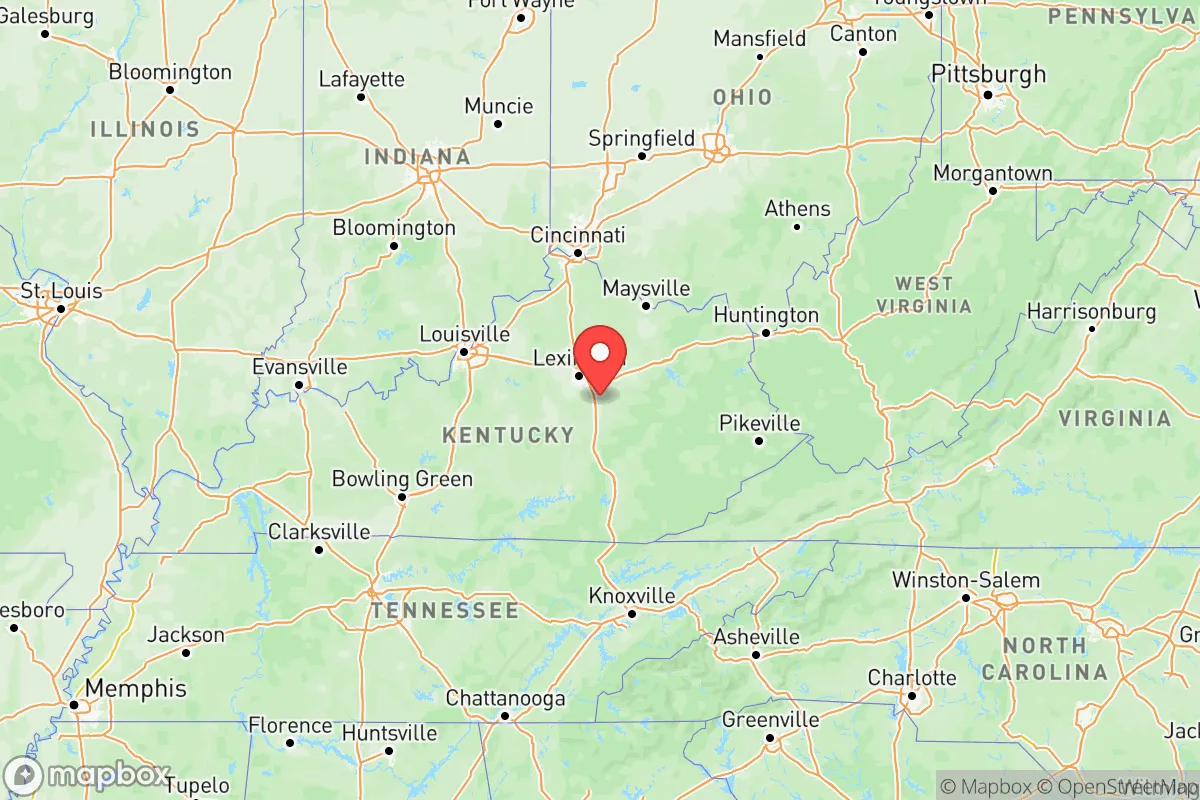
Photo: Wikipedia
Personal Sovereignty in Kentucky
Viable for self-reliance. Generally workable, though some barriers may limit total independence.
What does Personal Sovereignty tell us?
Personal Sovereignty measures your capacity for self-reliance and independence with minimal government friction. Higher scores mean fewer barriers between you and the way you want to live... but it assumes you have the space you need and good neighbors.
What does this tell us?
Personal Sovereignty measures your capacity for self-reliance and independence with minimal government friction. Higher scores mean fewer barriers between you and the way you want to live... but it assumes you have the space you need and good neighbors.
State Policy
Energy independence: Importer (60% of energy produced in-state)
Personal Liberty
Homesteading

Personal Liberty Analysis
Kentucky offers one of the strongest environments for personal sovereignty in the eastern United States, combining a deeply ingrained culture of self-reliance with state-level legal protections that push back against federal overreach. The Bluegrass State operates with a clear presumption that the individual—not the government—is the primary unit of authority, and this is reflected in everything from its tax code to its self-defense laws. For those looking to live free from the creeping regulatory state that dominates the coasts and even parts of the Midwest, Kentucky presents a viable, actionable alternative. The state’s constitutional carry law, low property tax burden, and minimal zoning restrictions in rural counties create a landscape where a prepper, homesteader, or liberty-minded family can actually build the life they want without constant permission-seeking from bureaucrats.
Tax burden and regulatory posture: How Kentucky compares to surrounding states
Kentucky’s tax structure is a major draw for those seeking to keep more of their own money and face less government interference. The state has a flat individual income tax rate of 4.0% as of 2025, with a scheduled reduction to 3.5% by 2026, and no state-level tax on Social Security benefits—a critical factor for retirees and those planning for long-term self-sufficiency. Property taxes are among the lowest in the nation, with an effective rate around 0.83% of home value, meaning a $200,000 property in a place like Bowling Green or Richmond costs roughly $1,660 annually in property tax. This is a fraction of what you’d pay in Ohio or Illinois. Regulatory posture is equally favorable: Kentucky is a right-to-work state, has no state-level OSHA plan (relying on federal OSHA, which is less aggressive in practice), and has a notoriously business-friendly legislature that has repeatedly rejected expansion of Medicaid and other federal programs. For the prepper mindset, this means fewer layers of red tape when building a workshop, installing a rainwater catchment system, or running a small farm operation. The contrast with neighboring states like Tennessee (which has no income tax but higher sales tax) and Indiana (which has a similar income tax but more aggressive property assessments) is notable—Kentucky strikes a balance that leaves more cash in your pocket and fewer inspectors on your land.
Self-defense and gun law specifics: Constitutional carry and castle doctrine in practice
Kentucky is a constitutional carry state, meaning no permit is required to carry a concealed firearm for any law-abiding adult 21 or older. This is not a recent concession; the law has been in place since 2019, and the state’s culture has long embraced armed self-defense as a fundamental right. The castle doctrine is codified in statute (KRS 503.055), establishing a legal presumption that a person using deadly force against an intruder in their home, vehicle, or place of business acted in self-defense. There is no duty to retreat in any place where you are lawfully present—a “stand your ground” principle that applies statewide. For those living in more rural areas like Pikeville or Paducah, this legal framework is not just theoretical; it’s a practical necessity given the long response times of local law enforcement. The state also preempts local gun ordinances, meaning cities like Louisville or Lexington cannot impose their own bans or restrictions—a critical protection against the kind of municipal overreach seen in places like Chicago or Denver. Ammunition and firearm purchases face no state-level background check beyond the federal NICS system, and there is no waiting period. For the survivalist, this means your ability to defend yourself and your family is not contingent on government permission or bureaucratic delays.
Self-reliance and homesteading viability: Lot sizes, zoning, and off-grid feasibility
Kentucky’s rural counties offer some of the most permissive zoning environments in the country for those pursuing self-reliance. Outside of incorporated city limits in places like Bowling Green or Owensboro, there is typically no county-level zoning at all—meaning you can build a barn, install solar panels, dig a well, or set up a composting toilet without applying for a variance or facing a planning board. Minimum lot sizes in unincorporated areas are often as low as one acre, and many counties allow for “agricultural exemption” structures that bypass building codes entirely. Off-grid living is entirely feasible: Kentucky has no state-level ban on rainwater collection, and many rural properties have existing wells or easy access to groundwater. The state’s climate—with 45 inches of annual rainfall and a growing season of 180 days—supports year-round food production. For the prepper, counties like Pulaski (around Somerset) or Graves (near Mayfield) offer affordable land—often under $5,000 per acre—with no HOA restrictions and minimal government oversight. The key distinction is between the “blue” urban islands of Louisville and Lexington, where zoning and building codes are more restrictive, and the rest of the state, where a homesteader can operate with near-total autonomy. If you want to live off-grid, raise livestock, and store supplies without a government official peering over your shoulder, Kentucky’s rural counties are among the best bets east of the Mississippi.
Personal liberties: Parental rights, medical autonomy, speech, and property protections
Kentucky has become a battleground for parental rights, with state law explicitly affirming that parents have the fundamental right to direct the upbringing, education, and healthcare of their children. The state’s 2022 “Parents’ Bill of Rights” (SB 150) requires schools to notify parents of any medical or mental health services provided to minors, prohibits classroom instruction on sexual orientation or gender identity in grades K-5, and allows parents to opt their children out of any instructional materials they find objectionable. This is a direct counter to the federal overreach seen in other states, and it gives families real leverage against school boards and administrators. Medical autonomy is more mixed: Kentucky has not expanded Medicaid under the ACA, which limits options for low-income individuals, but it also has no state-level vaccine mandate for adults and has passed laws prohibiting COVID-19 vaccine mandates by private employers in many cases. Free speech protections are robust, with no state-level hate speech laws and a strong tradition of protecting political expression—even controversial speech—under the Kentucky Constitution. Property rights are reinforced by the state’s “right to farm” law, which protects agricultural operations from nuisance lawsuits, and by the absence of statewide zoning. For the liberty-minded individual, this means you can speak your mind, raise your children according to your values, and use your land as you see fit, without the state acting as an adversary.
Overall, Kentucky ranks among the top tier of states for personal sovereignty in the eastern U.S., comparable to West Virginia and Tennessee but with a lower cost of living and more permissive rural zoning. The combination of constitutional carry, low taxes, minimal regulation, and strong parental rights creates an environment where a prepper or survivalist can operate with a high degree of autonomy. The trade-offs are real: the state’s infrastructure is weaker than the national average, and the urban-rural divide means that liberties in Louisville or Lexington are more constrained than in the rest of the state. But for those willing to locate in counties like Pulaski, Graves, or Pike, Kentucky offers a level of freedom that is increasingly rare in modern America. If your priority is to live on your own terms, with minimal government interference and maximum personal responsibility, this state deserves serious consideration.

Top Cities for Personal Sovereignty in Kentucky










* Values derived from national, state, county, city and local statistics and may differ in a specific area. Last updated: 2026-04-18T22:38:41.000Z
Narrative content on this page is AI-generated and may contain mistakes. Verify any details that matter before acting on them.
ReloMaps may earn a commission from affiliate links at no extra cost to you.

