
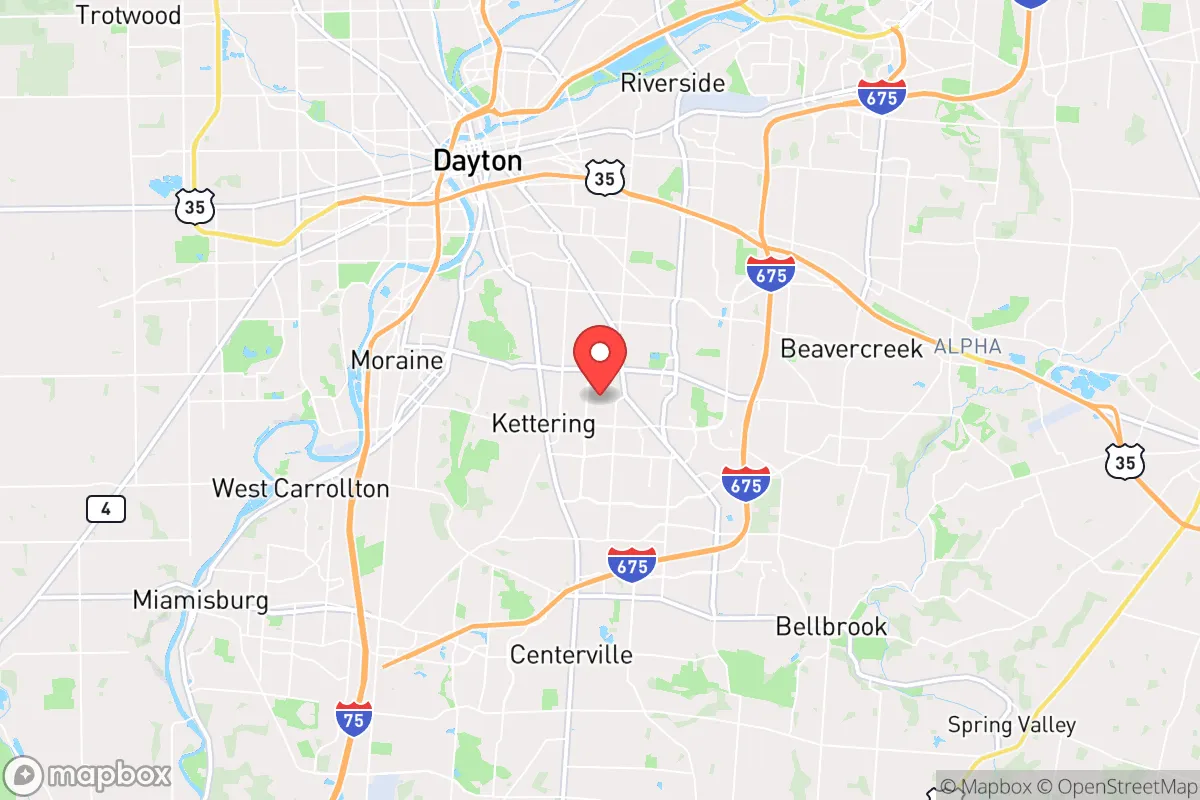
Photo: Wikipedia
Political ClimatePolitical Climate in Kettering, OH
District shown is the primary district for this city’s centroid. Cities may span multiple districts.
Local Political AnalysisPolitical Analysis of Kettering, OH
Kettering, Ohio, has long been a solidly conservative community, and that hasn't changed much despite the national trends. The Cook PVI of R+3 tells you the baseline: this is a Republican-leaning suburb, but it’s not a deep-red stronghold like some of the rural counties to the north and west. Over the last decade, the shift has been subtle but real—you’ll see more yard signs for moderate Democrats in the nicer neighborhoods near the golf courses, but the city council and school board still lean right. The real story is how Kettering’s politics compare to the surrounding areas, and what that means for the people who actually live here.
How it compares
Drive ten minutes east to Dayton, and you’re in a completely different world—a blue city with a Cook PVI of D+15, where progressive policies on housing and policing are the norm. Head south to Centerville or west to Oakwood, and you’ll find suburbs that are even more conservative than Kettering, with PVI numbers closer to R+8 or R+10. Kettering sits right in the middle, politically speaking. It’s not as reliably red as the rural townships, but it’s also not as susceptible to the progressive wave that’s washing over Dayton. That middle ground means Kettering residents get a mix: you’ll see some local ordinances that feel like government overreach—like the recent push for stricter rental inspections—but the city council usually pushes back on anything that smacks of big-government solutions. The contrast with Dayton is stark: while Dayton’s leadership has embraced things like "sanctuary city" policies and defunding police rhetoric, Kettering’s council has consistently voted to keep law enforcement funding steady and resisted any move toward sanctuary status. That’s a big deal for folks who value personal safety and local control.
What this means for residents
For a long-time resident like me, the biggest concern is how the creeping progressive ideology from Dayton and the state-level trends might start to bleed into Kettering. The school board, for example, has been a battleground—there was a big fight a couple years ago over a proposed "equity" curriculum that felt like it was pushing a political agenda. The conservative majority held the line, but it was close. What this means for you is that your property rights, your Second Amendment rights, and your kids’ education are all still pretty safe here, but you have to stay vigilant. The tax burden is reasonable compared to Montgomery County as a whole—property taxes are about 1.8% of assessed value, which is lower than Dayton’s 2.2%—and there’s no city income tax for non-residents who work here. That’s a big plus if you value keeping more of your own money. The local government is still small enough that you can actually call your council member and get a straight answer, but that’s changing as the city grows.
Culturally, Kettering is still a place where people wave to their neighbors and the Fourth of July parade is a big deal. The policy distinctions that matter most are the ones that protect individual freedoms: no mask mandates after 2021, no vaccine passport requirements, and a zoning code that still lets you run a small business out of your home without a ton of red tape. The long-term trajectory is what worries me—if the progressive wave from Dayton keeps pushing, and if the state government in Columbus keeps passing preemption laws that override local control, Kettering could lose that independent, conservative character. For now, though, it’s one of the last places in the Miami Valley where you can still feel like your voice matters and the government isn’t trying to run your life.

State Political ClimatePolitical Climate in Ohio
State Political AnalysisPolitical Environment in the State
Ohio has long been the quintessential bellwether state, but its political center of gravity has shifted noticeably rightward over the past decade. While it voted for Barack Obama twice, it has since swung hard for Donald Trump by 8 points in 2020 and 11 points in 2024, cementing a Republican trifecta in state government. The dominant coalition is now a mix of working-class voters in the Mahoning Valley and Appalachian southeast, combined with suburban ex-urbanites fleeing the tax-and-regulate policies of neighboring states like Michigan and Pennsylvania. The 10-20 year arc is clear: Ohio is becoming more reliably red, driven by a cultural backlash against progressive overreach in blue states and a steady exodus of moderate Democrats from the party.
Urban vs. rural divide
The political map of Ohio is a textbook study in contrast. The three Cs — Columbus, Cleveland, and Cincinnati — are the Democratic strongholds, with Cuyahoga County (Cleveland) delivering a 2-to-1 margin for Biden in 2020. But outside these urban islands, the state is deeply red. The rural northwest, from Defiance to Findlay, votes Republican by 30-40 point margins. The Appalachian southeast, including counties like Belmont and Monroe, has flipped hard from blue-dog Democrat to Trump country. The real story is the suburbs: places like Delaware County (north of Columbus) and Warren County (north of Cincinnati) are now among the most Republican counties in the state, with GOP margins exceeding 60%. Meanwhile, Mahoning County (Youngstown) has shifted from reliably blue to a swing county, reflecting the broader working-class realignment. The divide isn't just geographic — it's cultural, with urban centers pushing progressive policies on crime and education while the rest of the state pushes back.
Policy environment
Ohio's policy environment is a mixed bag for conservatives, but trending in the right direction. The state has a flat income tax of 3.5% (down from 4.8% in 2020) and no tax on Social Security benefits — a major win for retirees. Property taxes are moderate, averaging 1.5% of home value, but local levies can vary wildly. The regulatory posture is business-friendly, with right-to-work laws not on the books but a strong tort reform environment. Education policy is a flashpoint: the state has expanded school choice significantly, with the EdChoice voucher program now available to any family earning under 400% of the federal poverty line. However, the state board of education has been embroiled in battles over critical race theory and library content, with conservative parents winning some local battles. Healthcare is a mixed bag — Ohio expanded Medicaid under Obamacare, but the state has not pursued a state-based exchange. Election laws are solid: voter ID is required, early voting is limited to 28 days, and drop boxes are restricted to one per county. The 2020 election integrity concerns were largely unfounded here, but the state has tightened laws to prevent future issues.
Trajectory & freedom
Ohio is becoming more free in several key areas, but the battle is ongoing. The biggest win for personal liberty was the 2022 passage of HB 99, which eliminated the requirement for a concealed carry permit — Ohio is now a constitutional carry state. This was a direct response to federal overreach and local gun control efforts in cities like Columbus and Cleveland. On parental rights, the state passed HB 8 in 2023, which requires schools to notify parents of any changes to a student's health or well-being, effectively banning secret gender transitions. Medical autonomy took a hit with the 2023 passage of Issue 1, which enshrined abortion rights in the state constitution — a major loss for conservatives. However, the state has pushed back with a 24-hour waiting period and parental consent laws that remain in effect. Property rights are strong, with no statewide rent control and limited eminent domain abuse. The tax burden is declining, but local governments in blue cities are raising levies. The trajectory is toward more freedom on guns and education, but the abortion fight is far from over.
Civil unrest & political movements
Ohio has seen its share of political flashpoints. The 2020 protests in Columbus and Cleveland over George Floyd's death turned violent, with looting and arson in downtown Columbus that led to a lasting distrust of city leadership. The state has a robust Second Amendment movement, with groups like Ohio Gun Owners actively challenging local gun ordinances in places like Cincinnati and Toledo. Immigration politics are relatively quiet compared to border states, but the influx of Somali and Latino communities in Columbus has sparked debates over sanctuary policies — the state passed a law in 2024 banning sanctuary cities, though Columbus has resisted. Election integrity remains a hot topic: the 2022 gubernatorial race saw no major issues, but the 2024 presidential election saw claims of irregularities in Cuyahoga County that were never substantiated. The most visible movement is the parental rights wave, with groups like Moms for Liberty active in Delaware County and Warren County, successfully pushing for book bans and curriculum transparency. The left is equally organized, with Indivisible groups in Columbus and Cleveland fighting every conservative move. A new resident will notice the political energy at local school board meetings and county fairs — it's not passive.
Projection
Over the next 5-10 years, Ohio will likely become more conservative, but not uniformly. The in-migration from blue states like California and Illinois is accelerating, but these newcomers are often fleeing progressive policies, not importing them. The suburbs of Columbus and Cincinnati are growing fast, and they are voting redder with each cycle. The urban cores will continue to shrink and become more Democratic, but their political power is diluted by gerrymandering — the state's congressional map is heavily Republican. The demographic shift is working in conservatives' favor: the white working-class base is aging but still dominant, and the Hispanic population in places like Lorain County is trending Republican. The wildcard is the abortion issue — if the 2023 constitutional amendment leads to a backlash, it could energize the pro-life base further. Expect more school choice expansion, more tax cuts, and more battles over local control. Someone moving in now should expect to find a state that is solidly red at the state level, but with blue islands that require vigilance at the local level.
Bottom line for a new resident: Ohio offers a strong conservative policy environment on taxes, guns, and education, but you'll need to pick your county carefully. Avoid the urban cores of Columbus, Cleveland, and Cincinnati if you want to escape progressive overreach. Instead, target the exurbs like Delaware, Warren, or Medina counties, where the politics match the policy. The state is trending in the right direction, but the fight over local control — especially in schools — is ongoing. If you value personal freedom and a low-tax environment, Ohio is a solid bet, but don't expect a libertarian paradise. It's a red state with blue pockets, and the culture war is alive and well.
* Values derived from national, state, county, city and local statistics and may differ in a specific area. Last updated: 2026-04-22T02:39:33.000Z
Narrative content on this page is AI-generated and may contain mistakes. Verify any details that matter before acting on them.
ReloMaps may earn a commission from affiliate links at no extra cost to you.

