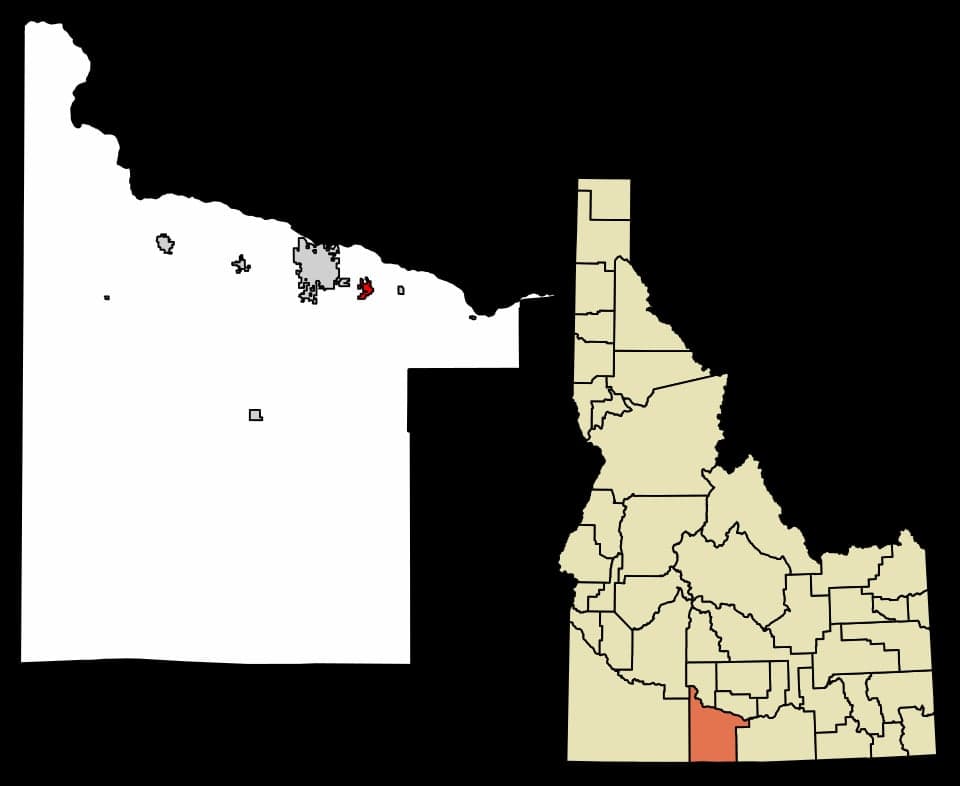
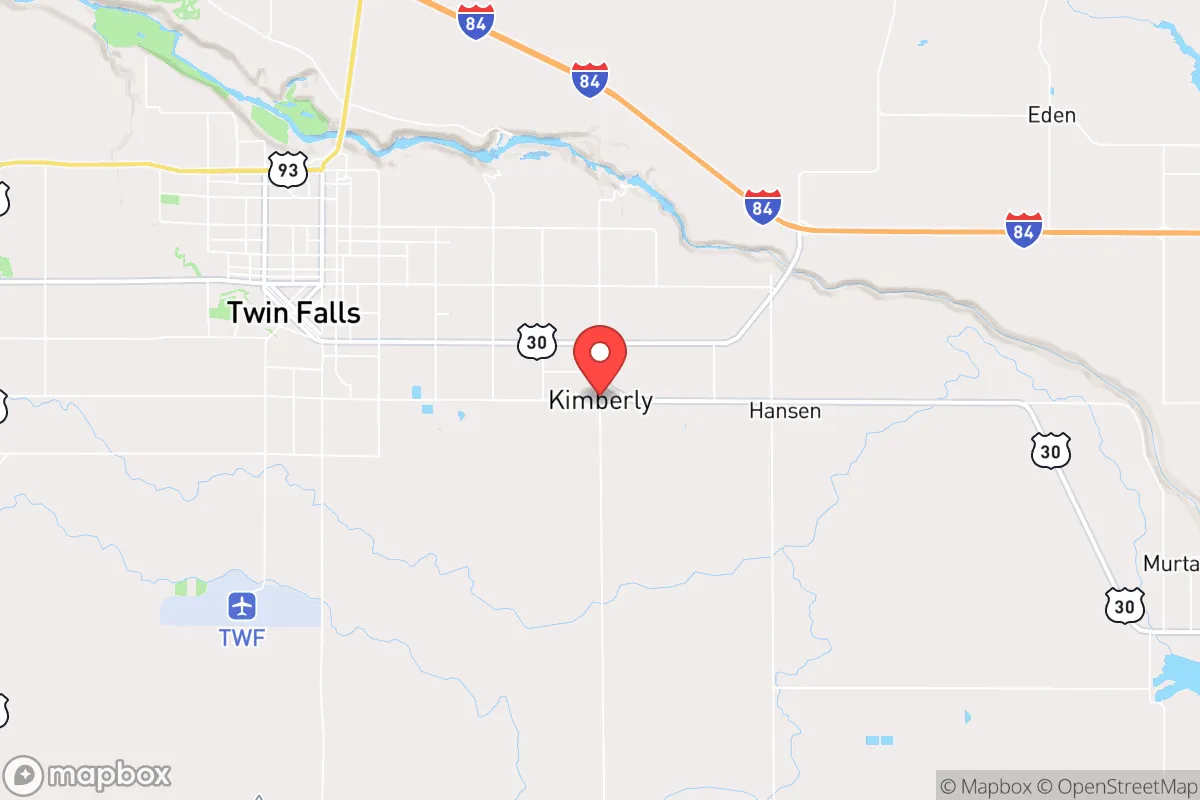
Photo: Wikipedia
Demographics of Kimberly, ID
Affluence Level in Kimberly, ID
A middle-class area roughly in line with national averages across income, home values, education, and employment.
People of Kimberly, ID
Kimberly, Idaho, is a small, tight-knit agricultural community of 4,883 residents where a white majority (64.8%) coexists with a substantial Hispanic population (33.6%), reflecting a deep-rooted Latino presence that has shaped the city's character for generations. The city's identity is distinctly working-class and family-oriented, with a low college attainment rate of 21.8% and a foreign-born share of just 5.0%, indicating that most Hispanic residents are U.S.-born descendants of earlier migrant workers. Kimberly feels more like an extended rural neighborhood than a typical town, with strong ties to the surrounding dairy and potato farming economy that anchors the Magic Valley region.
How the city was settled and grew
Kimberly was founded in 1904 as a railroad stop along the Oregon Short Line, named after a local rancher and businessman, Peter Kimberly. The original settlers were predominantly white homesteaders of Northern European descent—mostly English, German, and Scandinavian—who were drawn by the promise of irrigated farmland following the construction of the Milner Dam and the Twin Falls Canal Company's water system. These early families built the core of what is now Old Town Kimberly, the historic district centered around Main Street and Kimberly Road, where many original Craftsman-style homes and the old grain elevators still stand. A second wave arrived during the 1910s and 1920s, when the area's sugar beet industry boomed, attracting a smaller number of Basque and Italian immigrants who settled in the Railroad Avenue corridor near the depot. By 1930, the population had reached roughly 800, and the town's character was firmly set as a white, agricultural service hub.
Modern era (post-1965)
The most significant demographic shift in Kimberly began in the 1970s and 1980s, when the dairy and potato processing industries expanded rapidly, drawing Mexican and Mexican-American migrant laborers to the Magic Valley. Unlike many Idaho towns where Hispanic growth is recent, Kimberly's Latino population grew steadily over decades, with families settling in the South Kimberly area—roughly bounded by 3300 South and the Snake River—where affordable housing and proximity to dairy operations made it a natural landing point. By 2000, the Hispanic share had reached roughly 20%, and it has since climbed to 33.6%. The East Kimberly neighborhood, near the intersection of 3600 North and Kimberly Road, also saw significant Hispanic homeownership, with many families moving from rental units into single-family homes. The white population, meanwhile, has remained stable in absolute numbers but declined as a share, with many younger white residents moving to Twin Falls (8 miles west) for college and professional jobs. The Black, Asian, and Indian populations remain at 0.0%, making Kimberly one of the most racially binary small towns in Idaho—a white and Hispanic community with virtually no other ethnic representation.
The future
Kimberly's population is projected to continue growing slowly, likely reaching 5,500–6,000 by 2040, driven by natural increase among the Hispanic population and some spillover from Twin Falls' housing market. The city is not homogenizing; rather, it is becoming more distinctly bicultural, with the Kimberly Heights subdivision (a newer development off 3600 North) attracting a mix of white and Hispanic families, while Old Town remains predominantly white and older. The Hispanic population is not tribalizing into isolated enclaves—intermarriage rates are moderate, and Spanish is widely spoken but not dominant in public life. The foreign-born share (5.0%) is low, suggesting that most Hispanic growth is now from U.S.-born second and third generations rather than new immigration. The biggest unknown is whether the dairy industry's labor demands will continue to draw new migrants, or whether automation will slow that flow. For now, Kimberly remains a place where the white and Hispanic communities work side by side in the fields and processing plants, with a shared identity rooted in agriculture rather than ethnic division.
For a conservative-leaning individual or family moving to Kimberly today, the city offers a stable, low-crime environment where traditional values of hard work and neighborliness still hold. The population is not diversifying in the way many Western towns are—it is solidifying into a white-Hispanic bicultural community with little racial tension but also little racial variety. Newcomers will find a place where everyone knows the local high school football team and the harvest schedule, and where the biggest change in the next decade will likely be more rooftops on the east side, not a shift in the city's fundamental character.

* Values derived from national, state, county, city and local statistics and may differ in a specific area. Last updated: 2026-05-03T05:01:02.000Z
Narrative content on this page is AI-generated and may contain mistakes. Verify any details that matter before acting on them.
ReloMaps may earn a commission from affiliate links at no extra cost to you.

