
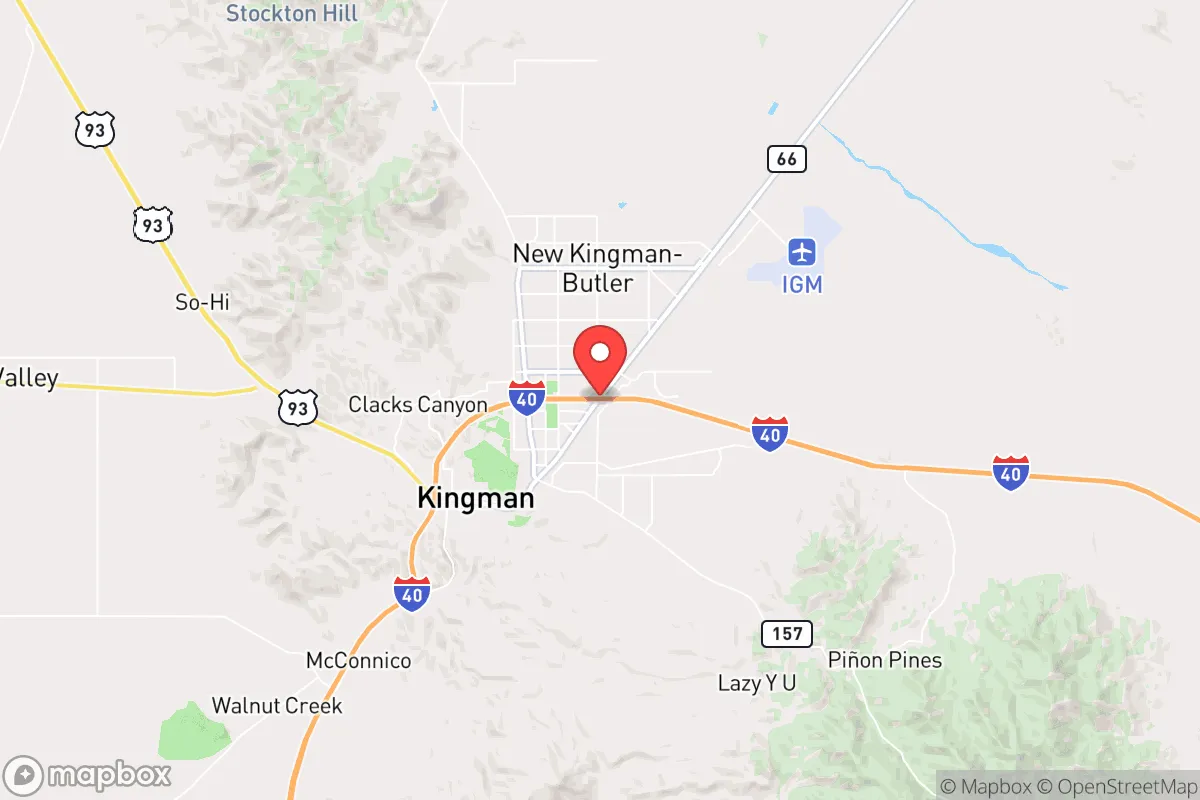
Photo: Wikipedia
Personal Sovereignty in Kingman, AZ
Viable for self-reliance. Generally workable, though some barriers may limit total independence.
What does Personal Sovereignty tell us?
Personal Sovereignty measures your capacity for self-reliance and independence with minimal government friction. Higher scores mean fewer barriers between you and the way you want to live... but it assumes you have the space you need and good neighbors.
What does this tell us?
Personal Sovereignty measures your capacity for self-reliance and independence with minimal government friction. Higher scores mean fewer barriers between you and the way you want to live... but it assumes you have the space you need and good neighbors.
State Policy
Energy independence: Importer (20% of energy produced in-state)
Personal Liberty
Homesteading

Personal Liberty Analysis
Kingman, Arizona offers a personal sovereignty environment that stands in stark contrast to the coastal and urban jurisdictions many relocating families are fleeing. Nestled in Mohave County, this high-desert town operates under Arizona’s strong preemption laws, which systematically strip local governments of the power to impose restrictive ordinances on firearms, land use, and property rights. For the survivalist or prepper, Kingman represents a strategic foothold where state-level protections create a buffer against the creeping overreach seen in blue states—though it is not a lawless frontier, and understanding the specific legal and regulatory landscape is critical before making the move.
Tax burden and regulatory posture: How Arizona’s state framework protects your wallet and choices
Arizona’s tax structure is a major draw for those seeking to minimize government extraction. The state levies a flat income tax rate of 2.5% as of 2025, with no inheritance or estate tax, and a state sales tax of 5.6% (Mohave County adds a modest 1.125%, bringing the total to around 6.725% in Kingman). Property taxes are among the lowest in the nation, with an effective rate of roughly 0.62% of assessed value—meaning a $300,000 home carries an annual tax bill of about $1,860. This low burden is not accidental; Arizona’s constitutional spending limits and voter-approved Prop 117 (which caps annual property value increases for tax purposes at 5%) provide structural protection against runaway assessments. On the regulatory side, Kingman operates under Arizona’s “right to farm” and “right to try” laws, and the state has no general business license requirement for most small operations. Zoning in unincorporated areas around Kingman is notably permissive, with no county-wide building codes for rural parcels—a critical advantage for those wanting to construct a workshop, bunker, or off-grid dwelling without layers of permits. However, within Kingman city limits, standard building codes and planning department oversight apply, so preppers should target parcels outside the municipal boundary for maximum regulatory freedom.
Self-defense and gun law specifics: Stand-your-ground, permitless carry, and what it means for daily life
Arizona is a constitutional carry state, meaning any law-abiding adult 21 or older can carry a concealed firearm without a permit. Kingman residents benefit from this directly, as the city has no local gun ordinances that supersede state law—no magazine capacity bans, no “sensitive place” expansions beyond state statute, and no waiting periods. The state’s stand-your-ground law (A.R.S. § 13-405) is unambiguous: there is no duty to retreat in any place where a person is lawfully present, and use of deadly force is justified if a reasonable person would believe it necessary to prevent death or great bodily harm. For parents, this extends to defending children in the home or vehicle. The castle doctrine covers occupied vehicles and workplaces, not just residences. Kingman’s location in Mohave County is also relevant: the county sheriff’s office has a stated policy of not enforcing federal gun laws they deem unconstitutional, and the county is a Second Amendment Sanctuary. For the prepper, this means that even during federal-level panic-buying cycles, local law enforcement is unlikely to assist in confiscation scenarios. The only practical limitation is that carrying in K-12 schools (even with a permit) is prohibited, and bars that derive more than half their revenue from alcohol sales are off-limits for concealed carry—though open carry remains legal in most places.
Self-reliance and homesteading viability: Lot sizes, zoning, and off-grid feasibility in the Kingman area
Kingman’s surrounding landscape is a prepper’s canvas. Mohave County allows rural residential zoning on parcels as small as 2.5 acres in some areas, but the sweet spot for serious self-reliance is 5- to 40-acre tracts in the Hualapai Valley or along the foothills of the Cerbat Mountains. These parcels often have no HOA, no county water or sewer hookup requirement, and no minimum square footage for a primary dwelling. Off-grid living is explicitly legal: Arizona law (A.R.S. § 11-269.15) prohibits counties from banning rainwater harvesting, composting toilets, or solar power systems on rural properties. Many Kingman-area homesteaders use a combination of solar panels (the region averages 280 sunny days per year), propane generators, and well water (drilling costs run $15–$30 per foot, with typical wells hitting water at 200–400 feet). Zoning allows for livestock—chickens, goats, and even cattle—on parcels over 2.5 acres, though a conditional use permit may be needed for pigs or exotic animals. The city itself has more restrictive rules (no livestock within city limits except chickens with a permit), but the unincorporated county land is where the serious prepper should focus. One caution: wildfire risk is real in the high desert, and the county requires defensible space clearance around structures. This is a reasonable regulation, not an overreach, and can be integrated into a permaculture design.
Personal liberties: Parental rights, medical autonomy, free speech, and property rights in practice
Arizona has become a national leader in protecting parental rights. The state’s Parental Rights Act (A.R.S. § 1-601) establishes that parents have the fundamental right to direct their children’s education, healthcare, and religious upbringing—and that any government action infringing on this right is subject to strict scrutiny. In practice, this means Kingman parents can opt their children out of any curriculum or activity without needing a reason, and the school district cannot override medical or vaccination decisions. The state also has a robust school choice program: the Empowerment Scholarship Account (ESA) gives families roughly $7,000–$9,000 per child annually to spend on private school, homeschooling materials, or tutoring. On medical autonomy, Arizona’s “Right to Try” law (A.R.S. § 36-2601) allows terminally ill patients to use experimental treatments without FDA approval, and the state has no vaccine passport mandate. Free speech is protected by both the First Amendment and Arizona’s own constitutional provision (Article 2, Section 6), which is interpreted more broadly than the federal version in some cases—street preaching, political signage, and open carry of firearms as political speech are all common in Kingman. Property rights are reinforced by Arizona’s private property rights protection act (A.R.S. § 12-1131), which requires the government to pay just compensation for any regulatory taking that reduces property value by more than 20%. This makes it very difficult for the county to impose downzoning or use restrictions that would cripple a prepper’s plans.
In the broader landscape of American personal sovereignty, Kingman ranks among the top small towns for those prioritizing autonomy over convenience. Compared to similar desert enclaves like St. George, Utah (which has stricter alcohol laws and more HOA control) or Prescott, Arizona (which is more expensive and has tighter building codes), Kingman offers a rare combination of low taxes, permissive gun laws, off-grid viability, and strong parental rights—all within a county that actively resists federal overreach. It is not a utopia; the trade-offs include limited healthcare infrastructure, extreme summer heat, and a job market that leans heavily on logistics and retail. But for the individual or family whose primary concern is maximizing personal freedom and minimizing government intrusion, Kingman provides a legal and practical foundation that is increasingly difficult to find elsewhere in the continental United States.

* Values derived from national, state, county, city and local statistics and may differ in a specific area. Last updated: 2026-04-22T11:26:40.000Z
Narrative content on this page is AI-generated and may contain mistakes. Verify any details that matter before acting on them.
ReloMaps may earn a commission from affiliate links at no extra cost to you.

