Photo: Wikipedia
Demographics of Kingman, AZ
Affluence Level in Kingman, AZ
A middle-class area roughly in line with national averages across income, home values, education, and employment.
People of Kingman, AZ
The people of Kingman, Arizona, today number roughly 33,850, forming a predominantly white (75.4%) and politically conservative community with a significant Hispanic minority (16.8%). The city’s identity is rooted in its history as a railroad and Route 66 highway town, giving it a blue-collar, self-reliant character that appeals to retirees, families seeking affordable housing, and those looking for a slower pace away from Phoenix or Las Vegas. With only 19.9% of adults holding a college degree, the population skews toward practical trades and service-sector employment, and the very low foreign-born share of 2.1% reflects a community shaped overwhelmingly by domestic migration rather than international immigration.
How the city was settled and grew
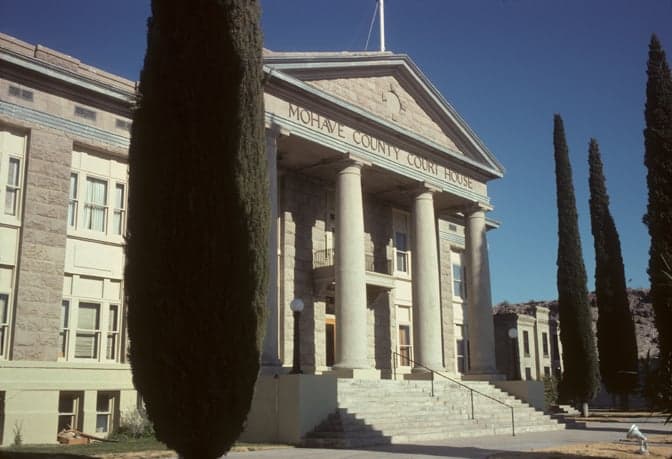
Kingman was founded in 1882 as a railroad town along the Atlantic and Pacific Railroad, later part of the Santa Fe line. The original population was a mix of Anglo-American railroad workers, miners drawn to the surrounding gold and copper claims, and a small number of Chinese laborers who helped build the tracks. These early Chinese workers settled in a modest enclave near the railroad depot, an area now part of the Downtown Kingman Historic District, though few descendants remain today. By the 1920s, the completion of U.S. Route 66 brought a new wave of migrants—service station operators, motel owners, and truck drivers—who clustered along the highway corridor in what is now Old Town Route 66. The city’s population remained small and overwhelmingly white through the mid-20th century, with Hispanic families beginning to arrive in modest numbers during the 1940s and 1950s, drawn by agricultural work in the surrounding valleys and settling in the Baca Flats neighborhood south of downtown.
Modern era (post-1965)
After the 1965 Immigration and Nationality Act, Kingman saw little direct impact from new international immigration; the foreign-born share remains negligible. Instead, the post-1965 story is one of domestic in-migration from California and the Midwest. Starting in the 1970s, retirees and working-class families from Southern California began relocating to Kingman for lower housing costs and a drier climate, a trend that accelerated after the 2008 housing crisis. These newcomers predominantly settled in newer subdivisions on the city’s north and east sides, particularly in Rancho Santa Fe and Hualapai Mountain Estates, areas characterized by larger lots and newer construction. The Hispanic population grew steadily but organically, rising from roughly 8% in 1990 to 16.8% today, with families concentrated in the older Baca Flats and Kingman Heights neighborhoods. The Black (1.8%) and East/Southeast Asian (1.3%) populations remain very small, with no distinct ethnic enclaves; these residents are dispersed across the city, primarily in the newer subdivisions. The Indian-subcontinent population (0.2%) is negligible, consisting mostly of professionals working at the Kingman Regional Medical Center or the nearby Kingman Airport industrial park.
The future
Kingman’s population is projected to continue growing slowly, driven by continued domestic in-migration from California and Arizona’s larger cities. The city is not homogenizing into a single cultural bloc; rather, it is developing a subtle geographic divide. The older, more established white and Hispanic populations remain concentrated in the central and southern neighborhoods like Baca Flats and Downtown, while newer, predominantly white retirees and remote workers fill the northern subdivisions. The Hispanic community is growing but assimilating linguistically and culturally; Spanish-language media and services are limited, and the foreign-born share remains low. The Black and Asian populations are likely to remain small, as Kingman lacks the job base or ethnic infrastructure to attract significant numbers. Over the next 10–20 years, the city will likely become slightly more diverse in absolute terms but remain overwhelmingly white and native-born, with a growing retiree cohort and a stable working-class base.
For a conservative-leaning mover, Kingman is becoming a place where traditional American small-town values persist, with a population that is aging but stable, and where the demographic changes are gradual enough to avoid cultural friction. The city offers a predictable, low-cost environment for families and singles alike, with the understanding that ethnic diversity will remain limited and that the community’s character will continue to be shaped by domestic migrants rather than international arrivals.

* Values derived from national, state, county, city and local statistics and may differ in a specific area. Last updated: 2026-04-22T11:26:40.000Z
Narrative content on this page is AI-generated and may contain mistakes. Verify any details that matter before acting on them.
ReloMaps may earn a commission from affiliate links at no extra cost to you.

